



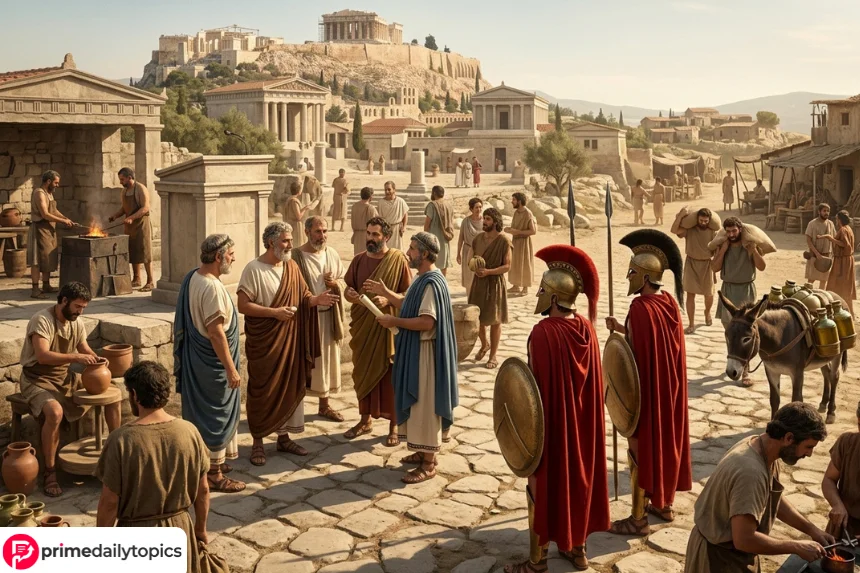
Ancient Greece social structure was not one fixed pyramid shared by every Greek community. Greece consisted of independent city-states, or poleis, and each developed its own rules for citizenship, political participation, property, labor, family life, and enslavement. Nevertheless, most communities distinguished among citizens, free non-citizens, women and children, dependent laborers, and enslaved people.
Athens and Sparta provide the clearest comparison. Classical Athens combined democracy for adult male citizens with strict exclusions based on birth, sex, and legal status. Sparta placed a small citizen-warrior group above the free but politically subordinate perioikoi and the unfree helots. Therefore, understanding Greek society requires more than memorizing a simple class pyramid.
Ancient Greece Social Structure Quick Facts
| Topic | Key information |
|---|---|
| Basic political unit | The independent city-state, or polis |
| Main source of status | Citizenship and legal standing |
| Other status factors | Wealth, family, gender, age, occupation, and freedom |
| Highest-status group | Usually adult male citizens, especially wealthy citizens |
| Athenian political citizens | Adult free men of citizen descent |
| Athenian resident foreigners | Metics, who were free but lacked citizen political rights |
| Enslaved population | Worked in households, agriculture, workshops, mines, commerce, and public service |
| Athenian women | Belonged to citizen families but could not vote or hold political office |
| Spartan ruling group | Spartiates or homoioi, the full citizen-warriors |
| Spartan free non-citizens | Perioikoi, who lived in surrounding communities |
| Spartan dependent population | Helots, who performed much of the agricultural labor |
| Social mobility | Possible in wealth and occupation, but legal-status barriers remained strong |
| Important household unit | The oikos, including family, property, dependents, and enslaved workers |
| Main period discussed | Archaic and Classical Greece, especially the fifth and fourth centuries BCE |
What Was the Ancient Greece Social Structure?
In practice, ancient Greek society organized people through several overlapping hierarchies. A person’s position depended not only on money but also on whether the polis recognized that person as a citizen, foreign resident, freed person, dependent laborer, or enslaved individual.
The Perseus overview of Classical Greek history explains that citizenship distinguished free members of the polis from resident foreigners and enslaved people. Yet citizenship itself did not produce complete equality. Wealthy families retained influence, citizen women lacked direct political participation, and poorer citizens often had fewer economic choices than richer non-citizens.
Consequently, a more accurate model uses several questions:
- Was the person free or enslaved?
- Was the person a citizen or non-citizen?
- Was the person male or female?
- Was the person an adult or child?
- How much wealth, land, or family influence did the person possess?
- Which city-state and historical period applied?
This multidimensional approach explains why a wealthy metic could have more money than a poor citizen but still lack the citizen’s political rights.
Why Was There No Single Greek Social Pyramid?
Ancient Greece was a cultural region rather than a unified nation-state. Athens, Sparta, Corinth, Thebes, Argos, and hundreds of smaller poleis governed themselves.
They shared language, religious traditions, festivals, and aspects of material culture. However, they disagreed about political institutions, citizenship rules, education, military organization, and the treatment of dependent populations.
Moreover, Greek society changed over time. Mycenaean palace society differed from the Archaic polis, while Hellenistic kingdoms created new opportunities and inequalities after Alexander the Great. Therefore, most classroom diagrams describe Classical Athens, Sparta, or a generalized combination rather than every Greek society.
Ancient Greece Social Structure: Status, Class, and Citizenship
For convenience, modern readers often use “class” to describe Greek society. However, the modern idea of social class does not capture the full system.
Legal status mattered greatly. Citizens possessed rights and duties tied to the polis. Metics could be prosperous and respected, yet Athens normally excluded them from voting and landownership. Enslaved people might perform skilled work or manage money, but an owner still controlled their legal status.
At the same time, wealth also mattered. Rich citizens could finance public projects, command social networks, sponsor festivals, own land, and devote more time to political life. Poor citizens held citizen rights but might work as farmers, laborers, rowers, artisans, or small traders.
The Cambridge study What Do We Really Know About Athenian Society? stresses that legal status, wealth, and occupation did not always align. Citizens, metics, freed people, and enslaved workers could sometimes perform similar jobs.
Was Ancient Greek Society Based on Birth or Wealth?
It was based on both, although their importance varied by place and period.
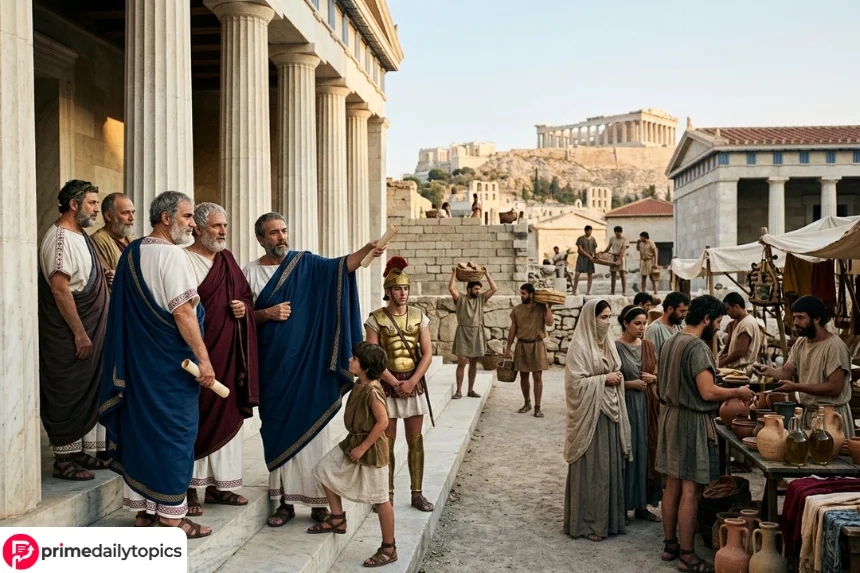
Birth determined access to citizenship in many poleis. In Classical Athens, citizenship became closely tied to descent from citizen parents. Birth into a citizen family gave a person a civic identity that money alone normally could not buy.
Nevertheless, wealth shaped prestige and political opportunity. In early Athens, traditional property classes linked income or agricultural production to military obligations and eligibility for certain offices. These conventional categories included:
- Pentakosiomedimnoi, the wealthiest group
- Hippeis, associated with the ability to serve as cavalry
- Zeugitai, often linked with hoplite-level resources
- Thetes, the poorest citizen category
These were property divisions within the citizen body, not a complete list of everyone living in Athens. Women, metics, enslaved people, and children stood outside that male citizen classification.
Ancient Greece Social Structure in Athens
Above all, Classical Athens is famous for democracy. However, Athenian democracy applied directly to only part of the population.
A useful summary of Athenian legal-status groups is:
- Adult male citizens
- Citizen women and children
- Metics or resident foreigners
- Freed people
- Enslaved people
Wealth differences existed inside nearly every free group. Therefore, Athens was not simply divided into “rich citizens, middle-class foreigners, and poor slaves.”
Male Citizens in Ancient Athens
Consequently, adult male citizens held the strongest formal political position.
They could participate in the Assembly, serve on juries, vote, speak on public matters, and, subject to particular rules, hold office. Citizenship also carried military, religious, financial, and legal duties.
The British Museum’s guide to fifth-century BCE Athens notes that citizens could speak and vote, although skilled speakers and men supported by family wealth often achieved the greatest prominence.
Citizen men were not all aristocrats. They included:
- Large landowners
- Small farmers
- Craftsmen
- Shopkeepers
- Sailors
- Laborers
- Soldiers
- Wealthy political leaders
- Poor citizens who relied on wages or public payments
Thus, democratic citizenship reduced some political differences among men without eliminating economic inequality.
Wealthy Athenian Citizens and Aristocrats
Moreover, at the top of Athenian social influence stood wealthy landowners and prominent families.
They could fund warships, sponsor dramatic festivals, host elite gatherings, arrange advantageous marriages, and build patronage networks. Their education and leisure also helped them prepare for public speaking and leadership.
The symposium illustrates elite male social life. For example, the symposium was a carefully organized aristocratic drinking gathering where men socialized, debated, performed, and reinforced relationships.
However, wealth did not create a separate legal citizenship. A poor citizen remained a citizen, while a wealthy metic remained outside the citizen political body unless the polis granted an exceptional honor.
Farmers, Artisans, Merchants, and Laborers
Nevertheless, most Athenians did not belong to a leisured elite.
Small farmers worked land in Attica. Artisans produced pottery, metalwork, clothing, furniture, weapons, and other goods. Merchants connected Athens to Mediterranean trade networks, while laborers worked on construction, docks, farms, and public projects.
Occupations did not always reveal legal status. A workshop might involve a citizen owner, metic manager, freed craftsman, and enslaved workers. Likewise, a rich metic merchant could possess greater economic influence than a struggling citizen farmer.
Therefore, ancient Greece social structure should not be explained through occupation alone.
Women in the Ancient Greece Social Structure
Women’s position differed by city-state, wealth, family status, and whether they were free or enslaved.
In Athens, women born into citizen families possessed a civic and religious identity. However, they could not vote in the Assembly, sit on juries, or hold ordinary political office.
The Cambridge book Citizenship in Classical Athens challenges the oversimplified statement that women were not citizens in any sense. Athenian law, descent, religion, and family membership gave citizen women a recognized place in the polis, even though men monopolized formal political institutions.
Daily Life of Athenian Women
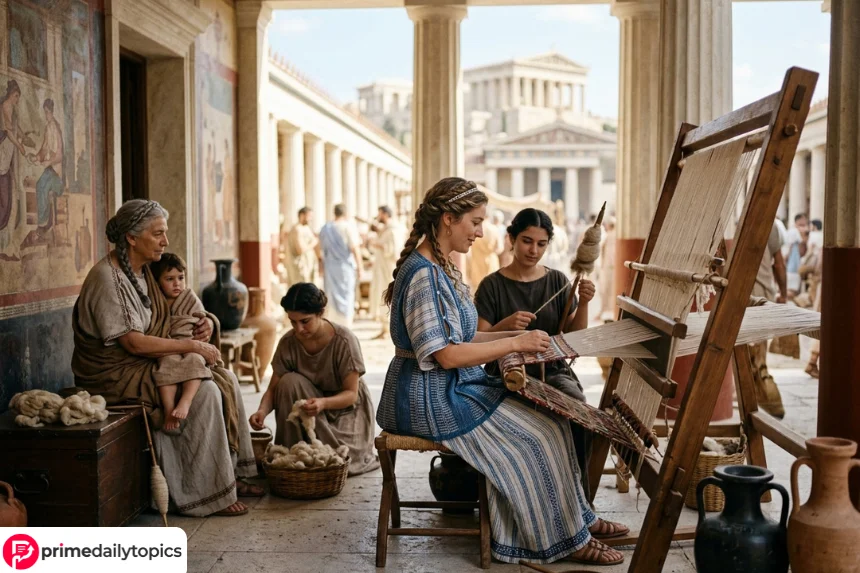
Athenian ideals associated respectable citizen women with the household, marriage, childbearing, textile production, and property management under male guardianship.
The Metropolitan Museum’s essay on women in Classical Greece explains that marriage transferred a young woman from her father’s protection to her husband’s household. The dowry remained an important financial element and generally had to be returned if the marriage ended.
Nevertheless, not every woman lived in isolation. Women participated in:
- Religious festivals
- Funerals and mourning practices
- Household management
- Textile production
- Market activity, especially among poorer families
- Midwifery and caregiving
- Priesthoods and sacred offices
- Family property arrangements
Poor women often had to work outside the home, while enslaved women faced labor, sexual exploitation, and family insecurity.
Athenian Women and Political Rights
Athenian citizen women could not:
- Vote in the Assembly
- Serve as jurors
- Hold most political offices
- Represent themselves independently in many legal settings
However, they played important roles in maintaining citizen descent, households, religious cults, and inheritance lines. Priestesses could hold prestigious public religious positions, and festivals gave women visible communal responsibilities.
Therefore, “women had no role” is inaccurate. A better statement is that Athenian society excluded women from formal democratic power while depending on their household, religious, reproductive, and economic labor.
Metics in the Ancient Greece Social Structure
Meanwhile, metics were free resident foreigners living in Athens and Attica.
They could come from another Greek polis or from elsewhere in the Mediterranean. Many worked in trade, banking, manufacturing, skilled crafts, and services. Some became wealthy and culturally influential.
However, metics did not automatically gain citizenship through residence or wealth.
The Cambridge article The Origin of Metic Status at Athens summarizes the standard legal distinction: metics were free but could not vote in the Assembly, serve as magistrates or jurors, or normally own land. They also paid a special tax and needed a citizen sponsor.
What Rights and Duties Did Metics Have?
Metics could usually:
- Live and work in Athens
- Make contracts
- Use the courts through established procedures
- Participate in commerce
- Practice crafts
- Serve in the military
- Take part in parts of religious and social life
Yet they generally could not:
- Vote
- Hold political office
- Own land without a special grant
- Pass Athenian citizenship automatically to their children
The category demonstrates why wealth and legal rank were not identical. A prosperous foreign banker could have money, clients, and influence while remaining politically subordinate to a poor citizen.
Enslaved People in the Ancient Greece Social Structure
At the same time, enslavement formed a major part of Greek economic and household life.
People became enslaved through warfare, piracy, trade, birth, punishment, and other forms of coercion. Enslaved people came from many regions and did not constitute one ethnic group.
Their work included:
- Domestic service
- Childcare
- Farming
- Mining
- Pottery and metal workshops
- Construction
- Retail and trade
- Banking
- Transportation
- Entertainment
- Public administration
- Military support
Some state-owned enslaved people performed specialized duties. In Athens, publicly owned Scythian archers are traditionally associated with policing functions.
Did All Enslaved People Have the Same Life?
No. Conditions varied greatly, although every enslaved person lacked full personal freedom.
A domestic servant, mine worker, workshop artisan, household tutor, and independently operating commercial agent could experience very different working conditions. Some skilled enslaved workers handled money or lived apart from owners while making regular payments.
Nevertheless, these differences did not erase ownership and vulnerability. Owners could sell, punish, relocate, or separate enslaved people from family members. Ancient sources also reflect the viewpoints of free elites far more often than the voices of enslaved individuals.
Could Enslaved People Become Free?
Manumission occurred, but freedom did not normally produce citizenship.
A freed person in Athens usually entered a status similar to the metic community and retained obligations toward the former owner. Therefore, manumission improved legal standing without placing the individual inside the citizen body.
This restriction shows how strongly the ancient Greece social structure protected citizenship by descent.
The Oikos in the Ancient Greece Social Structure
In addition, the oikos was the basic household unit.
It included more than a nuclear family. Depending on wealth, it could include:
- Husband and wife
- Children
- Other relatives
- Property
- Land
- Enslaved workers
- Dependents
- Tools, animals, and stored goods
The household connected private life with public status. Marriage produced legitimate heirs, inheritance preserved property, and household wealth supported military and political duties.
Men represented the household in formal politics and many legal matters. Women managed significant parts of domestic production and childrearing. Enslaved people supplied labor. Consequently, the polis depended on households even though political ideology centered on male citizens.
Ancient Greece Social Structure in Sparta
By comparison, Sparta’s hierarchy differed sharply from Athens.
The Oxford Academic chapter Sparta’s Civic Structure describes three central groups:
- Spartiates or homoioi, the full citizens
- Perioikoi, free inhabitants of surrounding communities
- Helots, the unfree laboring population
This system supported a citizen class dedicated to military training and public discipline.
Spartiates: Full Spartan Citizens
Spartiates were the adult male citizens often called the “equals,” or homoioi.
They underwent the state-directed agoge education system, participated in military life, and belonged to common dining groups. Full status depended on meeting demanding social and economic expectations.
Spartiates did not form the majority of people living under Spartan control. Instead, they were a relatively small ruling group.
Their position relied heavily on helot agricultural production and perioikic manufacturing, trade, and military service. Therefore, Spartan equality existed mainly within a narrow citizen elite and rested on broader inequality.
Perioikoi: Free but Politically Subordinate
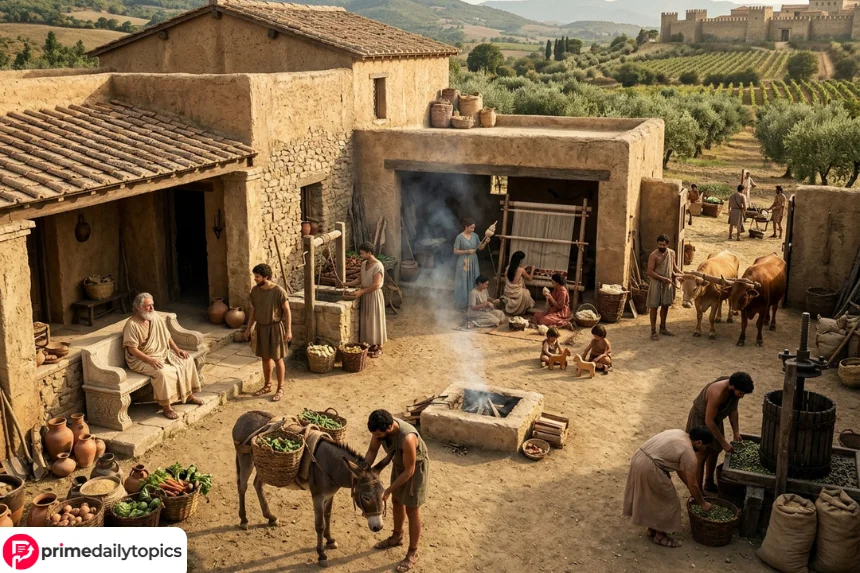
The perioikoi, or “dwellers around,” lived in communities across Laconia and surrounding territory.
They were personally free and managed many local affairs. They farmed, traded, manufactured goods, worked metal, maintained ports, and served in the military.
However, they lacked full participation in Spartan central decision-making. The Spartiates controlled major questions of war and foreign policy.
Perioikoi were not helots and should not be called enslaved people. Instead, they occupied an intermediate position: free communities with economic and military importance but subordinate political status.
Helots: Sparta’s Dependent Laboring Population
Helots worked much of the land in Laconia and Messenia.
Scholars debate the precise legal language that best describes their status, but they were an unfree and exploited population under Spartan domination. The Oxford Classical Dictionary’s helots overview emphasizes that their labor supported Spartiate wealth and leisure.
Helots lived in family groups and delivered agricultural produce to Spartan masters. Sparta also used them in military support and, at times, armed service.
Fear of rebellion shaped Spartan policy. Violence and intimidation helped preserve the system, while revolts and resistance remained continuing concerns.
Women in Sparta Compared With Athens
Spartan women had greater economic visibility and physical freedom than Athenian citizen women.
They received physical training, could inherit and control property, and often managed estates while men spent long periods in military institutions or war. Over time, women accumulated a substantial share of Spartan land.
However, Spartan women did not vote in the citizen Assembly or hold the formal political authority of male Spartiates.
Therefore, the comparison requires balance:
| Topic | Athens | Sparta |
| Formal political voting | Adult male citizens only | Adult male Spartiates only |
| Female property position | Restricted and usually mediated by a guardian | Greater ability to inherit and control land |
| Female education | Usually household-centered, with religious and practical training | Included notable physical training |
| Public movement | Respectable ideals emphasized domestic life | Generally greater public visibility |
| Main civic expectation | Marriage, household management, legitimate heirs | Marriage, estate management, and producing citizen-warriors |
Spartan women had more room in some areas, but they did not enjoy modern gender equality.
Ancient Greece Social Structure: Athens vs. Sparta
| Social feature | Athens | Sparta |
| Ruling citizen group | Adult male citizens | Male Spartiates |
| Political system | Direct democracy for male citizens | Mixed and oligarchic citizen system |
| Free non-citizens | Metics | Perioikoi |
| Main unfree population | Chattel slaves and other enslaved workers | Helots, plus other enslaved people |
| Citizen ideal | Politically active male householder | Disciplined citizen-soldier |
| Economy | Farming, trade, crafts, maritime commerce, mining | Helot agriculture supported citizen military life; perioikoi handled many crafts and trade |
| Women | No voting; major household and religious roles | No voting; greater property control and physical freedom |
| Social mobility | Wealth could change, but citizenship remained restricted | Full Spartiate status was tightly guarded and could be lost |
| Outsider integration | Metics were economically important | Sparta was more suspicious of outsiders |
Neither city-state was socially equal. Athens extended political participation more broadly among citizen men, while Sparta emphasized equality within a smaller warrior elite.
Children, Education, and Social Status
Likewise, children inherited much of their social position through family.
In Athens, boys from citizen households could receive education in literacy, music, athletics, and rhetoric, although quality depended on family resources. At adulthood, citizen sons entered military and civic responsibilities.
Girls usually received household-centered instruction, religious training, textile skills, and preparation for marriage. Wealthy families could provide more extensive education, while poorer children often worked.
In Sparta, the agoge shaped male citizen identity. Boys entered collective training designed to produce disciplined warriors. Spartan girls also received physical education, partly because society connected female health with the production of future citizens.
Enslaved children inherited unfree status in many circumstances, while metic children did not automatically become citizens simply because they were born in Athens.
Religion and Social Hierarchy
Similarly, religion involved every social group, but participation reflected status.
Citizen men led many state rituals and funded festivals. Citizen women served as priestesses, joined processions, and performed ceremonies essential to the polis. Metics sometimes joined festivals or maintained their own cult associations. Enslaved people worshipped within households, local communities, and personal religious networks.
Religious office could give women significant prestige even without political voting rights. Similarly, festivals brought different social groups into shared public spaces while preserving legal distinctions.
Therefore, religion both united the polis and displayed its hierarchy.
Disability, Poverty, and Social Position
Ancient Greek communities did not place every disabled person into a separate social class.
Instead, disability interacted with wealth, citizenship, family support, occupation, age, and gender. A wealthy citizen with a disability could retain family resources and legal standing, while a poor laborer might face severe economic insecurity.
Evidence also shows that some communities recognized forms of public assistance. However, the surviving record is incomplete and usually written by elite men.
Consequently, modern writers should avoid two extremes: claiming that disabled people were always excluded or claiming that Greek society provided broad equality. Individual experience depended strongly on household resources and local institutions.
Social Mobility in the Ancient Greece Social Structure
Even so, some movement occurred, but the system imposed strong limits.
A citizen could gain or lose wealth. Merchants and craftsmen could become rich. Political upheaval or war could destroy elite families. An enslaved person might receive or purchase freedom. A metic might receive citizenship as an exceptional reward.
Nevertheless, major barriers remained:
- Wealth did not normally turn a metic into a citizen.
- Manumission did not usually create citizenship.
- Women did not gain formal voting rights through wealth.
- Helots could not ordinarily become Spartiates.
- Birth and recognized descent remained powerful.
The best description is limited mobility within a rigid legal framework.
Common Myths About Ancient Greece Social Structure
Myth: Ancient Greece had one national class pyramid. In reality, independent city-states created different social systems.
Myth: Every citizen was wealthy. Athens included rich and poor citizens.
Myth: Women were simply outside the community. Citizen women lacked political voting rights but held family, religious, economic, and civic identities.
Myth: Metics were enslaved people. They were free residents without full citizen rights.
Myth: All enslaved people performed the same labor. Their occupations and conditions varied widely, although all remained legally vulnerable.
Myth: Helots were the same as Athenian household slaves. Both were unfree, but Spartan helotage developed as a distinct system tied strongly to land and conquest.
Myth: Sparta was equal because its citizens were called equals. Equality applied to a narrow group supported by subordinate and unfree populations.
Myth: Occupation always revealed status. Citizens, metics, freed people, and enslaved workers could perform similar work.
FAQs About Ancient Greece Social Structure
1. What Were the Main Social Groups in Ancient Greece?
Common groups included citizens, women and children from citizen families, free resident foreigners, freed people, dependent laborers, and enslaved people. The exact categories differed by city-state.
2. Who Was at the Top of Ancient Greek Society?
Adult male citizens held the highest legal and political status. Wealthy citizens and aristocratic families usually exercised the greatest social influence.
3. Who Could Be a Citizen in Ancient Athens?
Classical Athenian citizenship generally depended on free birth and citizen descent. Adult male citizens could participate directly in democratic institutions.
4. What Was a Metic in Ancient Greece?
A metic was a free resident foreigner, especially in Athens. Metics could work and trade but could not normally vote, hold political office, or own land without special permission.
5. What Rights Did Women Have in Ancient Greece?
Rights varied by polis and status. Athenian citizen women lacked voting rights but held recognized family, religious, and property-related roles. Spartan women generally had greater property control.
6. What Work Did Enslaved People Do?
They worked in households, agriculture, mines, workshops, trade, banking, transport, construction, entertainment, and public service.
7. What Were the Three Main Groups in Sparta?
The main groups were Spartiates, perioikoi, and helots. Spartiates held full citizen status, perioikoi were free but politically subordinate, and helots supplied coerced agricultural labor.
8. Were Poor Athenian Men Citizens?
Yes, if they met citizenship requirements. Poor citizen men could vote and participate politically, although wealth affected education, leisure, influence, and opportunity.
9. Could Enslaved People Become Citizens?
Manumission was possible, but freed people normally did not become citizens. In Athens, they usually entered a status similar to metics.
10. Was Ancient Greece an Equal Society?
No. Some Greek poleis created broad political participation among male citizens, but society remained unequal by citizenship, gender, wealth, age, and freedom.
Conclusion: Understanding the Ancient Greece Social Structure
Ancient Greece social structure combined legal status, citizenship, wealth, gender, age, household position, and freedom. Because ancient Greece consisted of independent poleis, there was no universal pyramid that described every community.
Athens placed adult male citizens at the center of democratic politics while excluding women, metics, and enslaved people from voting. Sparta organized society around a small citizen-warrior group supported by the perioikoi and helots. Across both systems, households, labor, religion, descent, and property shaped daily life.
Therefore, the most accurate picture is not a simple ladder from rich to poor. It is a network of overlapping privileges and restrictions that changed by city-state and historical period.
READ MORE ABOUT: Fun Facts About Nicaragua
