



Mud dog is an informal term with more than one meaning. In United States wildlife usage—especially in the southern Appalachian region—it most often refers to the eastern hellbender, a large, fully aquatic salamander. However, people also confuse the name with the smaller mudpuppy or waterdog, which is a different salamander with permanent external gills.
In everyday pet talk, “mud dog” may simply mean a domestic dog covered in mud. The phrase is also a nickname for the Barbet dog breed and the title of a 2022 independent film. Therefore, the correct meaning depends on the context.
Mud Dog Quick Facts
| Question | Verified or practical answer |
|---|---|
| Primary wildlife meaning | A regional name for the eastern hellbender |
| Scientific name of the hellbender | Cryptobranchus alleganiensis |
| Is a mud dog a real dog? | Not in wildlife usage; it is a salamander nickname |
| Commonly confused animal | Common mudpuppy, Necturus maculosus |
| Main hellbender feature | Large, flattened body with loose skin folds |
| Main mudpuppy feature | Bushy external gills retained throughout life |
| Typical hellbender length | About 12 to 29 inches |
| Typical mudpuppy length | About 8 to 13 inches |
| Hellbender habitat | Cool, clean, swift, rocky streams and rivers |
| Mudpuppy habitat | Lakes, ponds, rivers, and streams |
| Are either poisonous? | No; both are harmless to people |
| What should anglers do? | Release the animal promptly and follow state wildlife guidance |
| Pet-dog meaning | An ordinary dog that has rolled or played in mud |
| Dog-breed nickname | The Barbet is sometimes called the “mud dog” |
| Film meaning | Mud Dog, a 2022 independent production |
| Best SEO interpretation | A disambiguation article led by the hellbender meaning |
What Does Mud Dog Mean?
Most importantly, mud dog does not have one universally accepted definition.
In regional wildlife language, the phrase commonly names the hellbender. The U.S. Fish and Wildlife Service used “mud dog” alongside “snot otter” and “lasagna lizard” when discussing the eastern hellbender in Missouri. A Georgia wildlife biologist also described mud dog as the most common local nickname for the animal in part of the southern Appalachians.
The U.S. Fish and Wildlife Service explanation of the mud dog nickname provides the strongest direct answer to the keyword.
Nevertheless, search results are mixed because the phrase can also point to:
- The common mudpuppy
- Any muddy domestic dog
- The Barbet dog breed
- The 2022 film Mud Dog
- Businesses, products, sports teams, songs, and usernames using the phrase
For a general informational article, the best approach is to explain the hellbender first and then separate the alternative meanings.
Why Is the Term So Confusing?
For example, several names overlap among aquatic salamanders.
Hellbenders are called water dogs, devil dogs, mud dogs, snot otters, grampuses, and Allegheny alligators. Mudpuppies are also called waterdogs. In addition, casual speakers sometimes use “mud puppy,” “water dog,” and “mud dog” loosely rather than as precise species names.
That overlap creates three common errors:
- Treating mud dog as an official scientific name
- Assuming hellbenders and mudpuppies are the same animal
- Assuming the term refers only to a dirty pet dog
Scientific names remove the ambiguity:
- Eastern hellbender: Cryptobranchus alleganiensis
- Common mudpuppy: Necturus maculosus
Mud Dog as a Name for the Eastern Hellbender
In wildlife contexts, the eastern hellbender is a giant salamander native to rivers and streams in the eastern United States.
It belongs to the family Cryptobranchidae, which also includes the giant salamanders of Asia. Adults have broad, flattened heads, paddle-like tails, small eyes, and loose folds of skin running along their sides.
The official U.S. Fish and Wildlife Service hellbender profile identifies the species as Cryptobranchus alleganiensis. Meanwhile, the Smithsonian describes the eastern hellbender as the largest salamander in the Americas.
Why Is a Hellbender Called a Mud Dog?
Historically, the nickname probably comes from the animal’s brown, mottled appearance, aquatic life, and habit of sheltering under rocks on stream bottoms.
“Dog” also appears in several traditional salamander names, including waterdog and devil dog. These names may reflect old stories, local speech, and mistaken beliefs about salamanders making doglike sounds.
However, hellbenders do not bark like domestic dogs. The nickname is cultural rather than a scientific description.
What Does a Mud Dog Hellbender Look Like?
In particular, a hellbender usually has:
- A wide, flattened head
- A flattened body
- Brown, gray, olive, or mottled coloring
- Loose, wrinkled skin folds along both sides
- Tiny eyes
- Four short legs
- Four toes on each front foot
- Five toes on each rear foot
- A broad, rudder-like tail
- No bushy external gills as an adult
The body shape helps the animal remain close to the rocky bottom in flowing water. Meanwhile, the skin folds increase the surface area available for absorbing oxygen from the water.
How Big Is a Mud Dog?
By comparison, adult eastern hellbenders commonly measure about 12 to 29 inches.
The Kentucky Department of Fish and Wildlife hellbender guide says adults can reach 29 inches, making them much larger than the average mudpuppy.
Size alone is not a perfect identification tool because young hellbenders and large mudpuppies can overlap. External gills and side folds provide better clues.
Where Do Mud Dog Hellbenders Live?
Above all, hellbenders need cool, clean, fast-moving rivers and streams with high levels of dissolved oxygen.
They usually shelter beneath large, flat rocks during the day and emerge at night. Suitable waterways have stable rocky bottoms, clean spaces beneath stones, and enough flowing water to carry oxygen over the animal’s skin.
Eastern hellbenders occur across parts of the eastern United States. Their range historically extended from New York and the Midwest south through the Appalachian region.
They do not normally live in muddy farm ponds, backyard puddles, or stagnant swamps. Therefore, the word “mud” in the nickname can be misleading.
What Do Hellbenders Eat?
Typically, hellbenders mainly eat crayfish.
They may also consume:
- Small fish
- Aquatic insects
- Worms
- Snails
- Tadpoles
- Other small aquatic animals
They hunt mostly at night. Despite their large mouths and unusual appearance, they are not aggressive predators of people.
Are Mud Dog Hellbenders Dangerous?
No. Fortunately, hellbenders are not poisonous or venomous.
They have small teeth and may bite defensively if handled, but they generally avoid people. They also do not destroy sportfish populations, despite old myths that encouraged anglers to kill them.
Their slippery skin protects the animal and assists with underwater respiration. Handling can damage that skin, increase stress, and expose the salamander to disease.
Mud Dog vs. Mudpuppy: What Is the Difference?
Crucially, a hellbender and a mudpuppy are separate species from different salamander families.
Nevertheless, the confusion is understandable because both animals:
- Spend their entire lives in water
- Have broad heads and long tails
- Are usually brown or gray
- Hide beneath rocks or submerged cover
- Become active mainly at night
- May be caught accidentally by anglers
- Are often called waterdogs in local speech
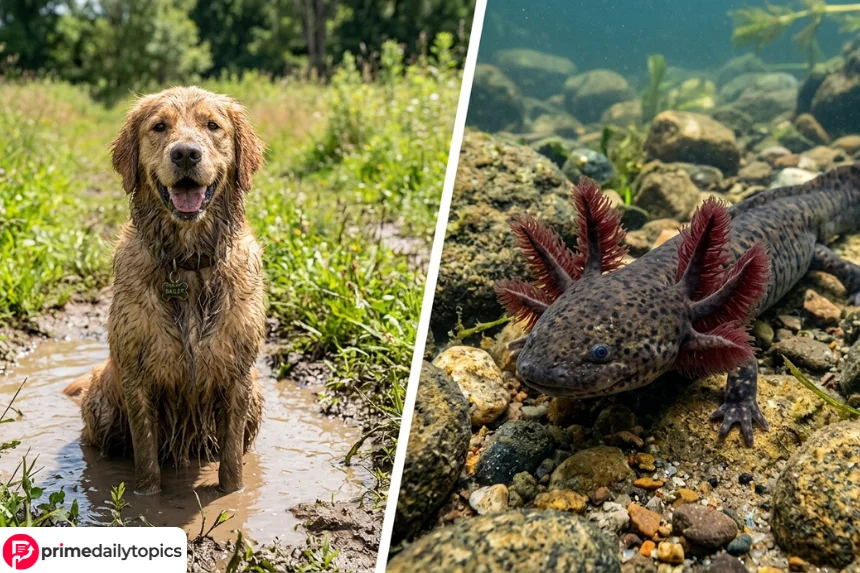
However, several physical features separate them.
| Feature | Mud dog or hellbender | Common mudpuppy |
| Scientific name | Cryptobranchus alleganiensis | Necturus maculosus |
| Family | Cryptobranchidae | Proteidae |
| Typical adult size | 12–29 inches | 8–13 inches |
| External gills in adults | No bushy external gills | Yes, large feathery gills |
| Side skin folds | Prominent loose folds | Smoother sides without prominent folds |
| Hind toes | Five | Four |
| Head | Broad and rounded | More square-shaped |
| Body pattern | Usually mottled | Often clearly spotted |
| Main habitat | Clean, swift, rocky streams | Lakes, ponds, rivers, and streams |
| Breathing | Primarily through skin | Primarily through external gills |
| Main range emphasis | Eastern U.S. river systems | Central and eastern North America |
The Purdue Extension comparison of hellbenders and mudpuppies confirms the main differences in gills, size, body folds, head shape, and habitat.
The Fastest Identification Test
First, look behind the head.
A mudpuppy has obvious reddish or maroon, feather-like external gills. An adult hellbender does not.
Next, check the sides. A hellbender has loose, wrinkled skin folds, while a mudpuppy looks smoother.
Do not capture, restrain, or turn over the animal merely to count its toes. A photograph taken without disturbing it is safer.
Is Mud Dog Another Name for a Mudpuppy?
Admittedly, some people use the terms interchangeably, but that usage is imprecise.
Authoritative wildlife sources generally call Necturus maculosus the mudpuppy or waterdog. The Michigan State University mudpuppy guide explains that the mudpuppy is a freshwater salamander also called a waterdog.
By contrast, official and regional sources more directly connect the exact phrase “mud dog” with the hellbender.
Therefore:
- Mud dog most clearly points to a hellbender in Appalachian wildlife usage.
- Mudpuppy or waterdog more clearly points to Necturus maculosus.
- Local speech may still vary.
A writer should identify the scientific name whenever the species matters.
Common Mudpuppy Facts
Meanwhile, the common mudpuppy is a fully aquatic salamander that retains its external gills throughout its life.
This retained juvenile form is called paedomorphosis. Unlike many salamanders, the mudpuppy does not complete a transformation into a land-dwelling adult.
The National Geographic mudpuppy profile lists an average size of 8 to 13 inches and describes its red external gills, four-toed feet, spotted body, nocturnal behavior, and aquatic habitat.
Habitat and Range
Geographically, mudpuppies occur in lakes, ponds, rivers, streams, and portions of the Great Lakes.
During the day, they usually hide beneath rocks, logs, vegetation, or other underwater cover. They can remain active in cold water and do not follow the same winter hibernation pattern as many land salamanders.
Diet
Likewise, mudpuppies eat:
- Crayfish
- Worms
- Snails
- Aquatic insects
- Small fish
- Fish eggs
- Tadpoles
- Other small aquatic prey
They are opportunistic carnivores rather than a major threat to game fish.
Conservation
Broadly, the common mudpuppy is often classified as Least Concern at the species level. However, local populations have declined in some areas because of water pollution, habitat degradation, chemical exposure, and deliberate killing.
Legal protection differs by state and province. Therefore, anglers should never assume that collection or possession is legal.
What Should You Do if You Find a Mud Dog?
Above all, leave it where it is whenever possible.
Hellbenders and mudpuppies depend on underwater cover. Lifting or moving large rocks can destroy shelter, nests, and eggs. It may also crush animals when the rock is replaced.
Follow these general rules:
- Do not remove the salamander from the wild.
- Do not hold it for photographs.
- Do not grab external gills, legs, or tail.
- Do not move shelter rocks.
- Keep the exact location private when illegal collection is a concern.
- Report sightings through the relevant state wildlife agency or approved citizen-science program.
- Follow local laws because protection differs by jurisdiction.
The Susquehanna River Basin Commission hellbender guide advises visitors not to move stream rocks or reveal exact locations publicly.

What if an Angler Catches One?
If an angler catches one, act quickly and gently.
Keep the animal in the water as much as possible. If the hook can be removed without extensive handling or injury, carefully remove it. Otherwise, wildlife agencies often advise cutting the line close to the mouth.
Never throw the salamander onto the bank or keep it as bait, food, or a pet.
The exact recommended method can differ according to the species, hook position, and state law. Therefore, contact a local wildlife agency when practical.
Are Mud Dogs Endangered?
Importantly, the answer depends on which animal and location the speaker means.
Hellbender Status
Unfortunately, hellbender populations have declined because of:
- Sedimentation that fills spaces under rocks
- Water pollution
- Dams and altered stream flow
- Loss of streamside vegetation
- Disease
- Illegal collection
- Disturbance of shelter rocks
- Severe floods and other habitat changes
The Ozark hellbender has federal endangered status. The Missouri distinct population segment of the eastern hellbender has also been federally listed as endangered since 2021.
In December 2024, the U.S. Fish and Wildlife Service proposed listing the eastern hellbender throughout its range as endangered. The agency action page still described that range-wide action as proposed during research for this article in August 2026.
Because federal and state rules can change, publishers should verify the current status before making a year-specific legal claim.
Mudpuppy Status
Similarly, mudpuppy status also varies.
The species may be broadly secure or Least Concern while remaining rare, endangered, threatened, or a species of concern in particular jurisdictions. For example, state agencies have documented substantial local declines.
Therefore, neither animal should be killed simply because it looks strange or appears on a fishing line.
Mud Dog as a Muddy Domestic Dog
By contrast, outside wildlife discussions, mud dog can simply mean a pet dog covered in mud.
For example, dogs may roll in mud because it is cool, interesting, strongly scented, or fun to explore. Mud itself is not automatically an emergency. However, dirty water can contain sharp debris, fecal contamination, parasites, chemicals, or harmful cyanobacteria.
How to Clean a Mud Dog Safely
For light mud:
- Keep the dog in an easy-to-clean entry area.
- Wipe the paws and lower legs with a damp, pet-safe cloth.
- Clean between the toes and around the paw pads.
- Remove small stones, burrs, and plant material.
- Dry the paws and coat thoroughly.
For heavy mud:
- Rinse with lukewarm clean water.
- Use shampoo formulated for dogs when a full bath is necessary.
- Avoid getting shampoo in the eyes or ears.
- Rinse thoroughly.
- Dry the coat, skin folds, ears, and spaces between toes.
- Brush long coats after they are clean and mostly dry to prevent mats.
The American Kennel Club guide to cleaning dog paws recommends pet-safe wipes or warm washing for muddy paws, inspection between the toes, and thorough drying.
When Muddy Water Is Dangerous
More importantly, keep dogs away from water that:
- Looks like spilled paint
- Has green, blue, brown, or red scum
- Has foam, mats, or globs on the surface
- Smells unusually bad
- Is covered by a local health advisory
Harmful algal blooms can produce toxins that kill dogs rapidly.
The CDC guidance for protecting pets from harmful algal blooms says owners should prevent pets from drinking, swimming, playing, or eating near suspicious water. If exposure occurs, rinse the animal immediately with clean water and prevent it from licking its fur.
Contact a veterinarian urgently after suspicious water exposure if the dog develops vomiting, weakness, loss of coordination, collapse, breathing problems, tremors, or unusual tiredness.
Is Rolling in Ordinary Mud Healthy?
In general, ordinary clean soil and mud can be part of normal outdoor play, but it is not inherently therapeutic.
The safety depends on the location. A clean garden puddle presents a different risk from stagnant water near algae, sewage, pesticides, industrial runoff, sharp metal, or wildlife waste.
Supervision, reliable recall, and checking local water advisories are more useful than treating all mud as safe or dangerous.
Is the Barbet Known as a Mud Dog?
Yes. Separately, “mud dog” is a recognized nickname for the Barbet, a French water dog with a curly coat.
The breed historically worked around water and wet terrain. Its dense, shaggy coat can collect water, vegetation, and mud, which helps explain the nickname.
The American Kennel Club’s Barbet facts specifically notes that the breed is nicknamed the mud dog.
This meaning is separate from the hellbender salamander. Context such as “breed,” “puppy,” “grooming,” or “French water dog” usually indicates the Barbet.
What Is the Mud Dog Movie?
Finally, Mud Dog is also the title of a 2022 independent production associated with filmmaker Keenan Capps.
IMDb describes it as a 58-minute comedy about a high school student who skips school and spends the day with a countercultural character called Mud Dog. Blake Holden is credited in the title role.
The filmmaker’s FilmFreeway profile for Keenan Capps lists MUD DOG as a 2022 feature that he wrote, directed, and produced.
The Golden State Film Festival 2023 awards page lists Blake Holden and Mud Dog in a supporting-actor short-film category. Therefore, public databases disagree slightly about whether to label the production a feature or a short.
The movie is not about a mudpuppy, hellbender, or muddy pet dog. It is a separate entertainment result sharing the keyword.
Why the Competitor Results Are So Mixed
As a result, the supplied pages represent at least four search intents:
- Wildlife identification: mudpuppy and aquatic salamander pages
- Film lookup: the 2022 Mud Dog IMDb page
- Pet cleanup: guides and forums about muddy dogs
- Casual conversation: Reddit, Quora, and personal essays
Ultimately, no single competitor resolves the ambiguity.
An article targeting the exact phrase should answer the likely wildlife meaning immediately, explain the hellbender-versus-mudpuppy distinction, and then cover the pet and film meanings briefly.
That structure prevents entity confusion without forcing unrelated content into one definition.
Common Myths About Mud Dogs
Myth: Mud dog is one official species name. It is a regional or informal phrase with several meanings.
Myth: A mud dog is always a mudpuppy. The exact nickname is more strongly associated with the hellbender in Appalachian wildlife sources.
Myth: Hellbenders and mudpuppies are the same animal. They belong to different families and have clear physical differences.
Myth: Adult hellbenders have bushy red gills. Permanent external gills identify mudpuppies, not adult hellbenders.
Myth: Mud dogs are poisonous. Hellbenders and mudpuppies are harmless, nonvenomous salamanders.
Myth: They destroy game-fish populations. Wildlife agencies report no evidence that these salamanders cause harmful declines in sportfish.
Myth: Moving a rock is harmless. It can destroy shelter, nests, and stream habitat.
Myth: Any muddy puddle is safe for a domestic dog. Stagnant or discolored water may contain toxins or contaminants.
Myth: Mud dog is a recognized dog breed. It is a nickname for the Barbet, not the breed’s official name.
Myth: The film Mud Dog explains the animal term. The 2022 movie is a separate work using the phrase as a character and title.
FAQs About Mud Dog
1. What Is a Mud Dog?
In southern Appalachian wildlife usage, a mud dog usually means an eastern hellbender, a large aquatic salamander. The phrase can also have other meanings.
2. Is a Mud Dog the Same as a Mudpuppy?
No. A hellbender and common mudpuppy are different salamanders, although informal names sometimes overlap.
3. How Can You Tell a Hellbender From a Mudpuppy?
Most visibly, a mudpuppy has bushy external gills throughout life. An adult hellbender lacks those gills and has loose skin folds along its sides.
4. Are Mud Dogs Dangerous?
No. Hellbenders and mudpuppies are not poisonous or venomous, although wild animals should not be handled unnecessarily.
5. Where Do Mud Dog Hellbenders Live?
Generally, they live in cool, clean, fast-flowing rivers and streams with rocky bottoms in parts of the eastern United States.
6. What Should You Do if You Catch One While Fishing?
Keep it in the water, release it promptly, avoid unnecessary handling, and follow the relevant state wildlife agency’s instructions.
7. Can Mud Dog Mean a Dirty Pet Dog?
Yes. In everyday conversation, it may simply describe a domestic dog covered in mud.
8. How Should You Clean a Muddy Dog?
Rinse with clean lukewarm water, use dog-safe shampoo when needed, clean between the toes, inspect the paws, and dry the coat thoroughly.
9. Which Dog Breed Is Nicknamed the Mud Dog?
The Barbet, a French water dog, is sometimes known by that nickname.
10. Is Mud Dog a Movie?
Yes. Mud Dog is the title of a 2022 independent production associated with writer-director Keenan Capps.
Conclusion: The Correct Meaning of Mud Dog
Mud dog most often refers to the eastern hellbender when the phrase appears in Appalachian wildlife discussions.
In summary, the hellbender is a large, wrinkled, fully aquatic salamander that lives in clean, fast-moving streams. It is not the same as the common mudpuppy, which is smaller and keeps feathery external gills throughout its life.
However, context matters. Mud dog can also describe a muddy domestic dog, serve as a nickname for the Barbet breed, or identify a 2022 independent film.
A reliable article should not choose one meaning blindly. It should lead with the regionally supported hellbender definition, separate the mudpuppy clearly, and acknowledge the pet and entertainment uses without combining their facts.
Read more at Prime Daily Topics
