



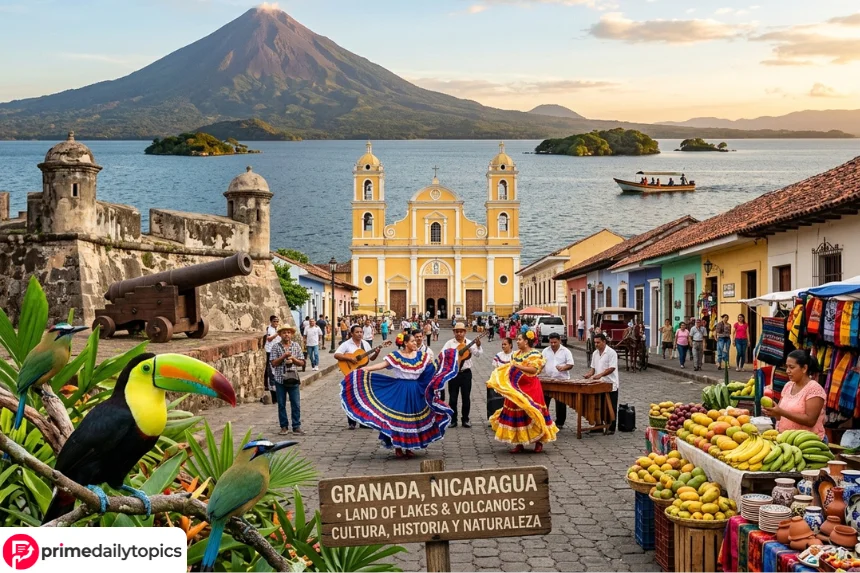
Looking for fun facts about Nicaragua? This Central American country is larger than any of its regional neighbors, touches both the Pacific Ocean and Caribbean Sea, and contains the region’s biggest freshwater lake. It is also home to active volcanoes, two UNESCO World Heritage Sites, multilingual Caribbean communities, distinctive foods, and one of the most influential poets in the Spanish language.
However, several popular claims need context. Lake Nicaragua’s bull sharks are not a unique freshwater species, while the familiar “Nicarao + agua” name origin remains debated. The facts below separate reliable information from unsupported internet trivia.
Fun Facts About Nicaragua at a Glance
| Question | Verified answer |
|---|---|
| Where is Nicaragua? | In Central America, between Honduras and Costa Rica, with Pacific and Caribbean coastlines. |
| What is its capital? | Managua. |
| Is it the largest Central American country? | Yes, by total area. |
| How many people live there? | The World Bank reports about 7.0 million people in 2025. |
| What language is spoken? | Spanish is dominant, while English-based Creole and Indigenous languages are also used, especially in Caribbean regions. |
| What is the currency? | The Nicaraguan córdoba, divided into 100 centavos. |
| What is Nicaragua famous for? | Lakes, volcanoes, colonial-era cities, poetry, music, food, biodiversity, and Pacific and Caribbean cultures. |
| Does Lake Nicaragua have sharks? | Bull sharks have occurred in the lake and can move between fresh and salt water. |
| How many UNESCO World Heritage Sites does it have? | Two: the Ruins of León Viejo and León Cathedral. |
| What nickname is commonly used? | “The land of lakes and volcanoes.” |
Geography and Nature: Fun Facts About Nicaragua
Nicaragua’s geography explains many of its best-known facts. Although the country looks narrow on a world map, it contains volcanoes, tropical forests, dry forests, wetlands, islands, rivers, lagoons, and two very different coastlines.
Fun Facts About Nicaragua: It Is Central America’s Largest Country
Nicaragua covers roughly 130,000 square kilometers, making it the largest of the seven countries usually included in Central America. For U.S. readers, its area is close to that of New York State, although comparisons vary slightly depending on whether inland water is included.
Despite its size, Nicaragua has a relatively modest population. The World Bank’s current Nicaragua data reports 7,007,502 residents in 2025. Therefore, much of the country remains comparatively sparsely populated.
It Has Both Pacific and Caribbean Coastlines
Nicaragua borders Honduras to the north and Costa Rica to the south. Meanwhile, the Pacific Ocean lies to the west, and the Caribbean Sea lies to the east.
The coasts feel remarkably different. The Pacific side contains much of the volcanic chain and several major cities. In contrast, the Caribbean side has extensive wetlands, forests, lagoons, islands, and strong Indigenous and Afro-Caribbean traditions.
Lake Nicaragua Is Central America’s Largest Lake
Lake Nicaragua, also called Lake Cocibolca, covers more than 8,000 square kilometers. As a result, it is the largest lake in Central America and one of the defining features of the country’s landscape.
The lake drains toward the Caribbean through the San Juan River. It also contains islands, including Ometepe and the Solentiname archipelago. A useful Lake Nicaragua overview provides general geographic background without relying on the supplied Nicaragua Wikipedia competitor page.
Fun Facts About Nicaragua: Bull Sharks Live in Lake Nicaragua
Bull sharks have been documented in Lake Nicaragua. However, they are not a separate shark species found nowhere else, and the lake is not the only freshwater environment bull sharks can enter.
The sharks can travel between fun facts about Nicaragua the lake, the San Juan River, and Caribbean waters. Because bull sharks tolerate major salinity changes, “Nicaragua has had bull sharks in a freshwater lake” is accurate, while “Nicaragua has the world’s only freshwater sharks” is misleading.
Fun Facts About Nicaragua: Ometepe Has Two Volcanoes
Ometepe rises from Lake Nicaragua and has a distinctive hourglass-like shape. Its two major volcanoes are Concepción and Maderas, joined by a low isthmus.
UNESCO designated the Ometepe Island Biosphere Reserve in 2010. Concepción remains active and rises to about 1,610 meters, while Maderas reaches about 1,394 meters and has a crater lagoon. Moreover, the island contains petroglyphs and archaeological remains that reflect a long Indigenous history.
Fun Facts About Nicaragua: The Country Has an Active Volcanic Chain
A line of volcanoes runs through western Nicaragua as part of the Central American Volcanic Arc. Some peaks are dormant or extinct, while others remain active.
Nicaragua’s territorial studies agency, INETER, operates real-time volcano monitoring for volcanoes including San Cristóbal, Telica, Momotombo, Masaya, and Concepción. Consequently, exact online claims such as “Nicaragua has precisely 19” or “exactly 40 volcanoes” can be confusing because totals change according to whether a source counts volcanic centers, cones, complexes, or only recognized major volcanoes.
Cerro Negro Is Geologically Young
Cerro Negro first appeared in 1850, which makes it one of the youngest volcanoes in Central America. Its dark cone of loose volcanic rock stands out sharply against the greener surrounding landscape.
The volcano also became associated with “volcano boarding,” in which participants descend its loose slopes on boards. Nevertheless, Cerro Negro has erupted repeatedly since its formation and remains active.
Nicaragua Protects Rainforests, Dry Forests, and Wetlands
The country’s ecosystems extend far beyond volcanoes. Bosawás in the north and Río San Juan in the southeast protect large areas of tropical forest, while Pacific regions contain dry forest, mangroves, estuaries, and seasonal wetlands.
These habitats support jaguars, tapirs, sloths, monkeys, sea turtles, parrots, and many migratory birds. However, claims that Nicaragua contains a fixed percentage of all species on Earth are difficult to verify and should not be repeated without a current scientific inventory.
Cultural Fun Facts About Nicaragua
Nicaraguan culture reflects Indigenous, Spanish, African, and Caribbean histories. Therefore, traditions vary considerably between the Pacific and central regions and the autonomous Caribbean coast.
Fun Facts About Nicaragua: Spanish Is Not the Only Language
Spanish is the country’s dominant language. Nevertheless, Nicaragua is multilingual, particularly in the North Caribbean Coast and South Caribbean Coast autonomous regions.
Miskito, Mayangna, Rama, Garifuna, and English-based Creole varieties form part of the country’s linguistic landscape. Consequently, describing Nicaragua as culturally uniform overlooks the communities whose histories connect Central America, the Caribbean, and Indigenous territories.
The Mosquito Coast Is Not Named After the Insect
The historic Mosquito Coast stretches along parts of the Caribbean shores of Nicaragua and Honduras. Its English name relates to the Miskito people, not to an unusually large population of mosquitoes.
European maps and documents fun facts about Nicaragua used several spellings, which helped produce the English word “Mosquito” for the region. Today, “Miskito” is the preferred name for the people and language.
El Güegüense Uses Comedy to Challenge Authority
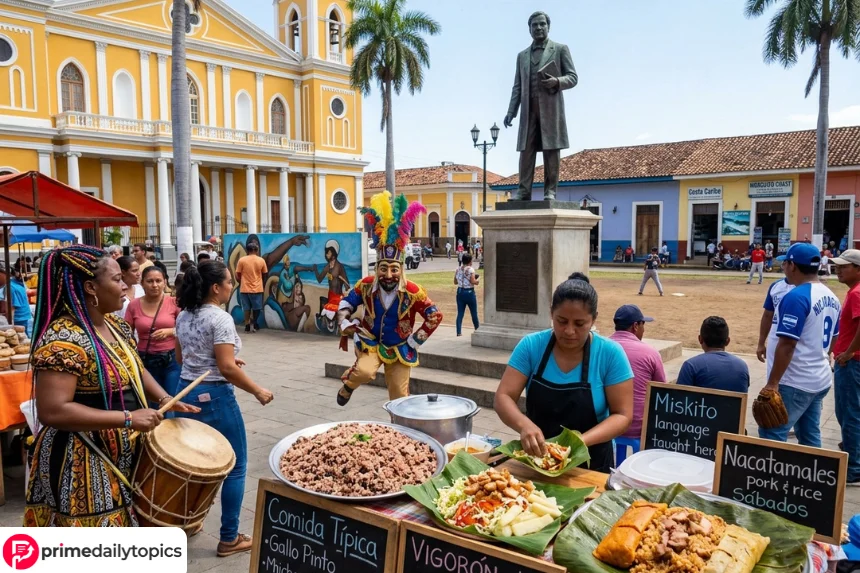
El Güegüense is a satirical drama that combines theater, dance, music, masks, and street procession. Its clever central character appears to cooperate with Spanish colonial officials while using wordplay and deception to undermine them.
UNESCO describes El Güegüense as a synthesis of Spanish and Indigenous cultures and an expression of protest against colonial rule. It entered UNESCO’s Representative List of the Intangible Cultural Heritage of Humanity in 2008 after being proclaimed a masterpiece in 2005.
Garifuna Heritage Connects Nicaragua With the Caribbean
Garifuna communities live in Nicaragua as well as Belize, Guatemala, and Honduras. Their cultural heritage combines Indigenous Caribbean and African influences.
Music, dance, oral tradition, fishing knowledge, and language help maintain Garifuna identity. Moreover, UNESCO recognizes Garifuna language, dance, and music as shared heritage across four countries.
Rubén Darío Changed Spanish-Language Poetry
Félix Rubén García Sarmiento, better known as Rubén Darío, was born in Nicaragua in 1867. His work helped establish modernismo, a literary movement that transformed Spanish-language poetry through new rhythms, imagery, themes, and forms.
The U.S. Library of Congress calls Darío one of the great voices of Spanish lyrical poetry in its profile of Rubén Darío and poetic modernism. Consequently, Nicaragua is often described as a nation of poets, and Darío’s image and name appear across public spaces and institutions.
Gallo Pinto Is a Daily Staple With a Regional Debate
Gallo pinto combines rice and beans, usually cooked with seasonings and sometimes prepared from leftovers. It appears at breakfast, lunch, or dinner and may accompany eggs, cheese, plantains, meat, or tortillas.
Both Nicaragua and Costa Rica strongly identify with the dish. Instead of assigning it exclusively to one country, the safer conclusion is that rice-and-bean traditions developed across the region, while each country created recognizable local styles.
Nacatamales Are More Than a Quick Snack
A Nicaraguan nacatamal typically contains seasoned corn dough filled with pork or another meat, rice, potato, vegetables, and herbs. Cooks wrap the mixture in plantain leaves and steam it for several hours.
Families often eat nacatamales on weekends or at celebrations. Therefore, the dish is also a social tradition that usually requires shared labor.
Vigorón Is Closely Associated With Granada
Vigorón is commonly made with boiled yuca, pork rind, and a cabbage-based salad. Vendors traditionally serve it on a leaf or simple plate.
The dish is particularly associated with Granada, although people eat it across Nicaragua. Regional versions vary in crunch, acidity, salt, and softness.
Baseball Has a Major Place in National Sports Culture
Soccer has a growing audience, but baseball has long held a special place in Nicaragua. Local leagues, international competitions, and professional players sustain its popularity.
Dennis Martínez became the first Nicaraguan-born player in Major League Baseball. Later, in 1991, he pitched a perfect game for the Montreal Expos, becoming the first Latin American-born pitcher to achieve that MLB milestone.
History and Heritage Facts About Nicaragua
Nicaragua’s history includes Indigenous societies, Spanish colonization, British influence on the Caribbean coast, independence, foreign intervention, revolution, civil conflict, and political change. Several landmarks reveal how this history remains visible.
Nicaragua Declared Independence From Spain in 1821
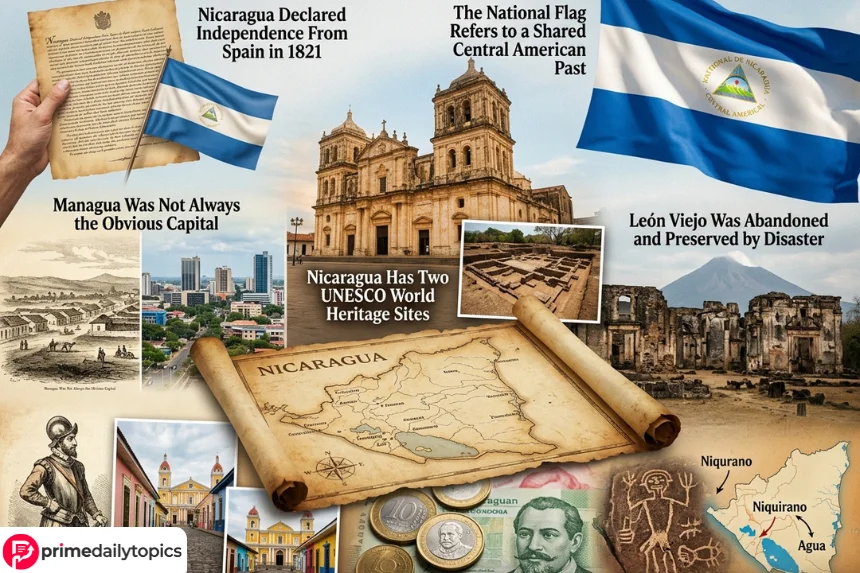
Nicaragua joined the Central American declaration of independence from Spain on September 15, 1821. It briefly became part of the Mexican Empire and later joined the United Provinces of Central America.
The country became a fully separate republic in the 19th century. Meanwhile, September 15 remains part of the shared independence celebrations held across several Central American nations.
Managua Was Not Always the Obvious Capital
León and Granada competed for political influence during the early national period. Managua, located between them, became the capital in 1852.
Its central position helped reduce rivalry between the older cities. However, earthquakes—especially the destructive 1972 event—shaped a modern capital without the concentrated colonial center seen in Granada or León.
Nicaragua Has Two UNESCO World Heritage Sites
UNESCO currently lists two Nicaraguan properties, and both are cultural rather than natural sites. The UNESCO World Heritage record for Nicaragua identifies the Ruins of León Viejo, inscribed in 2000, and León Cathedral, inscribed in 2011.
The ruins of León Viejo preserve one of the earliest Spanish colonial settlements in the Americas. In contrast, León Cathedral blends late Baroque and Neoclassical architectural influences while housing several important works of art.
León Viejo Was Abandoned and Preserved by Disaster
Spanish colonists founded León Viejo in 1524 near Momotombo Volcano and Lake Managua. Volcanic activity and a major earthquake contributed to the decision to move the city in 1610.
Because no later city covered the site, much of its original layout remained buried and comparatively undisturbed. As a result, archaeologists can study an early colonial settlement directly.
Granada and León Were Founded in the Same Colonial Era
Granada and León trace their Spanish foundations to 1524. Today, both cities preserve important architecture and strong cultural identities, although war, fire, earthquakes, rebuilding, and modernization have changed them.
Writers sometimes call Granada mainland Central America’s oldest continuously inhabited European-founded city. However, that title depends on how “continuous settlement” and “city” are defined.
Nicaragua’s Currency Honors a Colonial-Era Founder
The national currency is the córdoba, symbolized as C$. It is named after Francisco Hernández de Córdoba, the Spanish founder associated with colonial León and Granada.
The Central Bank’s history of Nicaragua’s currency explains that Nicaragua adopted the córdoba in 1912, with the first notes circulating in 1913. Earlier, the country used pesos and several foreign or regional currencies.
The Country’s Name Has More Than One Proposed Origin
A popular story combines an Indigenous leader’s name, Nicarao, with the Spanish word agua, meaning water. Many websites repeat it as settled fact.
However, researchers have proposed several Nahuatl-based origins, including forms connected with Anáhuac, the Nahua people, or land near or surrounded by water. Therefore, the exact etymology remains debated, and the “Nicarao + agua” explanation should be presented as one tradition rather than certainty.
The National Flag Refers to a Shared Central American Past
Nicaragua’s flag uses blue-white-blue horizontal bands, echoing the flag of the former United Provinces of Central America. The national coat of arms contains five volcanoes between two bodies of water, representing the five original Central American republics and their position between oceans.
A rainbow and liberty cap also appear in the triangle. Consequently, the flag tells a regional as well as national story.
Common Myths About Nicaragua Facts
Several attractive claims spread because they fit neatly into short fact lists. However, accuracy requires a little more detail.
Myth: Lake Nicaragua has the world’s only freshwater sharks. Bull sharks can tolerate freshwater in several parts of the world. Nicaragua’s lake population is remarkable, but it is not a unique freshwater shark species.
Myth: Ometepe is unquestionably the world’s largest freshwater island. Ometepe is a major volcanic island in a freshwater lake, but global “largest island” claims vary by category and measurement. The two-volcano formation is the stronger verified fact.
Myth: Nicaragua has one universally agreed number of volcanoes. Counts vary because sources classify volcanic fields, cones, calderas, and major volcanoes differently. INETER’s monitored active systems provide a clearer current reference.
Myth: The country’s name definitely means “Nicarao’s water.” That explanation is popular, yet historians and linguists continue to discuss alternatives.
Myth: Every part of Nicaragua shares one culture and language. Pacific, central, Indigenous, Afro-descendant, and Caribbean communities have distinct histories and traditions.
FAQs About Fun Facts About Nicaragua
What Is the Most Famous Fact About Nicaragua?
Nicaragua is widely known as the “land of lakes and volcanoes.” The nickname reflects its large freshwater lakes and the volcanic chain that runs through the western side of the country.
Why Is Nicaragua Called the Land of Lakes and Volcanoes?
The country contains Lake Nicaragua, Lake Managua, many lagoons, and numerous volcanic formations. Moreover, active volcanoes such as Masaya, San Cristóbal, Telica, and Concepción remain important parts of the landscape.
What Is Unique About Lake Nicaragua?
It is the largest lake in Central America and connects to the Caribbean through the San Juan River. In addition, bull sharks have entered the lake because the species can tolerate both fresh and salt water.
Does Nicaragua Really Have Freshwater Sharks?
Bull sharks have been documented in Lake Nicaragua and the San Juan River. However, they are a saltwater-capable species that can also live in freshwater, not a separate freshwater-only shark.
What Are Three Cultural Facts About Nicaragua?
Nicaragua is the birthplace of poet Rubén Darío, home to the UNESCO-recognized drama El Güegüense, and part of the wider Garifuna cultural region. Moreover, its Caribbean communities maintain languages and traditions that differ from those of the Pacific region.
What Food Is Nicaragua Known For?
Commonly recognized foods include gallo pinto, nacatamales, vigorón, quesillo, and fried or baked plantains. However, recipes and preferred accompaniments differ by region and family.
What Are Nicaragua’s Two UNESCO World Heritage Sites?
They are the Ruins of León Viejo and León Cathedral. UNESCO inscribed León Viejo in 2000 and the cathedral in 2011.
What Language Do People Speak in Nicaragua?
Most people speak Spanish. Nevertheless, Miskito, Mayangna, Rama, Garifuna, and English-based Creole varieties also form part of the country’s linguistic heritage, especially on the Caribbean coast.
What Is Nicaragua’s Currency Called?
The currency is the Nicaraguan córdoba, divided into 100 centavos. It was named after Francisco Hernández de Córdoba and adopted as the national monetary unit in 1912.
Is Every Popular Nicaragua Fact Online Accurate?
No. Claims about unique freshwater sharks, a fixed volcano count, the origin of the country’s name, and global biodiversity rankings often lack context. Therefore, readers should favor current government, university, scientific, and UNESCO sources.
Conclusion: Why These Fun Facts About Nicaragua Matter
The best fun facts about Nicaragua reveal a country shaped by water, volcanic geology, Indigenous and Afro-Caribbean heritage, colonial history, literature, food, and regional diversity. Nicaragua is Central America’s largest country, contains its largest lake, and protects cultural landmarks ranging from León Viejo to El Güegüense.
Ultimately, the most interesting facts are not always the most exaggerated ones. Bull sharks that move between river, lake, and sea are more fascinating than the false claim of a unique freshwater species. Likewise, a debated Indigenous place-name tells a richer story than a simple invented translation. Accurate facts allow readers to appreciate Nicaragua without turning its people, landscapes, or history into internet trivia.
LEARN MORE ABOUT: What Is a Pentacle
