



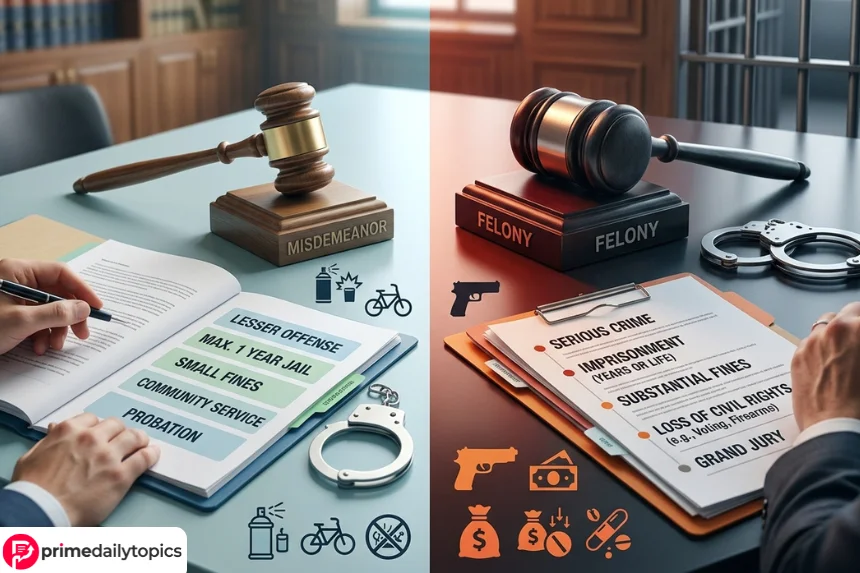
Understanding what is a misdemeanor vs felony begins with the seriousness of the offense and its maximum authorised punishment. Generally, a misdemeanor is a lower-level crime, while a felony is a more serious criminal offense.
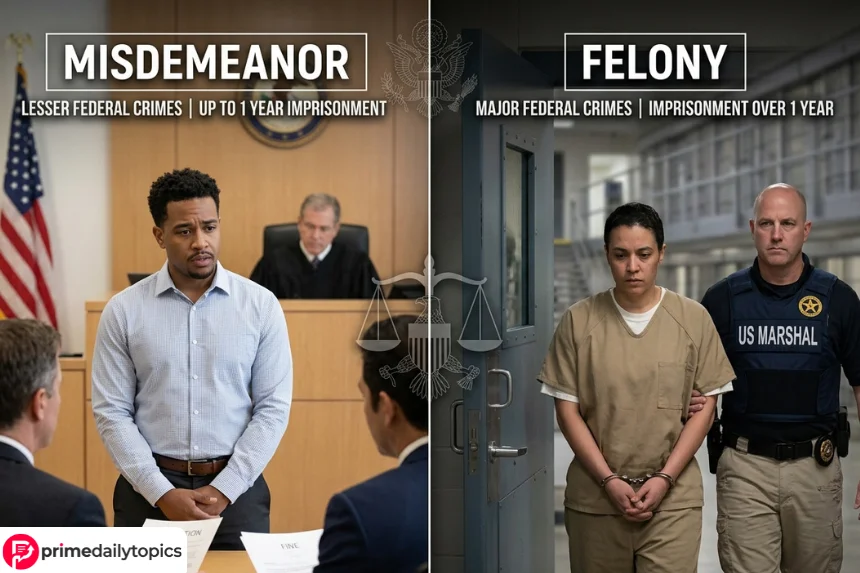
Under federal law, an offense punishable by more than one year of imprisonment generally qualifies as a felony. Meanwhile, an offense punishable by one year or less usually falls within a misdemeanor category. However, every state maintains its own criminal code. Therefore, the exact statute and jurisdiction ultimately determine how an offense is classified.
Quick answer: A misdemeanor is generally a less serious crime that may result in up to one year of incarceration under the federal system. A felony is more serious and can carry a sentence exceeding one year. Nevertheless, some states use different classifications and sentencing limits.
Legal disclaimer: This article provides general educational information about U.S. criminal law. It does not provide legal advice or predict the outcome of any criminal case. Laws, penalties, procedures, and record-clearing options vary by jurisdiction.
What Is a Misdemeanor vs Felony? Quick Comparison
| Comparison point | Misdemeanor | Felony |
|---|---|---|
| General severity | Less serious criminal offense | More serious criminal offense |
| Federal imprisonment benchmark | One year or less | More than one year |
| Usual place of confinement | Local or county jail | State or federal prison |
| Other possible penalties | Fines, probation, restitution, treatment or community service | Prison, probation, supervised release, fines or restitution |
| Common examples | Petty theft, simple assault or some first-time driving offenses | Aggravated assault, robbery, serious fraud or homicide |
| Criminal record | A conviction can appear on a criminal record | A conviction can appear on a criminal record |
| Employment consequences | Possible | Often more substantial |
| Firearm consequences | Possible in certain cases | Frequently possible under federal or state law |
| Record clearing | May be available under state law | Usually more limited, although some offenses may qualify |
| Governing authority | Federal or state statute | Federal or state statute |
This table provides a general comparison rather than a nationwide rule. For that reason, readers should examine the statute attached to the specific charge.
What Is a Misdemeanor vs Felony Under Federal Law?
Federal law classifies an offense according to the maximum term of imprisonment authorised by the statute. This classification system applies when the law defining the federal offense does not already assign it a letter grade.
Under 18 U.S.C. § 3559, federal crimes are classified as follows:
Federal felony classes
- Class A felony: Life imprisonment or death
- Class B felony: A maximum sentence of 25 years or more
- Class C felony: Less than 25 years but at least 10 years
- Class D felony: Less than 10 years but at least five years
- Class E felony: More than one year but less than five years
Federal misdemeanor classes
- Class A misdemeanor: More than six months but no more than one year
- Class B misdemeanor: More than 30 days but no more than six months
- Class C misdemeanor: More than five days but no more than 30 days
- Infraction: Five days or less, or no imprisonment
Therefore, the federal felony-misdemeanor dividing line generally rests at one year. An offense with a maximum authorised term exceeding one year falls within a federal felony class. In contrast, an offense carrying no more than one year falls within a misdemeanor or infraction category.
The U.S. Courts glossary also defines a misdemeanor as an offense punishable by one year of imprisonment or less.
What Is a Misdemeanor vs Felony? Why State Rules Differ
The one-year threshold offers a useful starting point. However, it should not be presented as an absolute rule for every U.S. jurisdiction.
Each state creates its own criminal classifications and sentencing ranges. Some states use lettered classes, while others use numbered levels or degrees. In addition, certain jurisdictions define crimes partly according to where a sentence may be served.
According to the National Conference of State Legislatures, one year represents the most common misdemeanor-felony penalty threshold. Nevertheless, six states have specific misdemeanor classes that may carry more than one year of incarceration.
As a result, an offense cannot always be classified by looking at the possible sentence alone. The reader must also check:
- The state or federal statute
- The official offense class or degree
- The maximum authorised punishment
- Any sentencing enhancement
- The court where prosecutors filed the charge
Consequently, a definition taken from one state may not accurately describe the law in another state.
What Is a Misdemeanor vs Felony: Misdemeanor Explained
A misdemeanor is a criminal offense that the legal system generally treats as less serious than a felony. Even so, a misdemeanor is still a crime and may lead to incarceration, probation, financial penalties, and a criminal record.
Possible misdemeanor penalties include:
- Time in a local or county jail
- Probation
- Fines and court costs
- Restitution to a victim
- Community service
- Alcohol or drug education
- Anger-management classes
- Driver’s licence restrictions
- Protective or no-contact orders
- Electronic monitoring
A judge does not impose every possible penalty in every case. Instead, the sentence depends on the statute, offense class, criminal history, case facts, plea agreement, and local sentencing rules.
Common misdemeanor examples
Depending on state law and the circumstances, misdemeanor offenses may include:
- Disorderly conduct
- Simple assault
- Petty theft or shoplifting
- Trespassing
- Low-level property damage
- Public intoxication
- Driving with a suspended licence
- Some first-time impaired-driving offenses
- Certain low-level drug-possession offenses
- Violations of local criminal ordinances
However, these examples are not classified identically across the country. For example, theft may qualify as either a misdemeanor or felony based on the property’s value. Likewise, an assault charge may become a felony when the incident involves serious injury, a dangerous weapon, or a protected victim.
What Is a Misdemeanor vs Felony: Felony Explained
A felony is generally the most serious category of crime in the American criminal justice system. Under the federal classification framework, an offense qualifies as a felony when its maximum authorised prison sentence exceeds one year.
Possible felony penalties include:
- More than one year in prison
- Life imprisonment for certain offenses
- Substantial fines
- Restitution
- Probation
- Supervised release
- Mandatory treatment
- Registration requirements
- Restrictions on firearm possession
- Restrictions affecting certain civil rights
- Professional-licence consequences
Although a felony carries the possibility of severe punishment, a person convicted of a felony does not necessarily receive prison time. For example, a court may impose probation when the law and circumstances allow it.
Nevertheless, the offense remains a felony because its classification usually depends on the maximum punishment authorised by law—not merely the sentence the judge selects.
Common felony examples
Depending on the applicable law, felony offenses may include:
- Homicide
- Aggravated assault
- Sexual assault
- Armed robbery
- Burglary
- Kidnapping
- Arson
- Serious drug trafficking
- Major theft
- Embezzlement
- Large-scale fraud
- Certain repeat impaired-driving offenses
- Serious crimes against children or vulnerable adults
Not every felony involves violence. For instance, fraud, identity theft, computer crimes, tax crimes, and embezzlement may qualify as felonies when the conduct meets the relevant statutory requirements.
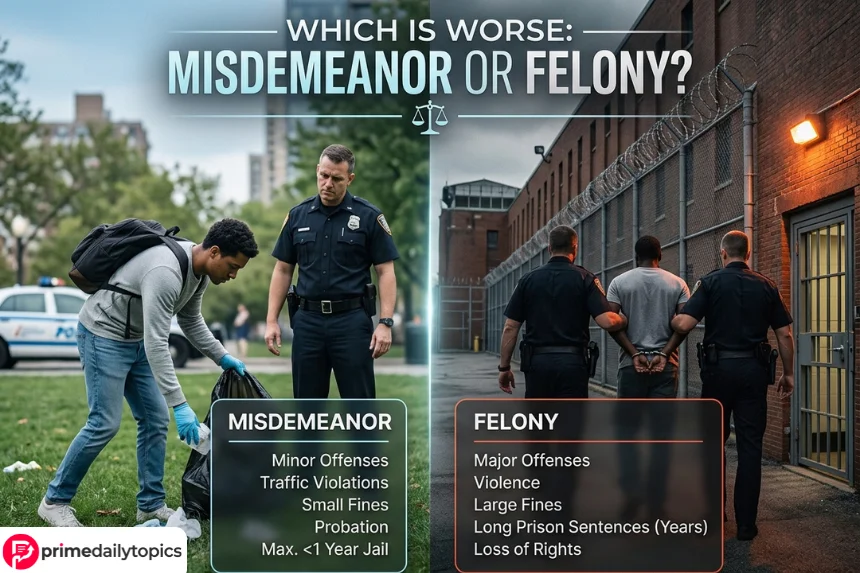
Which Is Worse: A Misdemeanor or Felony?
A felony is generally worse because it carries a higher maximum punishment and may create broader long-term consequences.
However, the label does not reveal every consequence. A misdemeanor involving domestic violence, theft, dishonesty, impaired driving, or professional misconduct may still affect employment, immigration status, driving privileges, housing, licensing, or firearm possession.
For example, federal firearm law may prohibit possession by someone convicted of a qualifying misdemeanor crime of domestic violence. Therefore, the assumption that only felony convictions affect firearm rights is incorrect.
A complete comparison should consider:
- The exact criminal statute
- The maximum possible sentence
- Whether a mandatory minimum applies
- The defendant’s criminal history
- Immigration consequences
- Firearm restrictions
- Employment and licensing concerns
- Record-sealing eligibility
- Probation or supervision requirements
Thus, a felony is normally the more serious classification. Still, no criminal charge should be dismissed as unimportant merely because prosecutors label it a misdemeanor.
Misdemeanor vs Felony: Maximum Punishment vs Actual Sentence
One of the most important differences involves the maximum punishment authorised by law rather than the sentence actually imposed.
Suppose a statute allows up to five years in prison. A judge might place the defendant on probation instead of ordering incarceration. Even so, the offense remains a felony because the statute authorises more than one year.
Similarly, a person convicted of a misdemeanor may receive only a fine or community service. The offense does not become an infraction simply because the court imposed a lighter sentence.
Therefore, readers should distinguish among three separate concepts:
- Offense classification: Whether the law identifies the crime as a felony, misdemeanor, or infraction
- Maximum authorised sentence: The harshest sentence the statute permits
- Actual sentence: The punishment the court imposes in a particular case
Confusing these concepts may lead someone to misunderstand the seriousness of a criminal charge.
Misdemeanor vs Felony: Jail vs Prison
People often use the words “jail” and “prison” interchangeably. However, they generally refer to different correctional facilities.
Jail
A jail is usually operated by a county or local government. It commonly holds:
- People awaiting trial
- People unable to post bail
- Defendants serving shorter sentences
- People waiting for transfer to another facility
Prison
A prison is generally operated by a state government or the federal government. It typically holds people serving longer sentences following felony convictions.
Nevertheless, this distinction also has exceptions. Several states operate unified correctional systems that combine functions commonly associated with jails and prisons.
For that reason, the facility where a person serves a sentence may offer useful context, but it does not independently determine whether the conviction is a misdemeanor or felony.
What Is a Misdemeanor vs Felony? Is a Misdemeanor a Crime?
Yes. A misdemeanor is generally a criminal offense even though it ranks below a felony in seriousness.
A conviction may still result in:
- A public court record
- A criminal-history entry
- Probation supervision
- Incarceration
- Employment difficulties
- Higher insurance costs in driving-related cases
- Immigration concerns
- Professional-licensing reviews
- Restrictions imposed by a protective order
Therefore, describing a misdemeanor as “minor” can be misleading. It may carry a lower maximum punishment than a felony, but its practical consequences can remain significant.
Moreover, an arrest or criminal charge is not the same as a conviction. A person receives a conviction only after a guilty plea, a recognised no-contest plea, or a guilty finding at trial. Until then, the accused remains legally presumed innocent.
What Can Change a Misdemeanor Into a Felony?
The same general conduct may lead to either a misdemeanor or felony charge. However, prosecutors must apply the specific statute and facts rather than rely on the everyday name of the offense.
For example, two incidents may both involve theft. One may remain a misdemeanor because the property value falls below the state’s felony threshold. Meanwhile, the other may qualify as a felony because the value exceeds that threshold.
Several factors commonly affect the final classification.
Serious bodily injury
An offense may receive a higher classification when the alleged conduct causes significant misdemeanor vs felony physical harm. For instance, an assault without serious injury may qualify as a misdemeanor in some jurisdictions. By contrast, an assault causing broken bones, permanent impairment, or another serious injury may support a felony charge.
The legal definition of serious bodily injury varies. Therefore, medical records, witness accounts, photographs, and expert evidence may become important in deciding which statute applies.
Use of a dangerous weapon
Using, displaying, or threatening someone with a firearm, knife, or another dangerous object can elevate a lower-level charge.
Nevertheless, an object does not always need to be designed as a weapon. Depending on the statute and manner of use, prosecutors may argue that an ordinary object functioned as a dangerous weapon during the incident.
Value of property or financial loss
Property crimes often use monetary thresholds to separate misdemeanor and felony charges.
These thresholds may apply to:
- Theft
- Shoplifting
- Property damage
- Fraud
- Embezzlement
- Receiving stolen property
- Unauthorized use of financial information
However, states set different limits. In addition, lawmakers may revise those amounts over time. Consequently, an article should not present one nationwide dollar threshold.
Prior criminal convictions
A previous conviction may increase the classification of a later offense. For example, conduct treated as a misdemeanor for a first offense may become a felony after repeated convictions.
Still, prior convictions do not automatically elevate every later misdemeanor. The enhancement must come from the applicable statute.
Moreover, the prosecution may need to establish that the earlier case qualifies for enhancement purposes. Questions may arise about the type of conviction, its date, the defendant’s representation by counsel, and whether the record was later cleared.
Identity or status of the alleged victim
Some statutes impose greater penalties when the alleged victim belongs to a protected group.
Enhanced charges may apply when the victim is:
- A child
- An older adult
- A person with a disability
- A police officer
- An emergency medical worker
- A teacher
- A judge
- A witness
- A household or family member
However, the protected categories and required facts differ among jurisdictions.
Location of the conduct
The location of an alleged offense may also affect its classification misdemeanor vs felony or sentence.
For example, enhanced penalties may apply to conduct occurring:
- Near a school
- Inside a correctional facility
- On government property
- In a protected place of worship
- Within a designated drug-free zone
- In the home of an alleged domestic-violence victim
Nevertheless, prosecutors may need to prove more than location alone. Some laws also require knowledge, intent, proximity, or a connection between the location and the prohibited conduct.
Drug type, amount, and alleged purpose
Drug charges frequently depend on the controlled substance, its weight, prior convictions, and whether prosecutors allege personal possession or distribution.
A small quantity may support a lower-level possession charge in one jurisdiction. Conversely, a larger amount, evidence of sales, or possession of certain substances may lead to a felony charge.
State marijuana laws also differ significantly. Therefore, conduct that is legal or civilly regulated in one state may remain criminal in another.
Defendant’s mental state
Criminal statutes may require proof that a person acted intentionally, knowingly, recklessly, or negligently.
The required mental state can affect both the offense and its classification. For instance, deliberately damaging property may carry different consequences from causing similar damage accidentally.
As a result, the outcome does not depend only on what happened. It may also depend on what the prosecution can prove about the accused person’s knowledge or intent.
Can a Misdemeanor Become a Felony?
A misdemeanor does not usually transform into a felony simply because a case remains open or a defendant receives a harsh sentence. Instead, a felony classification requires a legal basis under the governing statute.
However, a pending misdemeanor case may develop into a felony case in several circumstances.
New evidence supports a more serious charge
Prosecutors may amend or replace a misdemeanor charge when later evidence supports a felony allegation.
For example, an injury may initially appear minor. Nevertheless, later medical findings could show serious or permanent harm. Prosecutors may then review whether an aggravated felony statute applies.
The prosecution discovers a qualifying prior conviction
A charge may initially appear to involve a first offense. Later, a criminal-record search may reveal a prior conviction that triggers a repeat-offender provision.
Even so, the prosecutor must confirm that the earlier conviction legally qualifies. A similar charge from another state may not always satisfy the enhancement statute.
The alleged loss increases
Investigators may initially base a theft or fraud charge on incomplete financial information. However, additional records may show a larger total loss.
When the amount crosses the state’s felony threshold, the prosecution may file or seek a higher-level charge.
Aggravating circumstances become known
Video footage, witness statements, digital evidence, or forensic testing may reveal allegations involving a weapon, protected victim, organized activity, or other aggravating factor.
Consequently, the final charging decision may differ from the officer’s original citation or arrest description.
A later offense receives enhanced treatment
Some statutes classify the first violation as a misdemeanor but treat a misdemeanor vs felony later violation as a felony. In that situation, the original misdemeanor does not retroactively become a felony. Instead, the new case receives a higher classification because of the defendant’s prior record.
Can a Felony Be Reduced to a Misdemeanor?
A felony may sometimes be reduced to a misdemeanor. Nevertheless, no defendant has an automatic right to a reduction merely because the case involves a first offense or no one suffered an injury.
The available options depend on the jurisdiction, statute, evidence, criminal history, and stage of the case.
Prosecutorial charge reduction
A prosecutor may agree to amend a felony count to a misdemeanor during plea negotiations.
Such a decision may depend on:
- Weaknesses in the evidence
- Witness availability
- Lack of serious injury
- Restitution
- The defendant’s criminal history
- Acceptance of responsibility
- Completion of treatment
- The interests of the alleged victim
- Court resources
- Public-safety concerns
However, a prosecutor cannot always reduce an offense. Some statutes impose mandatory classifications or restrict plea agreements.

Lesser-included misdemeanor offense
A felony charge may contain a lower-level offense within it. Therefore, a defendant may plead guilty to or be convicted of a lesser-included misdemeanor when the evidence does not establish every element of the felony.
The exact relationship between offenses depends on their statutory elements. Similar offense names do not necessarily make one a lesser-included version of the other.
Diversion or deferred disposition
Some jurisdictions offer diversion programs for eligible defendants. A program may require treatment, education, restitution, community service, testing, or a period without new arrests.
After successful completion, the prosecutor or court may dismiss the charge, reduce it, or provide another form of relief.
However, diversion does not always erase the arrest or court record. In addition, immigration authorities, licensing boards, and law-enforcement agencies may apply their own definitions when reviewing the outcome.
“Wobbler” treatment
Certain states recognize offenses that prosecutors may charge or misdemeanor vs felony courts may sentence as either felonies or misdemeanors. These are often informally called “wobblers.”
Still, this concept is not available nationwide. The statute must specifically permit alternative treatment under the law of that jurisdiction.
Post-conviction reduction
Some states allow courts to reduce eligible felony convictions after the defendant completes probation, serves the sentence, or satisfies other statutory conditions.
Nevertheless, a later reduction may not eliminate every consequence of the original conviction. Federal agencies and other jurisdictions may independently decide how to treat the record.
How Do Misdemeanor and Felony Court Processes Differ?
The court process varies between federal and state systems. Even within one state, procedures may differ by offense level and court.
Generally, felony cases involve more procedural stages because they expose the defendant to greater possible punishment.
Arrest or citation
A criminal case may begin with an arrest, citation, summons, complaint, or investigation followed by formal charges.
An arrest does not prove guilt. It means law enforcement has taken a person into custody or otherwise begun a legal process based on suspected criminal conduct.
Moreover, police do not always make the final charging decision. Prosecutors may file different charges, decline charges, or request further investigation.
Initial appearance
After an arrest, the defendant may appear before a judge or magistrate. The court may address the allegations, legal representation, release conditions, and future hearing dates.
Release conditions may include:
- Posting bail or a bond
- Regular check-ins
- Travel restrictions
- Drug or alcohol testing
- Electronic monitoring
- Firearm restrictions
- No-contact orders
- Staying away from specified locations
A violation of release conditions may lead to additional charges or detention. Therefore, defendants should read every court order carefully.
Arraignment
At an arraignment, the court formally informs the defendant of the charge and requests a plea. The U.S. Courts glossary defines an arraignment as a proceeding in which a defendant hears the charges in an indictment or information and is asked to plead guilty or not guilty.
The available pleas and exact procedure vary. However, a plea at misdemeanor vs felony arraignment does not usually represent the final outcome of a contested case.
Preliminary hearing
Some felony cases include a preliminary hearing. At this stage, a judge may consider whether the prosecution has enough evidence to continue the case.
A preliminary hearing is not the same as a criminal trial. The government generally faces a lower evidentiary standard than the “beyond a reasonable doubt” standard required for conviction at trial.
State rules determine whether a hearing is required, may be waived, or becomes unnecessary after an indictment.
Grand jury review
In the federal system, a grand jury considers evidence presented by a prosecutor and decides whether probable cause exists to issue an indictment. A grand jury does not decide whether the defendant is guilty.
Federal criminal cases commonly involve grand juries, but state practices vary. Therefore, the final article should not suggest that every state felony charge requires grand-jury approval.
Pretrial motions and evidence
Before trial, the parties may address:
- Whether evidence was lawfully obtained
- Whether statements can be admitted
- Whether experts may testify
- Whether charges should be dismissed
- Whether trials should be separated
- Whether certain information should be excluded
- Whether the defendant is competent to proceed
Felony cases may involve more extensive evidence and motion practice. Nevertheless, serious misdemeanor cases can also involve complicated constitutional, forensic, or evidentiary issues.
Plea negotiations
Many criminal cases resolve through negotiated pleas rather than trials. A plea agreement may involve a reduced charge, dismissal of counts, sentencing recommendation, or agreement about particular facts.
However, the judge may retain authority over the final sentence. In addition, a guilty plea can create consequences beyond the penalty discussed in court.
For example, immigration, firearm, employment, and licensing consequences may depend on the offense’s elements rather than the informal description used during negotiations.
Trial
At a criminal trial, the prosecution carries the burden of proving guilt beyond a reasonable doubt. The defendant does not have to prove innocence.
Depending on the offense and jurisdiction, the defendant may have a right to a jury trial. However, petty offenses with very short maximum sentences may follow different misdemeanor vs felony constitutional and procedural rules.
Sentencing
If the defendant pleads guilty or is convicted at trial, the court imposes a sentence.
The judge may consider:
- The statutory sentencing range
- Mandatory minimum penalties
- Sentencing guidelines
- Criminal history
- Harm to the victim
- Restitution
- Acceptance of responsibility
- Mitigating circumstances
- Aggravating circumstances
- Statements from the parties
- Evidence presented at the sentencing hearing
Felony sentencing may include a presentence investigation and a separate hearing. Meanwhile, a court may sentence some misdemeanor defendants immediately after a plea or verdict.
Arrest, Charge, and Conviction: What Is the Difference?
These terms describe separate stages. Therefore, writers should not use them interchangeably.
Arrest
An arrest occurs when law enforcement takes a person into legal custody to answer an alleged criminal charge. However, an arrest is not proof that the person committed the offense.
Criminal charge
A charge is a formal accusation that a person violated a criminal statute.
The charge may appear in:
- A complaint
- An information
- An indictment
- A citation
- Another authorized charging document
Nevertheless, a charge remains an allegation unless the defendant admits guilt or the prosecution proves guilt in court.
Conviction
A conviction generally results from a guilty plea, an accepted no-contest plea where permitted, or a guilty verdict.
The effect of a plea may vary under immigration and other federal laws. misdemeanor vs felony For example, USCIS applies a specific federal immigration definition of “conviction” that may include certain outcomes even when state law later labels them differently.
Dismissal
A dismissal ends the charge without a conviction on that count. However, the related arrest and court records may remain publicly visible unless the person qualifies for sealing or another form of record clearing.
Acquittal
An acquittal means a judge or jury found the defendant not guilty. It may also occur when a judge determines that the evidence cannot support a conviction.
Therefore, an acquittal differs from a dismissal even though neither outcome results in a conviction for the acquitted or dismissed charge.
Does a Misdemeanor Go on Your Criminal Record?
A misdemeanor conviction can appear on a criminal record. Depending on the database and reporting rules, a background report may also show the arrest, filed charge, court disposition, sentence, or active warrant.
Nevertheless, not every record is complete or accurate. Similar names, outdated entries, missing dispositions, and data-matching errors may create problems.
The Equal Employment Opportunity Commission advises employers to consider the accuracy and relevance of conviction records before relying on them in employment decisions.
In addition, the EEOC distinguishes arrests from convictions. An arrest alone does not establish that criminal conduct occurred.
How long does a misdemeanor stay on a record?
A misdemeanor may remain on a record indefinitely unless state law provides a way to seal, expunge, set aside, or otherwise limit access to it.
However, there is no universal waiting period. Eligibility may depend on:
- The offense
- The final disposition
- The sentence
- Completion of probation
- Payment of restitution
- Time without new convictions
- The number of prior cases
- Whether the offense involved violence
- Whether the person files a petition
- Whether clearing occurs automatically
Therefore, readers should use official state court or legislature resources rather than relying on a national estimate.
Does a Felony Stay on Your Record Forever?
A felony conviction may remain visible indefinitely. Nevertheless, some states permit relief for selected felony offenses.
Record-clearing laws vary considerably by state and offense. Some jurisdictions allow petitions for certain nonviolent felonies, while others exclude broad categories such as violent, sexual, or serious public-corruption offenses.
Moreover, clearing a court record may not remove every private database entry immediately. A person may need to provide the clearing order to background-screening companies or challenge outdated information.
Expungement vs Record Sealing
People frequently use “expungement” and “sealing” as though they mean the same thing. However, states define these remedies differently.
Expungement
Expungement may remove, destroy, erase, or legally limit access to a criminal record. Nevertheless, its effect depends entirely on the statute.
In one state, expungement may allow a person to deny the case in many situations. In another, law enforcement or licensing agencies may still access the information.
Record sealing
Sealing usually restricts public access without necessarily destroying the record.
The court, law enforcement, prosecutors, or authorized government agencies may retain access. In addition, a sealed record may still matter during later criminal proceedings.
Automatic record clearing
Some states automatically clear eligible records once statutory conditions are met. In those systems, the person may not need to file a traditional petition.
However, automatic clearing usually applies only to specified offenses and dispositions. NCSL reports that states use different eligibility rules and procedures for automatic record relief.
Certificates of rehabilitation
A certificate of rehabilitation does not necessarily hide or erase the conviction. Instead, it may provide an official finding that the person has demonstrated rehabilitation.
A growing number of states authorize courts or parole boards to issue certificates or similar forms of limited relief. These documents may help reduce barriers involving employment or licensing, although their legal effect differs by jurisdiction.
Employment Consequences of a Misdemeanor vs Felony
Both misdemeanor and felony records may affect employment. However, the effect depends on the job, offense, time elapsed, state law, employer policy, and whether the position involves vulnerable people, money, driving, security, or professional trust.
An employer may consider:
- The nature of the offense
- How long ago it occurred
- Whether it relates to the job
- Evidence of rehabilitation
- The applicant’s work history
- Whether the record is accurate
- Whether the case ended without a conviction
Federal equal-employment law does not create a general ban on considering criminal records. Nevertheless, employers must not apply criminal-record policies in a discriminatory manner prohibited by Title VII.
State and local fair-chance laws may impose additional requirements. misdemeanor vs felony Therefore, the hiring rules can vary even between cities within the same state.
Housing and Education Consequences
Criminal records may create barriers to public or private housing. A landlord or housing authority may consider the type of offense, when it occurred, and whether it presents a current safety concern.
Likewise, colleges and training programs may ask about certain convictions, particularly when students need clinical placements, professional licenses, security clearances, or access to vulnerable populations.
Nevertheless, a criminal record does not automatically make a person ineligible for every housing or educational opportunity. The applicable law and institutional policy control.
Professional-License Consequences
A misdemeanor or felony may affect a professional license when the conduct relates to the occupation.
Licensing concerns may arise in fields such as:
- Health care
- Teaching
- Law
- Accounting
- Real estate
- Insurance
- Commercial driving
- Childcare
- Security services
- Construction
- Financial services
Some boards require applicants and existing license holders to disclose arrests, charges, convictions, or disciplinary orders. However, disclosure rules differ.
Therefore, a person should read the exact question carefully. A form asking about convictions does not necessarily require the same information as one asking about pending charges.
Immigration Consequences of a Misdemeanor vs Felony
The misdemeanor or felony label under state law does not determine misdemeanor vs felony every immigration result.
Federal immigration law uses separate definitions. As a result, an offense called a misdemeanor by a state may still affect:
- Admissibility
- Deportability
- Naturalization
- Visa eligibility
- Adjustment of status
- Cancellation of removal
- Asylum-related relief
- Good-moral-character findings
USCIS applies federal standards when deciding whether a court outcome counts as a conviction for immigration purposes. It also considers certain offenses and conduct when evaluating good moral character for naturalization.
Consequently, a noncitizen should obtain immigration-specific advice before entering a guilty or no-contest plea. A favorable sentence under state law does not necessarily prevent federal immigration consequences.
Firearm Consequences of a Misdemeanor vs Felony
Federal law generally prohibits firearm possession by a person convicted of a crime punishable by more than one year, subject to statutory definitions and exceptions.
However, felony convictions are not the only concern. A qualifying misdemeanor crime of domestic violence may also trigger a federal firearm prohibition.
In addition, certain restraining orders may affect firearm possession. misdemeanor vs felony State laws may impose separate or broader restrictions.
Therefore, a person should not decide firearm eligibility from the felony-or-misdemeanor label alone.
Voting Rights After a Misdemeanor or Felony Conviction
Felony convictions may affect voting, jury service, public office, or other civil rights. Nevertheless, the rules vary significantly by state.
Some states restore voting rights after release from incarceration. Others connect restoration to completion of probation, parole, or additional legal requirements.
Misdemeanors generally create fewer voting restrictions. However, certain election-related offenses or state-specific laws may receive different treatment.
Consequently, a person should verify eligibility through the state election authority rather than assume that a conviction permanently removes or automatically restores voting rights.
Why Collateral Consequences Matter
A criminal sentence may end after a person completes jail, prison, probation, fines, or community service. Nevertheless, the conviction’s indirect effects may continue.
Criminal records can create barriers involving employment, occupational licensing, housing, education, immigration, firearm possession, and other rights or benefits.
Therefore, anyone considering a plea should evaluate more than the immediate sentence. A plea that avoids jail may still create a serious professional, immigration, or licensing problem.
For that reason, the difference between a misdemeanor and felony involves more than incarceration. The lasting legal and practical consequences may matter just as much as the name of the charge.
How Can You Tell Whether a Charge Is a Misdemeanor or Felony?
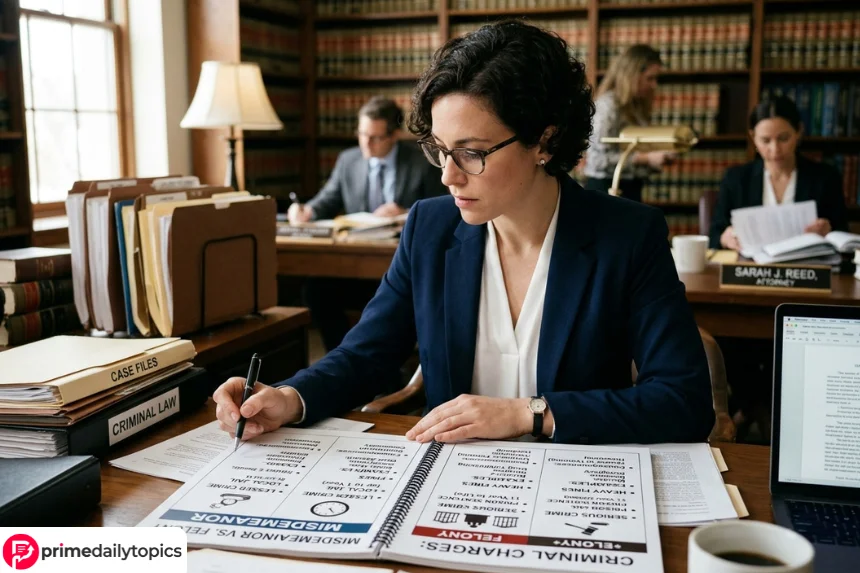
A person should not determine the seriousness of a charge from the offense name alone. Instead, the most reliable approach is to examine the official charging misdemeanor vs felony document and the statute listed on it.
The relevant document may be called a:
- Citation
- Criminal complaint
- Information
- Indictment
- Summons
- Notice to appear
- Court docket
- Charging statement
An indictment or information may contain several separate allegations. Courts commonly refer to each individual criminal charge as a count.
Check the statute number
First, locate the legal citation beside the offense name. It may look similar to:
- A state code abbreviation followed by numbers
- A municipal ordinance number
- A section of the United States Code
- A criminal-code chapter and subsection
Next, search for that statute on the official state legislature, state court, or federal government website.
The statute may directly identify the offense as:
- A felony
- A misdemeanor
- An infraction
- A particular class or degree
- An offense that can receive more than one classification
Look for a class, level, or degree
A charging document may use classifications such as:
- Class A misdemeanor
- First-degree misdemeanor
- Level 1 misdemeanor
- Class D felony
- Second-degree felony
- Unclassified felony
However, these labels do not carry identical penalties in every jurisdiction. Therefore, readers must check the sentencing rules of the state where the case was filed.
Review the maximum authorised penalty
Under the federal classification system, an offense punishable by more than one year is generally a felony. Meanwhile, an offense punishable by one year or less generally falls within a misdemeanor or infraction category.
Nevertheless, state exceptions exist. Consequently, misdemeanor vs felony the statute’s official classification remains more important than a general online definition.
Check for enhancements
The basic statute may not reveal the final level of the charge. A separate allegation may increase the offense because of:
- A previous conviction
- Use of a weapon
- Serious physical injury
- The victim’s age or status
- The location of the conduct
- Property value
- Drug weight
- Alleged gang involvement
- Commission of the offense while on release
- Violation of a protective order
For that reason, readers should review every count and enhancement listed in the charging papers.
Confirm which version of the statute applies
Legislatures sometimes revise sentencing ranges, property thresholds, offense names, and record-clearing rules. Therefore, the law in effect on the alleged offense date may matter.
A current version of a statute may not always match the version applicable to an older case. A licensed criminal defence lawyer can determine which law governs.
What to Do After Receiving a Misdemeanor or Felony Charge
A misdemeanor may appear less serious than a felony. Even so, both require prompt attention.
Read every page of the court documents
Court papers may contain:
- The court date
- Courtroom location
- Case number
- Charges
- Release conditions
- No-contact provisions
- Bail requirements
- Instructions for requesting counsel
- Deadlines for filing documents
Missing a court appearance may result in a warrant, additional penalties, or the revocation of release conditions.
Do not ignore a citation or summons
Some people assume that they do not need to respond because police released them instead of taking them to jail. However, a citation or summons may still require a court appearance.
Therefore, the person should confirm:
- Whether attendance is mandatory
- Whether payment is permitted
- Whether paying the amount counts as a guilty plea
- Whether the charge involves a criminal or civil violation
- Whether the court allows remote appearance
Follow every release condition
A court may order the defendant to:
- Avoid contacting a named person
- Stay away from a location
- Surrender firearms
- Avoid alcohol or controlled substances
- Attend testing
- Remain within a geographic area
- Report to pretrial services
- Use electronic monitoring
- Avoid new criminal conduct
A person should comply even when the protected individual initiates contact. Only the court can change a court-issued condition.
Preserve potentially relevant evidence
Useful material may include:
- Text messages
- Emails
- Call logs
- Photographs
- Videos
- Receipts
- Location records
- Medical records
- Employment schedules
- Witness names
- Insurance documents
- Security-camera information
Evidence can disappear quickly. For example, businesses misdemeanor vs felony may overwrite surveillance footage after a limited period. Therefore, early preservation may become important.
However, a person should not alter, delete, fabricate, or pressure someone to change evidence.
Avoid discussing the case online
Social-media posts, comments, direct messages, photographs, and videos may become relevant to a criminal case.
Even a post intended as a joke may be misunderstood. In addition, deleting content after learning about an investigation could create separate concerns.
Therefore, the safest general approach is to avoid discussing disputed facts publicly and seek legal advice before making statements about the case.
Do not assume that explaining everything will end the case
A person may want to contact the police, alleged victim, or prosecutor to explain what happened. Nevertheless, an unplanned statement may create additional evidence or violate a no-contact order.
The person should understand the legal consequences before giving a detailed statement.
Ask about all consequences before accepting a plea
A plea offer may appear favourable because it avoids jail. However, the conviction may still affect:
- Immigration status
- Firearm possession
- Employment
- Professional licensing
- Housing
- Driving privileges
- Security clearance
- Student placement
- Child-custody proceedings
- Future sentencing
USCIS applies federal immigration rules when deciding whether a court outcome counts as a conviction. Therefore, a favourable state label does not necessarily prevent immigration consequences.
Similarly, federal firearm restrictions may apply to certain people convicted of misdemeanor domestic-violence offenses, not only to people convicted of felonies.
Speak with a lawyer licensed in the correct jurisdiction
Criminal law varies by state, county, and court system. misdemeanor vs felony Therefore, general online information cannot determine the best response to a particular charge.
A lawyer can review:
- Whether the prosecution can prove every element
- Whether police lawfully obtained evidence
- Whether an enhancement applies
- Whether diversion is available
- Whether a plea could affect immigration
- Whether the person may lose a professional licence
- Whether the charge may be reduced
- Whether the record may later qualify for clearing
When a person cannot afford private representation, the court may provide information about applying for appointed counsel where legally available.
Common Mistakes People Make When Comparing a Misdemeanor vs Felony
Assuming every misdemeanor carries less than one year
The one-year line works well as a federal benchmark. However, several states have misdemeanor classes that can authorise longer periods of incarceration.
Therefore, the article should never claim that every U.S. misdemeanor has the same maximum sentence.
Looking only at the actual sentence
A defendant may receive probation for a felony or a fine for a misdemeanor. Nevertheless, the imposed sentence does not necessarily change the offense classification.
Instead, the statute and maximum authorised punishment usually control.
Assuming a first offense must be a misdemeanor
A first-time defendant may still face a felony when the alleged conduct satisfies a felony statute.
Criminal history may affect charging or sentencing. However, it does not automatically turn every first charge into a misdemeanor.
Believing a dismissed charge automatically disappears
A dismissal means the person was not convicted of that count. Nevertheless, the arrest, charge, docket, and dismissal may remain in court or background-check records.
State law governs whether the record qualifies misdemeanor vs felony for sealing, expungement, or another restriction. NCSL’s state-law resources show that eligibility and procedures vary considerably by jurisdiction and offense.
Treating every felony as violent
Felonies can include violent crimes. However, serious fraud, theft, computer offenses, embezzlement, tax crimes, and drug-distribution offenses may also receive felony classifications.
Therefore, “felony” describes the legal seriousness or classification of an offense, not necessarily whether physical violence occurred.
Assuming every felony permanently removes voting rights
Voting rules differ substantially among the states. Some jurisdictions restore rights after incarceration, while others connect restoration to probation, parole, sentence completion, or an additional application.
In Maine, Vermont, and the District of Columbia, people with felony convictions do not lose voting rights even while incarcerated. Other states apply different restoration systems.
Assuming a sealed record no longer exists
Sealing generally limits access rather than guaranteeing physical destruction of every record.
Courts, law-enforcement agencies, prosecutors, licensing bodies, or other authorised entities may retain access under state law. Consequently, people should review the exact effect of the court order they receive.
Frequently Asked Questions About What Is a Misdemeanor vs Felony
Is a misdemeanor a criminal offense?
Yes. A misdemeanor is generally a criminal offense, although it is less serious than a felony. A conviction may lead to jail, probation, fines, court costs, restitution, community service, or other requirements.
Can you go to jail for a misdemeanor?
Yes. Many misdemeanor statutes authorise misdemeanor vs felony incarceration. However, the court may impose probation, a fine, treatment, community service, or another sentence when permitted by law.
Can a first offense be a felony?
Yes. A person does not need a previous conviction before prosecutors can file a felony charge. Serious assault, robbery, major fraud, homicide, and other felony offenses may be charged against first-time defendants.
Is every crime punishable by more than one year a felony?
Under the federal classification system, an offense punishable by more than one year generally falls within a felony class. However, state systems can differ, and certain states authorise longer sentences for some misdemeanor classes.
Can someone face misdemeanor and felony charges in the same case?
Yes. One criminal case may contain several counts with different classifications.
For example, prosecutors might file one felony count and one or more misdemeanor counts based on separate alleged acts. An indictment or information can contain multiple counts, each alleging a separate offense.
Can prosecutors change a misdemeanor to a felony?
Prosecutors may file a more serious charge when new evidence, injuries, property values, prior convictions, or aggravating circumstances support it.
However, the change must have a basis in the applicable law. Prosecutors cannot classify conduct as a felony merely because they consider it serious.
Can a felony be reduced before trial?
Sometimes. A prosecutor may agree to amend the charge, misdemeanor vs felony dismiss a felony count, accept a plea to a lesser offense, or offer diversion.
Nevertheless, the available options depend on the statute, evidence, criminal record, prosecutorial discretion, and local law.
Does probation mean the conviction is a misdemeanor?
No. A person can receive probation for either a misdemeanor or felony when the law permits it.
The sentence imposed does not by itself determine the classification.
Is an infraction the same as a misdemeanor?
Usually not. An infraction generally ranks below a misdemeanor and often carries a fine rather than meaningful incarceration.
However, jurisdictions may use terms such as violation, civil infraction, petty offense, ordinance violation, or summary offense. The legal effect depends on local law.
Does a misdemeanor show up on a background check?
It can. A background report may show a misdemeanor conviction, and it may also display the original charge, arrest, court disposition, or sentence.
Whether the information appears depends on the database, state reporting restrictions, age of the case, and whether a court cleared the record.
Does a dismissed misdemeanor appear on a background check?
It may. Dismissal prevents a conviction on that charge, but it does not always erase the arrest or court file.
A person may need to request sealing, expungement, or correction of inaccurate reports.
Can a misdemeanor affect employment?
Yes. The effect may depend on the offense, job responsibilities, time misdemeanor vs felony since the case, employer policy, licensing requirements, and state or local fair-chance laws.
For example, a theft offense may receive closer scrutiny for a job involving money. Meanwhile, a driving offense may matter more for a commercial-driving position.
Can a misdemeanor affect immigration?
Yes. Immigration law applies federal definitions rather than relying only on the state’s misdemeanor or felony label.
Certain pleas, sentences, and offenses may affect admissibility, deportability, naturalisation, visas, or other immigration benefits. USCIS may also require certified court dispositions when reviewing relevant criminal history.
Can a misdemeanor prevent someone from owning a firearm?
Certain misdemeanors can affect firearm rights. Federal law includes a prohibition connected with qualifying misdemeanor crimes of domestic violence. In addition, state laws and certain protective orders may impose separate restrictions.
Can someone vote after a felony conviction?
Possibly. Voting-rights rules depend on the jurisdiction and may change after release, completion of supervision, sentence completion, pardon, or another restoration process.
Therefore, a person should check the current rules published by the relevant state election authority.
Can a misdemeanor or felony be expunged?
Possibly. Some states allow record clearing for eligible misdemeanors and selected felonies. However, waiting periods, excluded offenses, filing procedures, and legal effects vary.
State law controls the process of sealing, expunging, or otherwise misdem eanor vs felonyclearing a criminal record.
Does expungement remove a record from every database?
Not necessarily. A court order may restrict official records, but outdated information may remain in private databases until those companies update their files.
Furthermore, certain government agencies may retain access where the law allows it.
Is jail the same as prison?
Generally, no. Local authorities usually operate jails, while state or federal governments operate prisons.
However, correctional systems differ. Therefore, the place of confinement should not be used as the only method of identifying the offense classification.
How can someone confirm the exact level of a charge?
The person should review the charging document, find the statute number, identify the class or degree, and check the official criminal code.
They should also look for enhancement allegations and confirm which version of the law applied on the alleged offense date.
Final Answer: What Is a Misdemeanor vs Felony?
So, what is a misdemeanor vs felony? A misdemeanor is generally a lower-level criminal offense, while a felony is generally a more serious crime with a greater maximum punishment.
Under the federal framework, a felony authorises more than one year of imprisonment. A misdemeanor generally authorises one year or less. However, state classifications differ, and some states allow longer sentences for particular misdemeanors.
Moreover, the distinction involves more than jail or prison time. Either type of conviction may affect a criminal record, employment, housing, immigration, professional licensing, firearm possession, or other rights.
Therefore, readers should examine the exact statute, maximum authorised penalty, aggravating allegations, and jurisdiction. Anyone facing an actual charge should seek advice from a lawyer licensed where the case was filed.
READ MORE ABOUT:
