



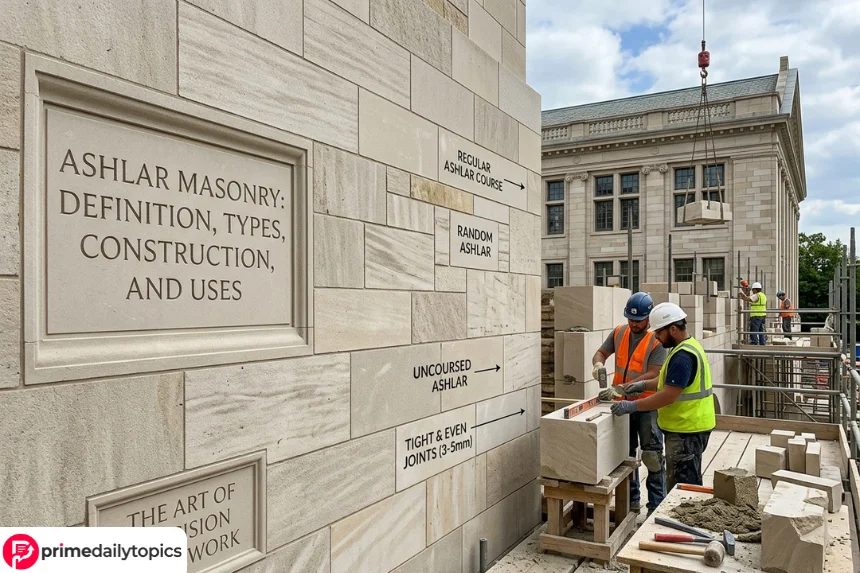
Ashlar masonry is stone construction made with accurately cut and dressed blocks that fit together in regular patterns with thin, controlled joints. The stones are usually rectangular, although some historic examples use trapezoidal or specially shaped units. Depending on the project, ashlar can form a solid load-bearing wall, the visible face of a composite wall, or an anchored dimension-stone cladding.
Its clean geometry distinguishes it from rubble masonry, which uses irregular or minimally worked stone. However, “ashlar” describes the preparation and arrangement of the stone—not one universal stone type, joint width, wall thickness, or structural system.
Ashlar Masonry Quick Facts
| Topic | Verified or practical answer |
|---|---|
| Basic definition | Masonry made from cut and dressed stone units with accurate beds and joints |
| Typical unit shape | Rectangular or square blocks |
| Common materials | Limestone, sandstone, granite, marble, and other suitable dimension stone |
| Joint appearance | Thin, regular, and carefully finished |
| Main contrast | Rubble masonry uses irregular or roughly worked stone |
| Can ashlar be structural? | Yes, but modern ashlar may also be facing or anchored cladding |
| Can it be dry laid? | Yes in some historic traditions, though most modern work uses mortar or engineered anchors |
| Common layouts | Coursed, random ashlar, and specialized face treatments |
| Common finishes | Fine-tooled, rough-tooled, quarry-faced, rock-faced, chamfered, rusticated, or polished |
| Main benefits | Precision, durability, prestige, repeatable coursing, and refined appearance |
| Main drawbacks | High material, cutting, labor, lifting, detailing, and repair costs |
| Restoration priority | Match stone properties, mortar compatibility, joint profile, tooling, and coursing |
| Modern design need | Architect, structural engineer, stone supplier, and experienced mason coordination |
| Symbolic meaning | “Rough ashlar” also has a separate Masonic metaphorical meaning |
What Is Ashlar Masonry?
In practical terms, masons and fabricators cut natural stone into controlled shapes before installing ashlar masonry.
Merriam-Webster defines it broadly as masonry made from sawed, dressed, tooled, or quarry-faced stone with proper bond. Likewise, the ASTM overview of dimension-stone standards explains that dimension stone is natural rock quarried as blocks or slabs to meet requirements for size and shape.
In practical terms, true ashlar work usually has four recognizable features:
- Dressed beds where one stone rests on another
- Dressed vertical joints between neighboring stones
- Deliberate bonding and coursing
- A controlled visible finish
The exposed face does not need to be smooth. It may be polished, finely tooled, rough-tooled, quarry-faced, rock-faced, chamfered, or rusticated. Therefore, a rough visible surface can still be ashlar when the beds and adjoining faces are accurately worked.
What Does the Word Ashlar Mean?
The term can describe:
- An individual dressed stone block
- Masonry built from those blocks
- The visual effect created by accurately dressed stonework
Historically, the word entered English through medieval French forms and has long referred to finely worked building stone. Historical spelling also includes “ashler,” although “ashlar” is standard today.
How Do You Pronounce Ashlar?
In American English, ashlar is commonly pronounced ASH-ler.
The first syllable sounds like “ash,” while the second is unstressed.
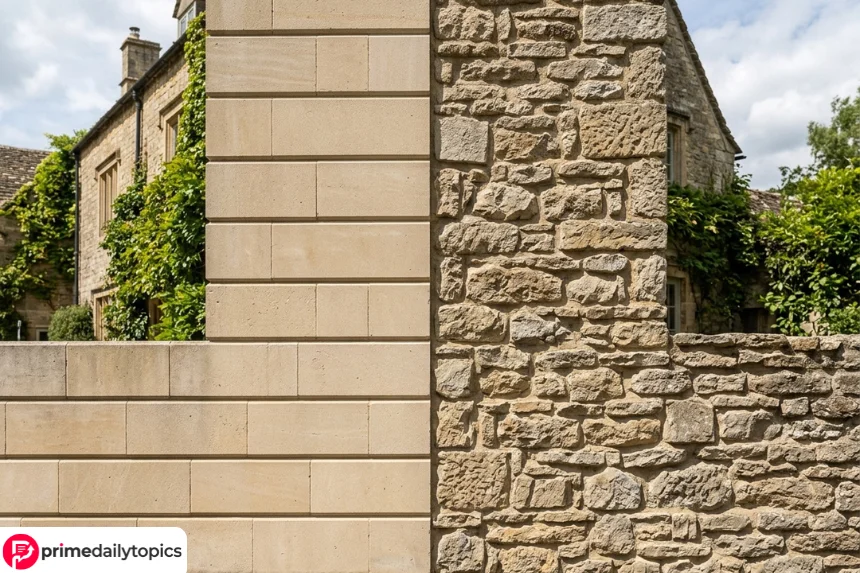
Ashlar Masonry Versus Rubble Masonry
Most importantly, the main difference is the amount and accuracy of stone dressing.
| Feature | Ashlar masonry | Rubble masonry |
| Stone shape | Accurately squared or otherwise controlled | Irregular, natural, or roughly dressed |
| Beds and joints | Closely worked and regular | Wider and less uniform |
| Courses | Usually deliberate and visually controlled | May be coursed or uncoursed |
| Mortar visibility | Typically limited by close-fitting units | Usually more prominent |
| Labor | High | Generally lower |
| Material yield | More cutting and offcut waste | Makes greater use of irregular stone |
| Appearance | Formal, geometric, refined | Rustic, varied, natural |
| Typical historic use | Monumental, civic, religious, bridge, and high-status work | Rural, vernacular, retaining, foundation, and economical walling |
Ashlar is not automatically stronger than every rubble wall. Structural performance depends on stone quality, wall thickness, bond, mortar, workmanship, foundation conditions, loads, moisture, and maintenance.
Nevertheless, accurate contact surfaces and organized bonding can provide predictable load paths. For that reason, builders have long used dressed stone in arches, piers, facades, monuments, and important public buildings.
Is Squared Rubble the Same as Ashlar?
No, although the boundary can become visually subtle.
Squared rubble uses stones that receive enough dressing to create more regular beds and joints. However, the units and joints remain less precise than true ashlar work.
“Block-in-course” masonry often occupies the middle ground. The stones are squared and laid in courses, yet their finish and joint accuracy do not reach fine ashlar standards.
Types of Ashlar Masonry
However, terminology varies among countries, textbooks, contractors, and historic periods. Therefore, the following categories are useful descriptions rather than one universal code classification.
1. Fine-Tooled Ashlar Masonry
Fine-tooled ashlar has carefully dressed beds, sides, and visible faces.
Masons aim for:
- Straight horizontal beds
- Plumb vertical joints
- Consistent course heights
- Sharp arrises, or block edges
- Very thin, even joints
- A smooth or finely tooled face
This is among the most labor-intensive forms. Consequently, it commonly appears on formal facades, monuments, classical buildings, institutional architecture, and premium restoration work.
2. Coursed Ashlar Masonry
Coursed ashlar places dressed blocks in continuous horizontal layers.
The stones within one course commonly share a consistent height, while neighboring courses may use the same or different heights. Vertical joints should be bonded rather than stacked continuously unless the engineered design specifies otherwise.
Coursed ashlar creates a formal rhythm. It also simplifies alignment around openings, corners, belt courses, cornices, and other architectural elements.
3. Random Ashlar Masonry
Random ashlar uses dressed units of different lengths and heights in a planned irregular pattern.
Despite the name, good random ashlar is not careless. The mason coordinates block sizes, avoids weak continuous joints, controls visual balance, and maintains proper bearing.
Random ashlar gives a less formal appearance than uniform coursing while preserving the disciplined beds and joints that distinguish ashlar from rubble.
4. Rough-Tooled Ashlar Masonry
Rough-tooled ashlar combines accurate beds and joints with a visibly tooled face.
The face may show chisel, point, or other intentional tool marks. Therefore, the wall retains texture without losing the geometric order of ashlar construction.
This finish suits buildings that need visual depth, a handmade character, or a transition between refined trim and more rustic walling.
5. Quarry-Faced or Rock-Faced Ashlar Masonry
Quarry-faced ashlar leaves the central visible face projecting or naturally rough while dressing a margin around the edges.
The drafted border helps define each block and keeps the adjoining surfaces accurate. Meanwhile, the raised center catches light and creates strong shadow.
“Quarry-faced” and “rock-faced” are often used interchangeably, though local practice may distinguish particular tooling methods.
6. Chamfered Ashlar Masonry
Chamfered ashlar has beveled edges around the exposed face.
The bevel produces recessed lines and pronounced shadows between blocks. Historic and modern designers use the treatment to make individual units visually distinct.
The chamfer dimension should come from the architectural drawings and stone shop drawings. A fixed 45-degree, 1-inch, or 25-millimeter rule appears in many teaching pages, but it is not a universal requirement for every building.
7. Rusticated Ashlar Masonry
Rustication deliberately emphasizes the joints or face texture.
The stone may have:
- Deep recessed joints
- V-shaped or channel joints
- Rough projecting faces
- Vermiculated or patterned surfaces
- Alternating smooth and textured bands
Classical architecture often uses rusticated stone at lower stories to suggest strength, then changes to smoother ashlar above.
8. Ashlar Facing or Veneer
Ashlar facing uses dressed stone as the visible outer portion of a wall.
Historically, masons could tie an ashlar face to rubble or brick backing. Modern buildings may use full-bed stone veneer, anchored dimension-stone panels, or thinner adhered products.
These systems are not interchangeable. The ASTM discussion of dimension-stone construction notes that stone selection, attachment, and anchorage require dedicated standards and engineering guidance.
Therefore, a product that looks like ashlar may function as cladding rather than load-bearing masonry.
What Stones Are Used in Ashlar Masonry?
For example, builders can use many natural stones when the material suits the environment and structural role.
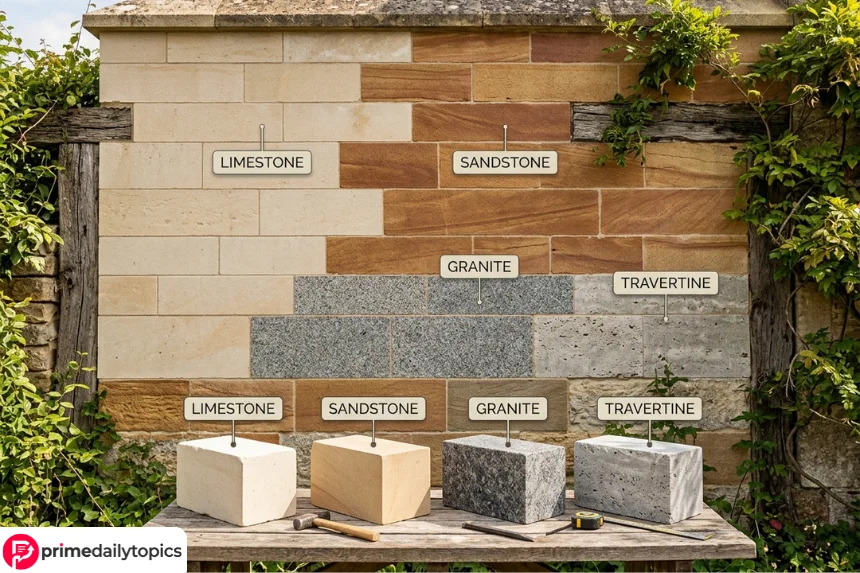
Common options include:
- Limestone
- Sandstone
- Granite
- Marble
- Slate in specialized applications
- Local building stones that can be accurately worked
Nevertheless, each stone behaves differently.
Limestone may be easy to carve but can vary greatly in pore structure and weather resistance. Sandstone offers many colors and textures, yet bedding orientation matters. Granite provides high strength and abrasion resistance but costs more to cut. Marble can deliver a refined finish, although some marbles may bow or weather poorly in certain exterior cladding conditions.
Accordingly, appearance alone should not drive stone selection. Designers should evaluate absorption, density, strength, freeze-thaw exposure, salts, bedding, anchorage, movement, and maintenance.
Is Concrete Ashlar Real Ashlar?
By contrast, manufacturers may mold or score concrete products to imitate ashlar.
Terms such as “cast-stone ashlar,” “ashlar block,” “ashlar-pattern concrete,” and “faux ashlar” describe an appearance rather than traditional natural dimension-stone construction.
These products can be appropriate, but specifications should identify the actual material. Calling every rectangular masonry unit “ashlar stone” can mislead owners about composition, installation, maintenance, and cost.
How Ashlar Masonry Is Constructed
Naturally, the construction sequence changes with the wall system, stone type, and project scale. Nevertheless, traditional ashlar work follows a recognizable process.
1. Survey and Design
The architect and engineer establish:
- Wall type and structural role
- Stone species and finish
- Unit sizes and course layout
- Bond pattern
- Openings, corners, copings, and projections
- Mortar or sealant joints
- Anchors, cramps, dowels, or ties
- Flashing, drainage, and movement details
For restoration, the survey also records existing stone, decay, previous repairs, joint profiles, and construction phases.
2. Quarrying and Stone Selection
The quarry supplies blocks with suitable color, grain, bedding, durability, and dimensions.
Natural stone varies. Therefore, the project may require range samples, mock-ups, testing, and agreed limits for color or geological markings.
3. Sawing, Squaring, and Dressing
Next, fabricators cut the blocks near their final dimensions. Then they work the beds, joints, and faces to the specified tolerances and finish.
Traditional tools include points, punches, chisels, mallets, axes, and drags. Modern shops also use diamond saws, CNC equipment, planers, and pneumatic tools.
4. Setting Out
Masons establish lines, levels, corners, course heights, and opening dimensions.
Accurate setting out matters because minor errors accumulate across a facade. Quoins, jambs, sills, arches, and cornices must coordinate with the general coursing.
5. Laying and Bonding
During installation, masons give each stone the full, stable bearing required by the system.
In mortared walls, masons spread compatible bedding mortar, place the stone, check line and level, and fill the joints. The vertical joints should be arranged to maintain bond and avoid long, unintended continuous seams.
Large blocks may require lifting equipment and temporary support.
6. Anchoring and Moisture Management
In addition, modern ashlar facades often rely on stainless-steel anchors, ties, support angles, flashing, cavity drainage, and movement joints.
These elements may be hidden, but they are essential. Water that enters behind stone must have a safe drainage path. Likewise, the system must accommodate thermal and structural movement.
7. Pointing and Finishing
Finally, masons finish mortar joints to the specified profile after the bedding mortar reaches the proper condition.
The joint should support water shedding and match the intended appearance. Smearing mortar over the stone face can permanently alter color and texture.
Finally, workers clean the wall using methods approved for the specific stone. Aggressive acids, high-pressure washing, or abrasive blasting can damage the surface.
How Thick Are Ashlar Mortar Joints?
Although ashlar joints are characteristically thin, there is no single correct width for every project.
Historic sources, teaching texts, and regional traditions give different figures. Fine ashlar may have extremely narrow joints, while rough-tooled or rock-faced work may use wider joints. Modern cladding may use sealant joints designed for movement rather than traditional mortar.
The correct joint depends on:
- Accuracy of stone fabrication
- Stone texture
- Structural system
- Historic precedent
- Mortar aggregate size
- Movement requirements
- Construction tolerances
- Architect and engineer specifications
Therefore, contractors should not apply a copied 1/8-inch, 1/4-inch, 3-millimeter, or 6-millimeter value without project-specific guidance.
Mortar for Ashlar Masonry
More importantly, mortar supports bedding, load transfer, alignment, weather resistance, and visual character.
For new construction, the design team selects mortar based on stone properties and structural needs. For historic work, compatibility becomes especially important.
The National Park Service guidance on historic mortar explains that mortar often acts sacrificially by managing moisture before the masonry units fail. Hard, impermeable replacement mortar can force moisture and stress into softer stone.
Likewise, the Historic England repointing guidance warns that unsuitable repointing can damage both the appearance and durability of historic masonry.
Should You Use Portland-Cement Mortar?
Not automatically. Instead, the design team must match the mortar to the stone and wall system.
Portland-cement-containing mortar may suit some modern stone systems. However, a strong, dense mix can damage soft or porous historic stone.
For older ashlar, a conservator or experienced specification professional should assess the original mortar, stone, exposure, and wall behavior. Lime-rich mortar is often appropriate, but even “lime mortar” is not one universal recipe.
The correct goal is compatibility—not simply choosing the weakest or strongest available mortar.
Advantages of Ashlar Masonry
Refined Appearance
First, ashlar creates clean lines, sharp geometry, and controlled shadow patterns. It can appear formal, monumental, rustic, or contemporary depending on the finish.
Long Service Life
Second, suitable stone, proper detailing, and regular maintenance can provide a service life measured in generations.
Design Flexibility
Moreover, designers can vary:
- Course height
- Block length
- Face texture
- Joint profile
- Stone color
- Rustication
- Chamfers
- Carved details
Structural Potential
Structurally, solid ashlar can support substantial compressive loads. Historically, builders used it for walls, towers, bridges, arches, piers, and monuments.
Repairability
In many cases, conservators can repair or replace individual stones and mortar joints. However, successful work requires matching materials and skilled detailing.
Prestige and Material Authenticity
Natural stone communicates permanence and craftsmanship. Consequently, ashlar remains popular for civic, religious, institutional, luxury residential, and heritage projects.
Disadvantages of Ashlar Masonry
High Cost
However, quarrying, testing, cutting, finishing, transport, lifting, installation, and specialist labor make ashlar expensive.
Skilled Labor Requirements
Furthermore, small layout errors can become highly visible. Furthermore, improper bedding, anchoring, or pointing can create structural and moisture problems.
Weight
Likewise, full-depth stone imposes significant dead load. Foundations, supports, anchors, and backup walls must be designed accordingly.
Slow Production
Consequently, custom fabrication and careful installation take time. Replacement stones for historic buildings may require quarry research and hand finishing.
Natural Variation
Because stone is natural, color, grain, fossils, veins, and weathering can vary. Mock-ups and range samples help manage expectations.
Difficult Alterations
Finally, cutting openings or routing services through finished ashlar can damage bond, water management, and historic fabric.
Common Uses of Ashlar Masonry
Today, ashlar appears in:
- Public buildings
- Courthouses
- Universities
- Museums
- Churches and cathedrals
- Monuments and memorials
- Bridges and bridge abutments
- Retaining walls
- Estate houses
- Town halls
- Banks
- Classical facades
- Entrance surrounds
- Columns, piers, quoins, and plinths
- Interior feature walls
- Modern dimension-stone cladding
Historically, builders often reserved expensive ashlar for visible elevations, corners, openings, and architectural trim while using rubble inside the wall.
Modern projects likewise concentrate natural stone where it delivers the greatest aesthetic and durability value.
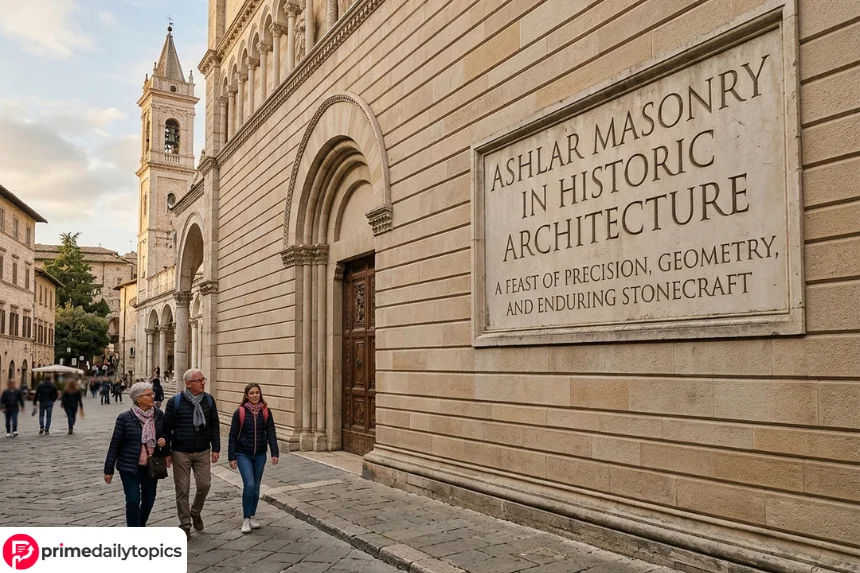
Ashlar Masonry in Historic Architecture
Historically, dressed-stone construction appeared across many civilizations.
Ancient Egyptian, Greek, Roman, Minoan, and Inca builders developed highly accomplished stone-cutting traditions. Medieval masons used ashlar in castles, abbeys, cathedrals, towers, and civic works. Renaissance and Neoclassical architects later used smooth ashlar and rustication to organize facades.
The Historic England stone-conservation resource emphasizes that historic stonework includes everything from simple walling to complex carving and requires diagnosis before treatment.
Examples should still be described carefully. A famous building may combine multiple materials and techniques rather than consist entirely of ashlar.
Ashlar Masonry Restoration and Repointing
Above all, restoration should begin with investigation, not immediate replacement.
Diagnose the Cause of Decay
For example, common causes include:
- Failed roofs, gutters, or flashings
- Rising or trapped moisture
- Salt crystallization
- Freeze-thaw cycles
- Corroding metal anchors
- Structural movement
- Incompatible hard mortar
- Aggressive cleaning
- Poor previous stone patches
- Incorrect replacement stone
Repairing the visible symptom without fixing the water or movement source usually leads to repeat failure.
Retain Sound Historic Material
Similarly, comprehensive repointing is rarely necessary.
Historic England advises leaving sound historic mortar undisturbed. Removing good mortar can damage stone edges and erase evidence of original workmanship.
Match Replacement Stone by Performance
Moreover, a similar color is not enough.
The Historic England guidance on sourcing replacement stone recommends considering chemical, physical, and mineralogical compatibility.
An unsuitable replacement may weather at a different rate, trap moisture, stain adjacent work, or create a patchwork appearance.
Avoid Over-Hard Mortar
For instance, the National Park Service documents cases where hard pointing remained intact while softer sandstone deteriorated around it.
Therefore, the replacement mortar should generally remain compatible in strength, permeability, color, texture, and joint behavior.
Use Skilled Masonry Conservators
Finally, historic ashlar often contains precise arrises, tooling, and narrow joints. Power tools can chip edges and widen joints quickly.
A qualified conservator, historic architect, or experienced restoration mason should prepare sample panels before large-scale work.
Ashlar Masonry Versus Stone Veneer
In summary, ashlar describes dressed units and their arrangement. Veneer describes the wall system or role of the stone.
Therefore:
- Solid ashlar can be structural.
- Full-bed ashlar veneer is supported and tied to backing.
- Thin adhered stone may imitate ashlar coursing.
- Anchored dimension-stone panels can create an ashlar facade.
- Cast stone or concrete block can imitate the appearance.
The visual result alone does not reveal how the wall carries load or manages water.
For a new project, specifications should state the stone thickness, backup wall, anchors, cavity, flashing, weeps, joint materials, movement design, and testing requirements.
Ashlar Masonry Cost
However, no universal price per square foot applies.
Cost depends on:
- Stone species and quarry location
- Block thickness and size
- Standard versus custom dimensions
- Face finish
- Amount of hand tooling
- Curves, arches, carvings, and chamfers
- Quantity and repetition
- Shipping distance
- Crane and access requirements
- Structural anchors and backup
- Labor market
- Mock-ups and testing
- New construction versus restoration
- Matching a closed or historic quarry
Ashlar typically costs more than rubble stone, manufactured veneer, or standard masonry units. However, lifecycle value may improve when durable local stone receives appropriate detailing and maintenance.
Owners should request project-specific bids rather than relying on generic online cost ranges.
What Does Rough Ashlar Mean in Freemasonry?
Separately, “rough ashlar” also has a symbolic Masonic meaning unrelated to construction specifications.
The Scottish Rite explanation of rough ashlar describes the rough stone as a metaphor for a person before education and moral refinement. A perfected or smooth ashlar represents self-improvement through learning and discipline.
That symbolism borrows from the stonemason’s transformation of quarry stone into a finished building unit. However, it should not be mixed into a technical definition of rough-tooled ashlar masonry.
Common Myths About Ashlar Masonry
Myth: Every ashlar wall has a polished face. The visible face can be rough, rock-faced, tooled, rusticated, or polished.
Myth: Ashlar always uses identical blocks. Coursed work may be regular, while random ashlar uses controlled variations.
Myth: Ashlar is always load-bearing. Many modern facades use ashlar facing or anchored cladding.
Myth: Thin joints mean no mortar is needed. Most ashlar walls use mortar, though some historic dry-laid examples exist.
Myth: A 6-millimeter joint defines all ashlar. Joint width varies by type, era, stone, finish, and specification.
Myth: Ashlar is automatically stronger than rubble. Structural performance depends on the entire wall system and workmanship.
Myth: Any rectangular concrete block is ashlar stone. Manufactured products may imitate the pattern but are not natural dressed stone.
Myth: Portland cement is always the best repair mortar. Hard, impermeable mortar can damage softer historic stone.
Myth: Matching replacement-stone color is enough. Physical and mineralogical compatibility also matter.
Myth: Rough ashlar has only a construction meaning. The phrase also appears as a separate Masonic metaphor.
FAQs About Ashlar Masonry
1. What Is Ashlar Masonry?
Ashlar masonry is construction using accurately cut and dressed stone blocks laid with controlled beds, joints, bonding, and coursing.
2. What Is the Difference Between Ashlar and Rubble Masonry?
Ashlar uses carefully worked units with regular joints, while rubble masonry uses irregular or roughly dressed stone with wider, less uniform joints.
3. What Are the Main Types of Ashlar Masonry?
Common descriptions include fine-tooled, coursed, random, rough-tooled, quarry-faced, rock-faced, chamfered, rusticated, block-in-course, and ashlar facing.
4. Which Stone Is Best for Ashlar Masonry?
The best stone depends on climate, loads, finish, availability, and durability. Limestone, sandstone, granite, and marble are common choices.
5. Is Ashlar Masonry Load-Bearing?
It can be. However, modern ashlar may also function as full-bed veneer or anchored dimension-stone cladding.
6. Does Ashlar Masonry Use Mortar?
Usually, yes. Some historic ashlar was dry laid, but most work uses mortar, engineered anchors, or both.
7. How Thin Should Ashlar Joints Be?
They should be accurate and consistent, but no universal width applies. The project specification should reflect the stone, finish, structural system, and historic precedent.
8. Why Is Ashlar Masonry Expensive?
The cost comes from quarrying, stone selection, precise cutting, finishing, transport, lifting, skilled installation, and detailed design.
9. Can Old Ashlar Be Repointed With Cement Mortar?
Not automatically. Instead, the design team must match the mortar to the stone and wall system. The replacement mortar must be compatible with the historic stone and original wall behavior; overly hard mortar may accelerate stone decay.
10. Is Ashlar Masonry Still Used Today?
Yes. It appears in new structural-stone projects, full-bed veneer, anchored cladding, restoration, monuments, civic architecture, and high-end residential work.
Conclusion: Why Ashlar Masonry Still Matters
Ashlar masonry combines natural stone with disciplined cutting, accurate joints, deliberate bonding, and controlled architectural finishes.
Its defining feature is not a perfectly smooth face or one fixed joint width. Instead, ashlar depends on accurately worked beds and adjoining surfaces that allow stones to form a precise masonry system.
The method ranges from fine-tooled monumental walls to rough rock-faced courses and modern anchored facades. It can provide durability, structural capacity, and exceptional visual quality. Nevertheless, those benefits require suitable stone, careful design, compatible mortar, moisture management, skilled installation, and informed maintenance.
For historic ashlar, conservative repair matters most. Retaining sound stone and mortar, diagnosing moisture, matching replacement materials, and avoiding overly hard pointing protect both the building and the craftsmanship recorded in its walls.
READ MORE ABOUT: Ancient Greece Social Structure
