



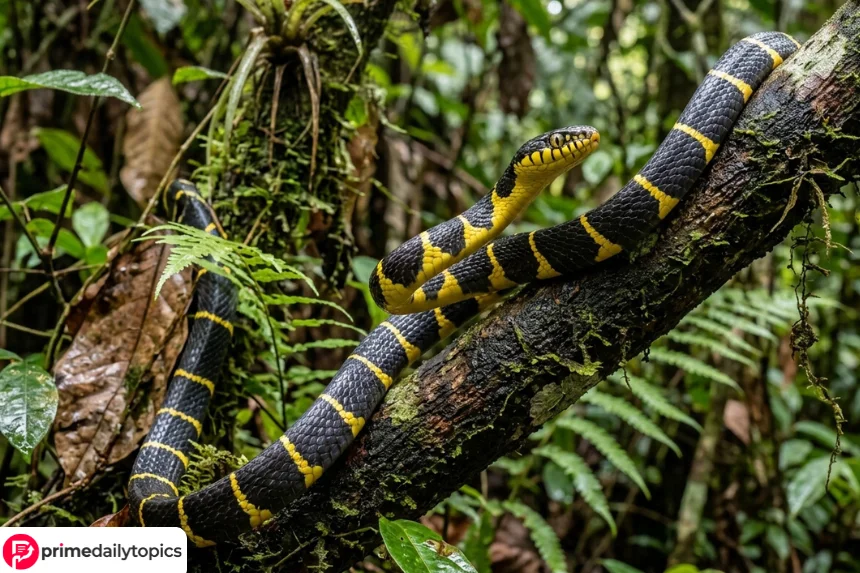
A cat snake is a slender, large-eyed snake commonly associated with the genus Boiga. These snakes get their familiar name from their narrow, vertical pupils, which resemble the pupils of a domestic cat. Moreover, most species become active at night and move skilfully through trees, shrubs and dense vegetation.
Although cat snakes have an attractive appearance, they are not harmless display animals. Members of Boiga possess enlarged rear fangs and produce venom for subduing prey. However, venom strength, bite symptoms, body size and colour can differ considerably between species.
The term cat snake does not describe one uniform animal. Instead, it covers a diverse genus that includes green, brown, spotted and boldly banded species. The Reptile Database currently lists 37 recognised species in the genus Boiga. Therefore, identification requires more than simply looking for one colour or pattern.
Quick answer: A cat snake is usually a member of the genus Boiga. It is recognised by its slender body, large eyes, vertical pupils and primarily nocturnal behaviour. Cat snakes are rear-fanged and venomous, although the effects of their venom vary among species.
Cat Snake Quick Facts
| Feature | Information |
|---|---|
| Common name | Cat snake or cat-eyed snake |
| Main scientific genus | Boiga |
| Family | Colubridae |
| Recognised species | 37 species in the current Reptile Database listing |
| Pupil shape | Narrow and vertically elliptical |
| Typical activity | Mostly nocturnal |
| General lifestyle | Arboreal or semiarboreal |
| Venom system | Enlarged rear fangs |
| Typical prey | Lizards, frogs, birds, eggs and small mammals |
| Reproduction | Egg-laying |
| Main geographic range | South Asia, Southeast Asia, Australia and parts of the Pacific |
| Notable U.S. connection | The invasive brown treesnake on Guam |
These are broad genus-level characteristics rather than fixed traits of every species. For example, the mangrove cat snake has a black body with yellow markings, whereas the green cat snake usually develops green or bluish-green colouring as an adult. Likewise, body length and preferred habitat vary according to species.
What Is a Cat Snake?
A cat snake is a member of a diverse group of colubrid snakes commonly placed in the genus Boiga. The genus includes well-known species such as the green cat snake, mangrove cat snake, brown treesnake, black-headed cat snake and common cat snake.
Scientifically, Boiga belongs to the family Colubridae and the order Squamata. However, common names can cause confusion because people sometimes use similar names for unrelated large-eyed snakes. Therefore, the scientific name offers the most reliable way to confirm a species.
The Reptile Database currently recognises 37 Boiga species. This list includes Boiga cyanea, Boiga dendrophila, Boiga irregularis, Boiga multomaculata, Boiga nigriceps and Boiga trigonata. Nevertheless, taxonomic totals can change when researchers separate populations, combine species or publish new genetic evidence.
Most cat snakes have bodies designed for moving through vegetation. Their narrow shape allows them to cross branches, while their long tails help with balance. In addition, their large eyes improve their ability to locate prey in low-light conditions.
Is a Cat Snake One Specific Species?
No, cat snake usually refers to a group rather than one individual species.
For example, Boiga trigonata is specifically known as the common cat snake. However, many other members of Boiga also carry “cat snake” in their common names. These include:
- Green cat snake — Boiga cyanea
- Mangrove cat snake — Boiga dendrophila
- Many-spotted cat snake — Boiga multomaculata
- Black-headed cat snake — Boiga nigriceps
- Brown treesnake — Boiga irregularis
Consequently, a page that describes every cat snake as green, black or brown would be misleading. Each species has its own range, markings, average size and ecological role.
Why Is It Called a Cat Snake?
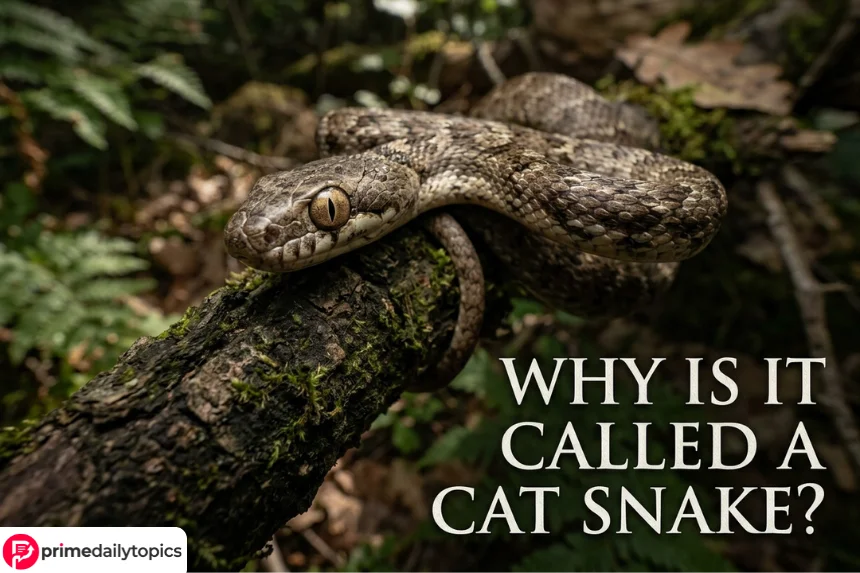
The name comes primarily from the animal’s eyes. Many cat snakes have large eyes with narrow, vertical pupils that look similar to the pupils of a domestic cat.
For instance, the Smithsonian describes the mangrove snake as having large eyes with narrow vertical slits. Because this snake hunts mainly at night, its eye structure supports vision in low-light environments. The same distinctive feature also explains why it is called a yellow-ringed cat snake.
However, the resemblance ends with the eyes. Cat snakes are reptiles, not mammals, and they do not share a close biological relationship with domestic cats. Instead, the common name simply provides a memorable description of their appearance.
What Does a Cat Snake Look Like?
A typical cat snake has a long, slender body, a noticeable head and a neck that appears narrower than the skull. Moreover, its eyes often look unusually large compared with the rest of its head.
Common identification features include:
- Large eyes with vertical pupils
- A slender or slightly compressed body
- A head that appears wider than the neck
- A relatively long tail
- Strong climbing ability
- Smooth-looking scales
- Nighttime or twilight activity
Nevertheless, these traits cannot confirm an identification on their own. Several unrelated snakes have slender bodies, large eyes or vertical pupils. Therefore, observers should consider geographic location, markings, scale arrangement and professional identification.
Cat Snake Colours and Patterns
Cat snakes display remarkable colour variation. Depending on the species, an individual may appear:
- Green or bluish green
- Brown or reddish brown
- Black with yellow bands
- Gray with dark markings
- Orange or rust coloured
- Spotted, striped or blotched
The mangrove snake provides one of the clearest examples. It has a mainly black body with narrow yellow bands and yellow scales around its face. However, the yellow bands generally do not connect completely across its back or belly.
Meanwhile, green cat snakes have a far less contrasting appearance. Their green colouring helps them blend into leaves and branches. Juveniles may also look different from adults, which makes colour-based identification even less reliable.
For that reason, people should never capture a snake simply to inspect its eyes or markings. Instead, they should remain at a safe distance and photograph the animal only when doing so presents no risk.
How Big Does a Cat Snake Get?
The size of a cat snake depends heavily on its species, age, sex and environment. Some members remain relatively small and lightly built. In contrast, larger species may grow several feet long.
Even when a cat snake reaches an impressive length, its body may still appear thin. Therefore, length alone does not indicate weight, strength or medical danger.
The brown treesnake illustrates this variation. According to the U.S. Department of Agriculture, adults can occasionally reach approximately 10 feet. However, most individuals recorded on Guam measure around 3 to 4 feet.
Because record-size individuals attract attention online, readers should not mistake a maximum documented length for a normal adult size. Average measurements provide a more realistic picture of most wild animals.
Cat Snake Behaviour
Most cat snakes are nocturnal. As a result, they usually remain hidden or inactive during the hottest and brightest parts of the day.
A resting cat snake may coil among branches, hide inside a tree hollow or shelter beneath vegetation. Then, after sunset, it begins searching for prey. Its large eyes help it function in dim conditions, while its narrow body supports movement through tangled branches.
The Smithsonian notes that mangrove snakes spend daylight hours coiled among branches in riverine and coastal forests. At night, however, they descend or travel through vegetation to hunt.
Similarly, USDA information describes the brown treesnake as an effective climber that rests in cool, dark locations during the day. It then becomes active at night and searches for food.
Are Cat Snakes Aggressive?
Cat snakes generally prefer avoiding unnecessary conflict. Nevertheless, an individual may strike when it feels trapped, restrained or threatened.
Defensive behaviour may include:
- Pulling the head backwards into a striking position
- Flattening or expanding part of the neck
- Opening the mouth
- Striking repeatedly
- Releasing a defensive odour
- Attempting to escape into nearby vegetation
Behaviour also differs between species and individual snakes. Moreover, a calm-looking animal can react suddenly when someone approaches too closely.
Therefore, people should never test whether a wild cat snake is aggressive. A defensive strike does not mean that the snake is hunting a person. Instead, it usually means that the animal believes it must protect itself.
Are Cat Snakes Good Climbers?
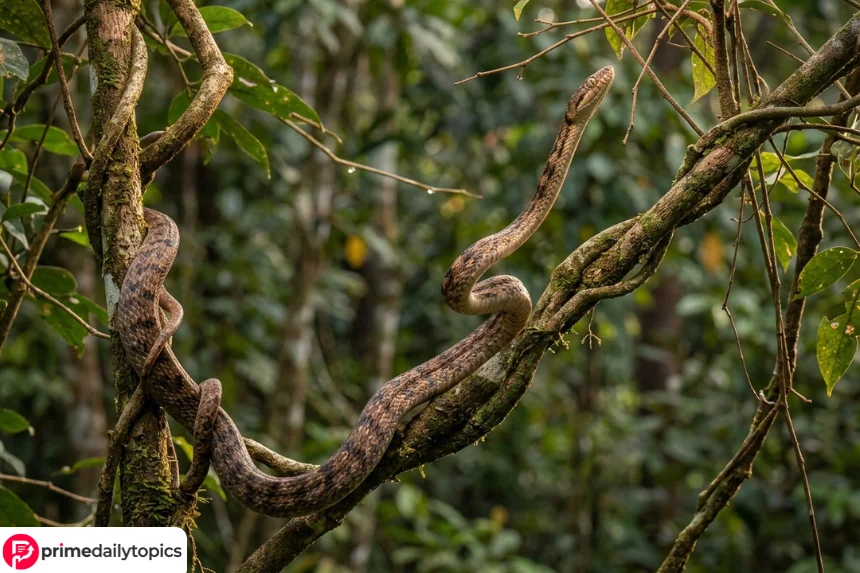
Yes, most cat snakes are highly capable climbers. Their slender bodies, muscular movement and long tails help them travel through trees and shrubs.
Some species spend much of their lives above the ground. Consequently, they may hunt birds, eggs, frogs, lizards, bats or small mammals in elevated locations.
The mangrove snake commonly rests on branches and inhabits mangrove, riverine and lowland forests. Meanwhile, the brown treesnake occupies trees, shrubs and forest habitats. Both species may descend to the ground while hunting or moving between locations.
However, describing a species as arboreal does not mean it never travels on land. Cat snakes may cross roads, enter low vegetation or move along the forest floor. Therefore, habitat use should be understood as flexible rather than absolute.
Cat Snake Habitat and Global Distribution
The natural range of the cat snake depends on the individual species. However, most members of the genus Boiga occur across South Asia, Southeast Asia, parts of China, Australia and several Pacific islands. Their habitats range from humid coastal forests to mountain woodland.
Many species prefer environments with trees, shrubs and dense vegetation. Therefore, tropical forests offer ideal shelter, hunting opportunities and daytime resting places. Some cat snakes also live in mangroves, plantations, secondary forests and areas near rivers.
Although these snakes are often described as arboreal, they do not remain in trees at all times. Instead, many descend to the ground while searching for prey or travelling between areas of vegetation. Their habitat use may also change according to weather, food availability and breeding activity.
Forest and Woodland Habitats
Forests provide several advantages for a cat snake. First, branches offer secure daytime resting places. In addition, leaves and tree hollows conceal the snake from predators and potential prey.
Primary forests support complex ecosystems with mature trees and abundant wildlife. However, some species can also survive in secondary forests that have regrown after logging or agricultural disturbance.
For example, the green cat snake inhabits primary and secondary forests, including mountain forests and coastal woodland at sea level. Although it spends much of its time above ground, it may occasionally descend while hunting.
Mangrove and Riverine Habitats
Some species have a particularly strong association with water-rich environments. The mangrove cat snake, for instance, occupies mangrove forests, riverine habitats and tropical lowland forests.
During the day, it commonly rests on branches above waterways. Then, after sunset, it moves through the trees or descends toward the forest floor to search for prey. The Smithsonian reports that mangrove snakes may rest on branches as high as 100 feet above the ground.
Mangroves provide birds, frogs, lizards, bats and other small animals. Consequently, they create valuable feeding grounds for a nocturnal predator.
Can Cat Snakes Live Near People?
A cat snake may occasionally enter gardens, farms, plantations or buildings located near suitable habitat. Usually, the animal is following prey rather than deliberately approaching humans.
Rodents, geckos and frogs can attract snakes to residential areas. Moreover, overgrown vegetation, unsecured animal feed and piles of debris may provide hiding places for both snakes and their prey.
The brown treesnake demonstrates this behaviour on Guam. According to USDA APHIS, it may enter buildings while searching for food, especially where rodents, lizards or poultry are abundant.
Nevertheless, seeing a snake close to a home does not mean that it wants to attack. Snakes generally seek shelter, food or a route through the area. Therefore, people should give the animal space and contact a trained wildlife professional when removal is necessary.
Where Do Different Cat Snake Species Live?
The genus Boiga contains 37 currently recognised species. As a result, no single distribution map represents every cat snake.
Some species occupy wide ranges across several countries. In contrast, others live in relatively restricted regions or on particular islands.
Green Cat Snake Range
The green cat snake, Boiga cyanea, occurs across parts of South and Southeast Asia. Its recorded distribution includes Bangladesh, Bhutan, Cambodia, China, India, Laos, Malaysia, Myanmar, Nepal, Thailand and Vietnam.
This species inhabits forests from coastal regions to mountainous areas. Because it has a long prehensile tail, it can grip branches and move efficiently through vegetation.
Mangrove Cat Snake Range
The mangrove cat snake, Boiga dendrophila, is native to Southeast Asia. Its range includes Indonesia, Malaysia, Thailand, Singapore, Vietnam, Cambodia and the Philippines.
Although its common name suggests that it lives only in mangroves, the species also occupies riverine areas and lowland forests. Therefore, the name describes an important habitat rather than its complete ecological range.
Brown Treesnake Range
The brown treesnake, Boiga irregularis, is native to northeastern Australia, eastern Indonesia, Papua New Guinea and the Solomon Islands. However, people accidentally introduced it to Guam around the late 1940s or early 1950s.
After its arrival, the species spread across the island. Because Guam lacked sufficient natural controls, the population grew to exceptionally high densities in some areas.
Today, U.S. agencies use trapping, trained detector dogs, cargo inspections, nighttime searches and other measures to prevent the snake from reaching new destinations.
What Does a Cat Snake Eat?
A cat snake is a carnivorous predator. Nevertheless, its preferred food depends on its species, age, body size and habitat.
Common prey animals include:
- Lizards and geckos
- Frogs and other amphibians
- Small birds
- Bird eggs
- Rodents
- Bats
- Smaller snakes
Young cat snakes generally target smaller animals. Meanwhile, larger adults can capture heavier prey, including birds and mammals.
Food availability also shapes the diet. For example, a snake living in a forest canopy may encounter birds, eggs and tree-dwelling lizards. In contrast, an individual hunting near the ground may find frogs, rodents or other snakes.
Green Cat Snake Diet
The green cat snake feeds mainly on lizards. However, it may also consume frogs, birds, rodents and smaller snakes.
Its green coloration helps it remain concealed among leaves. Additionally, its climbing ability enables it to search branches and vegetation where lizards and frogs rest.
Mangrove Cat Snake Diet
The mangrove cat snake has a broader documented diet. It eats other snakes, lizards and frogs, while birds, bird eggs, bats and other small mammals also form important parts of its food supply.
Birds appear to be particularly important prey. In fact, one component of the snake’s venom has shown stronger immobilising effects on bird muscle than on mouse muscle.
Brown Treesnake Diet
Brown treesnakes are opportunistic feeders. Therefore, they consume whatever suitable prey is available within their environment.
On Guam, their diet has included native birds, eggs, bats and lizards. As many native species declined, the snakes increasingly relied on introduced lizards, rodents and non-native birds.
This dietary flexibility has helped the species survive despite major changes in Guam’s wildlife community.
How Does a Cat Snake Hunt?
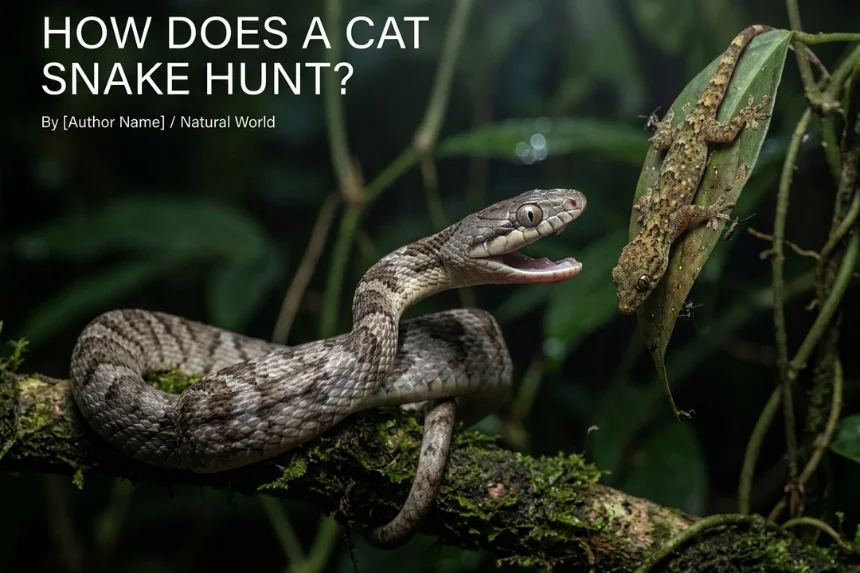
Most cat snakes begin hunting after sunset. Their large eyes support activity under low-light conditions, while their slender bodies allow them to move quietly through branches.
A hunting cat snake may remain motionless until prey comes within range. Alternatively, it may actively travel through vegetation while investigating movement or scent.
Once close enough, the snake strikes and grips the prey with its teeth. Its backward-angled rear fangs help hold a struggling animal. In some cases, the snake must maintain its bite or make chewing movements before enough venom reaches the wound.
Some species also use muscular pressure to restrain prey. For instance, USDA APHIS describes the brown treesnake as a rear-fanged semi-constrictor.
After the animal stops resisting, the snake swallows it whole. Like other snakes, a cat snake has flexible jaw connections that allow it to consume prey wider than its head.
Does a Cat Snake Use Venom or Constriction?
The hunting method can involve both venom and physical restraint. However, the relative importance of each method differs among species and prey types.
Venom may weaken a bird, lizard or frog. Meanwhile, the snake’s jaws prevent the animal from escaping. Larger prey may require a longer hold than smaller prey.
Consequently, the term “rear-fanged” does not mean that the snake cannot deliver venom effectively. Instead, it describes the position of the enlarged fangs toward the back of the upper jaw.
Is a Cat Snake Venomous?
Yes, snakes in the genus Boiga are venomous. They possess enlarged rear fangs connected to an oral secretion system that helps them subdue prey.
However, cat snake venom should not be compared directly with the venom-delivery systems of cobras, mambas or vipers. Those snakes have large front fangs that can deliver venom rapidly during a brief strike. In contrast, a cat snake’s enlarged fangs sit farther back in its mouth.
As a result, prolonged contact may deliver more venom than a quick defensive strike. The prey’s size, bite location and the length of the bite can also influence the outcome.
How Do Cat Snake Rear Fangs Work?
The mangrove cat snake provides a useful example. The Smithsonian explains that it has a Duvernoy’s gland located behind the eye. A duct connects this gland to enlarged, grooved rear fangs.
When the snake bites and holds its prey, secretions travel along the grooves. Because the fangs point backwards, they also help secure the animal inside the snake’s mouth.
Therefore, venom delivery may involve several actions:
- The snake strikes and grips the prey.
- Backward-facing teeth reduce the prey’s ability to escape.
- The snake adjusts its jaws around the animal.
- Venom enters through grooves in the rear fangs.
- The prey becomes easier to restrain and swallow.
This system works well for small animals. Nevertheless, it does not mean that every bite injects the same quantity of venom.
How Strong Is Cat Snake Venom?
Venom effects differ among species. Moreover, a toxin that works efficiently on one prey group may have a weaker effect on another.
The mangrove cat snake produces a toxin called denmotoxin. Research summarised by the Smithsonian found that it affected bird muscles more strongly than mouse muscles. This difference fits the snake’s natural feeding habits because birds form an important part of its diet.
In humans, mangrove cat snake venom is not considered lethal. However, a bite may cause painful swelling and skin discoloration.
USDA APHIS also classifies the brown treesnake as mildly venomous. Although it generally does not pose a serious danger to adults, the agency notes that very young infants may be vulnerable to both its bite and constriction.
Therefore, descriptions such as “mildly venomous” should never be interpreted as “safe to handle.”
Are Cat Snake Bites Always Severe?
No. The severity of a bite can vary according to:
- The species involved
- The size of the snake
- The depth and location of the bite
- How long the snake remains attached
- The quantity of venom delivered
- The victim’s age and health
- Individual allergic or immune reactions
A rapid defensive strike may deliver little venom. Conversely, a prolonged bite could deliver more secretion because the rear-fanged snake has time to maintain contact.
Even so, people should not diagnose a bite themselves. The CDC advises seeking prompt medical attention after snakebites and warns against trying to capture or kill the snake for identification.
Notable Types of Cat Snake
Green Cat Snake
The green cat snake is one of the most visually distinctive Boiga species. Adults usually display green, gray-green or bluish-green upper surfaces, while the underside may appear pale green or yellowish white.
Interestingly, hatchlings do not immediately share the adult coloration. Young green cat snakes are reddish brown with green heads, and their bodies gradually change colour as they mature.
The species can reach a reported maximum length of approximately 190 centimetres, although a common adult measurement is closer to 115 centimetres.
During daylight hours, it usually rests among branches. However, after dark, it becomes an active hunter.
Mangrove Cat Snake
The mangrove cat snake is also known as the yellow-ringed cat snake. It has a glossy black body marked with narrow yellow bands, as well as yellow scales around its face.Unlike complete rings, the yellow markings generally do not connect fully across the back or belly. Its large eyes and vertical pupils also support nocturnal hunting.
This species spends much of its time in trees. Nevertheless, it descends at night to search for birds, bats, frogs, lizards and other prey.
Because of its dramatic pattern, people sometimes assume that it is highly dangerous. However, appearance alone does not indicate venom strength.
Brown Treesnake
The brown treesnake varies from brown to olive, sometimes with darker bands or mottling. Its coloration helps it blend into branches, logs and forest vegetation.
Most individuals on Guam measure approximately 3 to 4 feet long. However, exceptional adults may approach 10 feet.
Unlike many cat snakes that attract interest mainly because of their appearance, the brown treesnake has become internationally important because of its invasive impact. On Guam, it has contributed to severe losses of native birds, lizards and bats.
Additionally, brown treesnakes sometimes climb electrical infrastructure and cause power outages. Therefore, their effects extend beyond native wildlife to homes, businesses and public services.
Many-Spotted Cat Snake
The many-spotted cat snake, Boiga multomaculata, has a pattern of dark spots and blotches rather than the uniform green or bold yellow bands seen in other species.
Its broad distribution includes parts of South, Southeast and East Asia. Since its markings can resemble those of unrelated snakes, reliable identification requires location, body structure and scale details rather than pattern alone.
The Reptile Database currently recognises Boiga multomaculata as one of the 37 species within the genus.
Black-Headed Cat Snake
The black-headed cat snake, Boiga nigriceps, occurs in Southeast Asia. As its common name suggests, adults often show a darker head than the rest of the body.
Nevertheless, coloration can vary. Light conditions, age and geographic population may also affect how the animal appears in photographs.
Therefore, a dark head should be treated as one identification clue rather than final proof of the species.
Cat Snake Species Comparison
| Species | Scientific name | Main appearance | General range | Notable feature |
|---|---|---|---|---|
| Green cat snake | Boiga cyanea | Green or bluish-green adult body | South and Southeast Asia | Reddish-brown juveniles change colour |
| Mangrove cat snake | Boiga dendrophila | Black with narrow yellow bands | Southeast Asia | Venom specialised partly for bird prey |
| Brown treesnake | Boiga irregularis | Brown, olive or mottled | Australia and Pacific region; invasive on Guam | Major invasive ecological impact |
| Many-spotted cat snake | Boiga multomaculata | Numerous spots and blotches | South, Southeast and East Asia | Pattern can complicate identification |
| Black-headed cat snake | Boiga nigriceps | Dark head with a lighter body | Southeast Asia | Distinctive head coloration |
Despite belonging to the same genus, these species differ greatly in colour, range and ecological effects. Therefore, readers should avoid applying one species profile to every cat snake.
How Does a Cat Snake Reproduce?
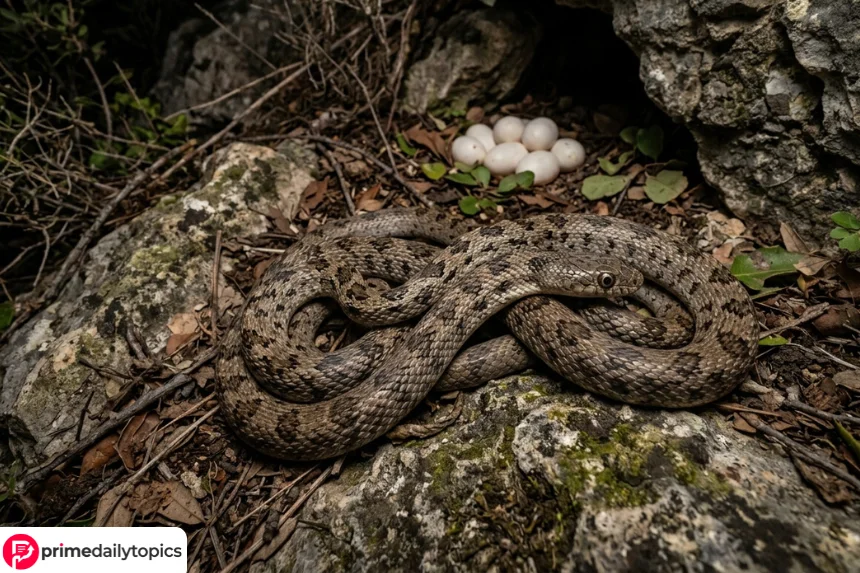
A cat snake reproduces by laying eggs. However, clutch size, nesting location and development time vary between species. Therefore, one species should not be used to define the entire genus.
Mangrove cat snakes provide a well-documented example. Females place their eggs inside protected tree hollows, where the developing young remain hidden from many predators. According to the Smithsonian’s National Zoo, a typical clutch averages about 10 eggs, although recorded clutches range from four to 15. The young hatch after approximately 45 days and measure about 8 inches long.
Unlike green cat snake hatchlings, which may display different colouring from adults, young mangrove cat snakes resemble the adults’ black-and-yellow appearance. Nevertheless, their smaller size makes them more vulnerable to predators and environmental changes.
Where Do Cat Snakes Lay Their Eggs?
The nesting site depends on the species and available habitat. Arboreal cat snakes often select concealed spaces that offer:
- Protection from predators
- Stable temperature and humidity
- Shelter from heavy rain
- Reduced exposure to direct sunlight
- Proximity to suitable habitat for hatchlings
Tree hollows are documented nesting sites for mangrove cat snakes. However, other Boiga species may use different protected spaces. Consequently, the article should not claim that every cat snake lays eggs in trees.
Do Cat Snakes Give Birth to Live Young?
No. Members of Boiga are generally egg-laying snakes rather than live-bearing reptiles. Nevertheless, specific reproductive details remain better documented for some species than others.
For that reason, exact clutch numbers should always be connected to a named species. A statement such as “all cat snakes lay ten eggs” would be inaccurate because clutch size varies.
What Should You Do After a Cat Snake Bite?
A cat snake bite should be treated seriously, even when the species is commonly described as mildly venomous. A person may not identify the snake correctly, and the amount of venom delivered can vary.
Seek emergency medical attention instead of waiting to see whether symptoms appear. In addition, do not drive yourself to a hospital because a snakebite can cause dizziness, weakness or fainting. The CDC recommends remaining calm, removing rings or watches before swelling begins, washing the wound with soap and water and covering it with a clean, dry dressing.
Take these steps:
- Move away from the snake.
- Call 911 or local emergency services.
- Remain as calm and still as possible.
- Remove tight jewellery near the bitten area.
- Wash the wound gently with soap and water.
- Cover it with a clean, dry dressing.
- Note changes in swelling or tenderness.
- Let another person take you for medical care.
A photograph may help with identification. However, take it only from a safe distance. Never approach, trap or kill the snake for a picture.
What Should You Avoid After a Cat Snake Bite?
Several traditional snakebite treatments can worsen the injury. Therefore, do not:
- Apply a tourniquet
- Cut or slash the wound
- Attempt to suck out venom
- Place ice directly on the bite
- Immerse the wound in water
- Apply electric shock
- Use unverified herbal or folk remedies
- Drink alcohol as a painkiller
- Try to capture the snake
The CDC specifically warns against these actions. Moreover, medical help should not be delayed while someone tries to identify the animal.
Medical note: This section provides general safety information, not individual medical advice. Call emergency services or a poison-control professional after any suspected venomous snakebite.
What Symptoms Can Follow a Snakebite?
Symptoms depend on the species, the amount of venom delivered and the person’s response. Possible signs around the wound include puncture marks, pain, redness, swelling, bleeding, bruising or blistering.
Meanwhile, broader symptoms can include nausea, vomiting, weakness, abnormal heart rate, numbness, tingling or breathing difficulty. Severe symptoms require immediate emergency treatment.
Not every cat snake bite produces significant envenomation. Nevertheless, the absence of immediate symptoms does not prove that the bite is harmless.
How Can You Avoid a Cat Snake Bite?
Most snakes bite when they feel threatened, restrained or trapped. Consequently, leaving the animal alone is the most effective safety measure.
When walking through suitable snake habitat:
- Watch branches as well as the ground.
- Use a flashlight after dark.
- Wear closed footwear and long trousers.
- Avoid placing your hands inside tree hollows.
- Do not reach blindly into brush or wood piles.
- Keep children and pets away from unidentified snakes.
- Never pick up a snake that appears dead.
A snake found inside a home should be removed by animal control or a trained wildlife professional. The CDC advises people not to trap or remove wild snakes themselves.
Are Cat Snakes Found in the United States?
Most cat snakes are not native to the continental United States. However, the genus has major U.S. relevance because the brown treesnake is established on Guam, a U.S. territory.
The U.S. Department of Agriculture coordinates an extensive programme to reduce brown treesnake populations and prevent the species from reaching additional destinations. Current measures include traps, trained snake-detector dogs, cargo inspections, nighttime spotlight searches, toxicants and public education.
Therefore, the brown treesnake is more than a wildlife-identification subject. It is also an important example of invasive-species prevention and ecosystem management.
How Can Guam Residents Reduce Brown Treesnake Encounters?
Brown treesnakes may approach buildings when nearby areas provide rodents, lizards, poultry or hiding places. As a result, reducing prey and shelter can make a property less attractive.
USDA APHIS recommends practical precautions such as:
- Keeping doors closed
- Repairing damaged window screens
- Covering outdoor vents and pipes
- Securing pet food and garbage
- Removing dense vegetation beside buildings
- Clearing debris that shelters rodents or lizards
These actions cannot eliminate every encounter. However, they can reduce the food, shelter and entry points that attract snakes.
Why Is Preventing Its Spread Important?
On Guam, the brown treesnake has caused serious ecological and economic harm. APHIS reports that most native forest birds and many native lizards have been lost from the island, while snakes have also caused repeated power disruptions.
Furthermore, wildlife agencies are researching improved traps, attractants, repellents and other management methods. The wider objective is to protect native species, sensitive facilities and other Pacific islands from new introductions.
The Guam example shows why an animal should never be moved or released outside its natural range.
Can a Cat Snake Be Kept as a Pet?
Although some Boiga species appear in the exotic-pet trade, a cat snake is not suitable for an inexperienced reptile keeper. Rear-fanged venom, defensive behaviour, specialised feeding needs and escape risks make responsible care difficult.
The CDC advises people not to keep venomous reptiles in homes. It also recommends researching the animal’s needs, finding a qualified exotic-animal veterinarian and checking state, local, rental and property rules before acquiring any reptile.
A secure enclosure would need to account for the snake’s:
- Climbing behaviour
- Nocturnal activity
- Adult length
- Temperature requirements
- Humidity requirements
- Feeding habits
- Ability to escape through small openings
Moreover, captive reptiles can carry germs even when they appear healthy. Proper hygiene and specialised veterinary care are therefore essential.
Should You Catch a Wild Cat Snake?
No. A wild snake should remain in its natural environment.
Capturing one can cause stress or injury to both the snake and the person. Furthermore, the animal may carry parasites, refuse food or require care that an unprepared owner cannot provide.
The CDC specifically advises against catching wild reptiles to keep as pets.
Can a Pet Cat Snake Be Released Outdoors?
No unwanted reptile should be released into the wild. A released animal may die because it cannot adjust to the local environment. Alternatively, it may survive and harm native wildlife.
The U.S. Fish and Wildlife Service advises owners to rehome unwanted pets rather than releasing them. In many states, releasing a non-native pet is also illegal.
Suitable alternatives include contacting:
- An experienced reptile keeper
- An exotic-animal veterinarian
- A reptile rescue organisation
- A licensed wildlife facility
- The original breeder or seller
Why Are Cat Snakes Important?
Within their natural ranges, cat snakes contribute to functioning food webs. They prey on rodents, lizards, frogs, birds and other small animals. In turn, larger predators may feed on young or adult snakes.
Consequently, native cat snakes can help regulate prey populations. The Smithsonian also highlights the broader ecological value of snakes, including their role in controlling rodents.
However, ecological value depends on location. A predator that performs a normal role within its native habitat may cause severe damage after introduction to an ecosystem that evolved without it.
The brown treesnake demonstrates this difference clearly. In its native range, disease, predators and competition help regulate its numbers. On Guam, those natural controls have not been sufficient.
Are Cat Snakes Endangered?
There is no single conservation status for every cat snake because Boiga contains numerous species with different distributions and population conditions.
Some species occupy broad geographic ranges. In contrast, others have restricted habitats or remain poorly studied. Therefore, conservation status must be checked at the species level rather than applied to the entire genus.
Major pressures may include:
- Forest clearing
- Mangrove destruction
- Agricultural expansion
- Road development
- Illegal wildlife collection
- Persecution caused by fear
- Pollution of rivers and wetlands
Protecting forests, mangroves and healthy waterways benefits cat snakes as well as the prey and predators that share their ecosystems. For example, the Smithsonian recommends reducing pesticide use, limiting excess fertiliser and keeping litter out of storm drains to support healthy mangrove habitats.
Frequently Asked Questions About the Cat Snake
Is a cat snake poisonous or venomous?
A cat snake is venomous, not poisonous. Venom is delivered through a bite, whereas the term poisonous generally describes something harmful when eaten or touched. Members of Boiga possess enlarged rear fangs that help deliver oral secretions to prey.
Can a cat snake kill a human?
The risk differs by species and circumstances. For example, the Smithsonian states that mangrove cat snake venom is not considered lethal to humans, although a bite may cause painful swelling and skin discolouration. Nevertheless, no suspected venomous bite should be dismissed without medical assessment.
Does every cat snake bite inject venom?
Not necessarily. A quick defensive bite may deliver little secretion, whereas a prolonged bite may deliver more. However, a person cannot reliably determine how much venom entered the wound. Therefore, medical help remains the safest response.
Is the brown treesnake a cat snake?
Yes. The brown treesnake, scientifically named Boiga irregularis, belongs to the same genus commonly called cat snakes. It is especially significant because of its invasive population on Guam.
Are cat snakes native to America?
Most Boiga species are native to regions of Asia, Australia and the Pacific rather than the continental United States. However, the brown treesnake has become firmly established on Guam.
Why do cat snakes have vertical pupils?
Their vertical pupils help these mainly nocturnal snakes function in low-light conditions. The pupils also create the cat-like appearance responsible for their common name. The Smithsonian describes this feature clearly in the mangrove cat snake.
Are green cat snakes dangerous?
Green cat snakes are rear-fanged and venomous. Although they are not usually discussed alongside medically dangerous cobras or vipers, they should not be handled. Any bite should receive professional medical assessment.
Do cat snakes live entirely in trees?
No. Many are highly arboreal, but they may descend to hunt, breed or move between areas. Therefore, “tree-dwelling” describes their strong climbing lifestyle rather than permanent residence above the ground.
What attracts cat snakes to homes?
Snakes may approach buildings that provide prey, shelter or access points. Rodents, lizards, poultry, pet food, rubbish, vegetation and debris can make an area more attractive to snakes.
What should you do when you see a cat snake?
Remain at a safe distance and allow it to leave. Keep children and pets away. If it enters a building or creates an immediate risk, contact animal control or a qualified wildlife professional rather than attempting to capture it.
Conclusion
A cat snake is typically a member of the genus Boiga, a diverse group of slender, large-eyed and mostly nocturnal snakes. Although species differ in colour, size and habitat, many share strong climbing abilities and enlarged rear fangs.
These snakes perform valuable ecological roles inside their natural ranges. However, the invasive brown treesnake on Guam demonstrates how serious the consequences can become when a predator reaches an ecosystem without effective natural controls.
Most importantly, people should observe wild cat snakes from a distance. They should never handle an unidentified snake, attempt unverified bite treatments or release a captive reptile outdoors. Instead, responsible observation, prompt medical care and habitat protection offer the safest approach for both people and wildlife.
