



Spoiler warning: This guide discusses major events from Loki: Agent of Asgard and the Loki Season 2 finale.
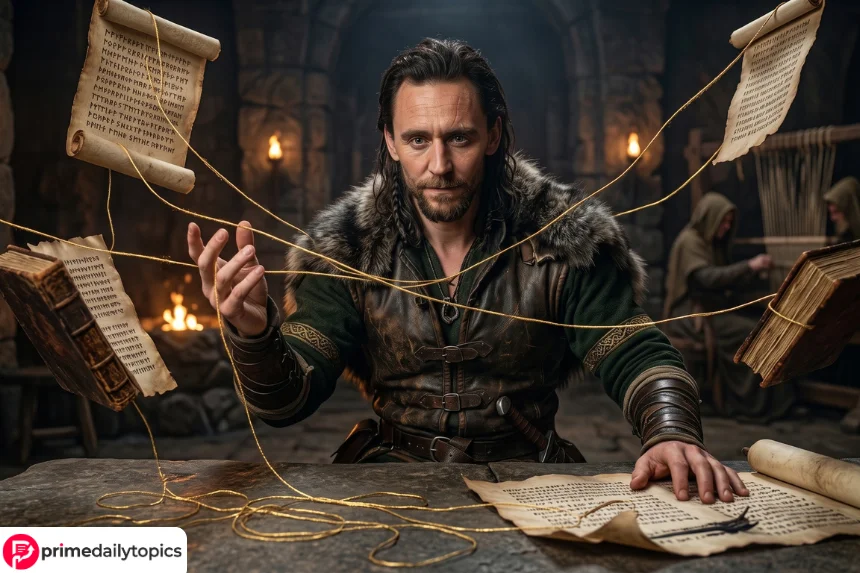
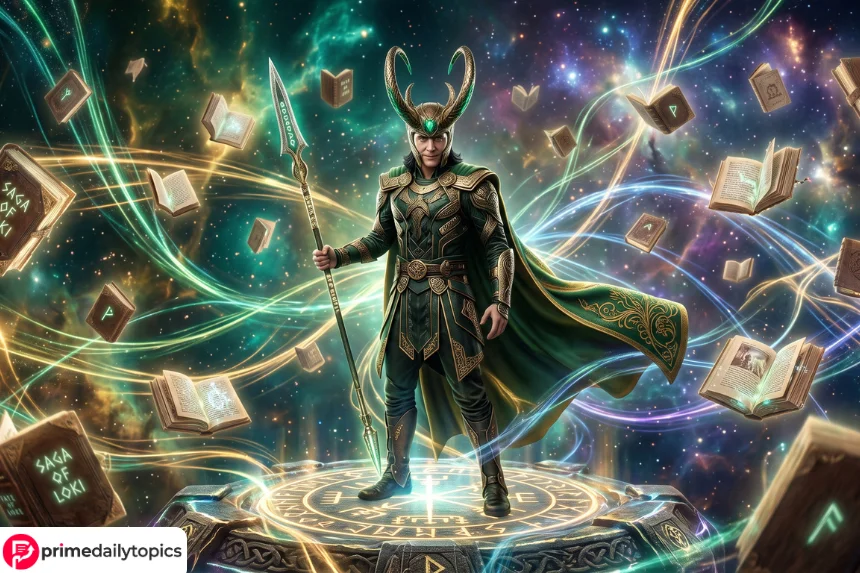
God of Stories Loki is a Marvel Comics identity that represents Loki’s attempt to escape the role of an inevitable villain. Instead of remaining the God of Lies, he recognizes that lies are also stories—and that stories can change.
The transformation occurs during Loki: Agent of Asgard, where Loki confronts his guilt over Kid Loki and a future version of himself known as King Loki. He refuses the two paths others have written for him: returning to villainy or ceasing to exist. Instead, he creates a new identity based on possibility, reinvention, and control over his own narrative.
The concept also helps explain why many fans connect the comic-book God of Stories with Loki’s role at the end of the Disney+ series. However, the comic and MCU versions follow different paths and possess different abilities.
Who Is God of Stories Loki?
God of Stories Loki is the Earth-616 version of Loki who emerges after the events involving Kid Loki, Ikol, the All-Mother, and King Loki. He is not a separate multiverse variant. Instead, the title marks another stage in the main comic character’s long history of death, rebirth, guilt, and reinvention.
This version of Loki had inherited Kid Loki’s body through the actions of Ikol, a magical echo of the older Loki. Although he looked like an older Kid Loki, he carried the memories and moral burden of the Loki who had arranged the takeover.
That history became central to Loki: Agent of Asgard. Loki tried to erase his past crimes by completing secret missions for the All-Mother. Yet he gradually learned that performing heroic acts would not automatically free him from the role everyone expected him to play.
How Did Loki Become the God of Stories?
Loki’s transformation was not caused by a magical artifact, an Infinity Stone, or a formal promotion from another god. It happened when he rejected the belief that his future had already been written.
Kid Loki and Ikol Created the Foundation
The original Loki died during the events surrounding Siege. He later returned as Kid Loki, a younger version who wanted to live differently and become a better person.
However, an echo of the older Loki survived as Ikol. Although Ikol appeared to guide Kid Loki, he eventually manipulated events so he could take over the child’s body and continue living through it.
The resulting Loki was not entirely the old villain or the innocent child. He became a new, guilt-ridden version who remembered what happened and understood that his continued existence came at Kid Loki’s expense.
Loki Became an Agent of Asgard
In Loki: Agent of Asgard, the All-Mother offered to remove one of Loki’s past crimes from Asgard’s records each time he completed a mission.
At first, this arrangement appeared to give Loki a path toward redemption. He worked as Asgard’s secret agent, confronted figures such as Doctor Doom, and formed an important friendship with Verity Willis, a human who could detect lies.
However, Loki eventually had to admit what had happened to Kid Loki. Thor and the other Asgardians rejected him when the truth emerged. His good deeds could not erase the pain caused by his earlier actions.
King Loki Represented an Unwanted Future
King Loki was an older version of the character from a possible future. He had completed his missions and cleared his record, but Asgard still treated him as the God of Lies. Eventually, he returned to villainy and brought destruction to Earth.
King Loki wanted his younger self to accept that outcome. In his view, Loki could change his appearance and behavior, but he could never escape the role of Thor’s enemy.
Verity Willis provided the evidence that challenged this claim. King Loki did not recognize her, which indicated that the future he remembered was no longer fixed. Her presence had already changed Loki’s path.
Loki Chose a Third Path
Loki faced representations of his earlier identities and received two apparent choices: return to his old villainous role or destroy himself.
Instead, he recognized that lies and stories share a basic quality. Both describe something that is not literally present, yet stories can also create meaning, inspire change, and open new possibilities.
Loki therefore rejected his assigned role and rebuilt himself as the God of Stories. The declaration appears in Loki: Agent of Asgard #13, while the remaining issues explore what the identity means as the Marvel Multiverse approaches its collapse during the lead-up to Secret Wars. The series ends with issue #17, published on August 19, 2015.
God of Stories Loki Timeline
| Story stage | What happens | Main reading |
|---|---|---|
| Kid Loki’s new life | A younger Loki tries to reject his predecessor’s crimes | Journey into Mystery |
| Ikol’s takeover | An echo of the older Loki takes Kid Loki’s body | Journey into Mystery and Young Avengers |
| Agent of Asgard | Loki completes missions while trying to change his reputation | Loki: Agent of Asgard #1–12 |
| New identity | Loki rejects King Loki’s predetermined future | Loki: Agent of Asgard #13 |
| Final test | The God of Stories faces King Loki and the death of the Multiverse | Loki: Agent of Asgard #14–17 |
| Later development | Loki serves as the Teller of the Tales and sometimes Thor’s Enemy | Immortal Thor |
Marvel’s official guide describes this journey as Loki’s movement from villain to hero, trickster, and God of Stories rather than a simple conversion from evil to good.
What Does the God of Stories Title Mean?
The title represents Loki’s ability to define himself rather than accept the identity that history, Asgard, or other characters have chosen for him.
Writer Al Ewing explained that changing Loki from the God of Lies to the God of Stories created a more neutral and chaotic character. A lie normally hides or distorts the truth. A story, by contrast, can entertain, preserve memory, offer possibilities, or change how someone understands an event.
Therefore, the transformation has three connected meanings.

Loki Can Change Without Becoming Perfect
Loki does not become a flawless hero after adopting the title. He remains unpredictable, clever, self-interested, and capable of causing problems.
However, his past no longer forces him to repeat the same villainous cycle. He can help Thor in one story and oppose him in another without automatically returning to the exact character he once was.
Loki Rejects Predetermined Roles
King Loki represents the idea that every Loki story must eventually end with betrayal. God of Stories Loki rejects that belief.
He cannot erase everything he has done. Instead, he accepts responsibility while refusing to let guilt become a permanent script for his future.
Stories Become a Form of Power
As the Multiverse collapses, Loki’s connection to stories allows him to preserve meaning beyond the destruction of physical worlds. He protects Verity, challenges beings that feed on Asgard’s repeating cycles, and carries King Loki as a reminder of the person he could still become.
Later comics develop the idea further by presenting Loki as the Teller of the Tales, a figure whose role includes telling, shaping, and sometimes opposing Thor’s story.
God of Stories Loki Powers and Abilities
The title adds a narrative and symbolic dimension to abilities Loki already possessed. However, Marvel has not presented it as a precisely defined power system with fixed rules.
Traditional Loki Abilities
Before becoming the God of Stories, Loki already possessed extensive magical abilities, including:
- Shapeshifting
- Illusion creation
- Asgardian sorcery
- Teleportation and magical travel
- Mental and psionic abilities
- Superhuman longevity and resilience
- Exceptional intelligence and manipulation skills
Marvel describes Loki as a skilled sorcerer who uses magic, intellect, shapeshifting, and illusion-casting against heroes and gods.
Narrative Reinvention
God of Stories Loki can resist attempts to force him into a predetermined identity. His most important achievement is rewriting his personal role from the God of Lies into something broader.
This does not mean he can casually change every event in Marvel history. Rather, the comics show him breaking the narrative pattern that continually returned him to the same form of villainy.
Preserving Stories Beyond Destruction
Near the end of Agent of Asgard, Loki and Verity continue to exist as the Multiverse falls into a blank void. Loki also protects and carries the stories of Asgard during this period.
This feat shows that his power concerns more than conventional illusions. Stories can survive even when the places and people connected to them disappear.
Awareness of Narrative Roles
In Immortal Thor, Loki can take on the aspect of the Teller of the Tales. Al Ewing also describes another aspect called Thor’s Enemy.
This allows Loki to serve as Thor’s ally, narrator, problem, or antagonist according to the mythic role required at that moment. The arrangement preserves Loki’s unpredictability without discarding the character development that produced the God of Stories identity.
Is God of Stories Loki Omnipotent?
God of Stories Loki is extremely powerful, but the comics do not establish him as an unlimited or all-powerful being.
Some discussions interpret narrative power as the ability to rewrite any part of reality without restriction. However, the published stories show something more focused. Loki can change his role, work with the magic of stories, resist a predetermined future, and preserve narratives during cosmic destruction.
His abilities still operate within a specific story and can face opposition, conditions, and consequences. Therefore, claims that he can defeat every Marvel character simply by rewriting them go beyond what the cited comics clearly demonstrate.
God of Stories vs. God of Mischief and God of Lies
| Loki title | Main meaning | Effect on the character |
| God of Mischief | Trickery, disruption, schemes, and chaos | Describes Loki’s classic role and behavior |
| God of Lies | Deception and the distrust created by his past | Connects Loki to a restrictive villain identity |
| God of Stories | Possibility, interpretation, memory, and reinvention | Allows Loki to change while remaining unpredictable |
| Teller of the Tales | Narrator and participant in Thor’s continuing myth | Gives Loki a later role in Immortal Thor |
These identities can overlap. Loki does not lose his talent for mischief when he becomes the God of Stories. Instead, the newer title gives his tricks and deceptions a wider purpose.
Is MCU Loki the God of Stories?
The Loki seen at the end of the Disney+ series has strong similarities to the comic-book God of Stories. However, Marvel Studios has not clearly presented the phrase as his formal onscreen title.
In the Season 2 finale, Loki realizes that the Temporal Loom cannot safely preserve every branching timeline. He destroys the Loom, gathers the branches himself, and takes a position where he can sustain them. His final choice changes “glorious purpose” from a desire for power into a sacrifice that gives other people freedom and a future.
The image of Loki holding branching timelines resembles a living version of Yggdrasil, the world tree from Norse tradition. Because he now protects countless timelines and their histories, the God of Stories comparison fits thematically.
Still, the two versions are not identical.
| Comic-book Loki | MCU Loki |
| Escapes a predetermined villain identity | Escapes the path created by He Who Remains |
| Draws power from stories and narrative roles | Masters time-slipping and sustains timelines |
| Becomes the God of Stories during Agent of Asgard | Takes a multiversal throne in the Season 2 finale |
| Continues shifting between ally and antagonist | Makes a largely selfless sacrifice for free will |
| Exists in Marvel’s Earth-616 comic continuity | Belongs to the Marvel Cinematic Universe |
Interestingly, Al Ewing stated that he had heard the God of Stories concept reached a writers’ room whiteboard. However, that comment confirms creative awareness rather than proving that the comic and television versions possess identical powers.
Is God of Stories Loki Stronger Than Thor?
God of Stories Loki is not simply a stronger version of Thor. Their abilities serve different purposes.
Thor usually holds the advantage in direct physical combat. He possesses immense strength, endurance, weather control, and the power associated with Mjolnir or other divine forces.
Loki relies more heavily on intelligence, sorcery, transformation, deception, and narrative influence. Therefore, he may succeed in situations that cannot be solved through physical power alone.
Immortal Thor continues to place Thor at the center while giving Loki an important supporting and antagonistic role. Ewing describes the relationship by suggesting that the answer to whether Loki is Thor’s friend or enemy is effectively both.
Essential God of Stories Loki Reading Order
Readers who only want the central transformation can begin with Loki: Agent of Asgard. However, the earlier material adds emotional weight.
1. Journey into Mystery
Kieron Gillen’s Journey into Mystery run introduces Kid Loki and explains why he wanted to escape the original Loki’s reputation.
2. Young Avengers
The 2013 Young Avengers series follows Loki after the events involving Ikol and Kid Loki. It also shows the guilt and identity problems that lead into his next series.
3. Loki: Agent of Asgard #1–17
This is the essential God of Stories Loki series. Al Ewing wrote the complete run, with Lee Garbett serving as its principal artist.
Issue #13 contains Loki’s transformation and declaration. Issues #14–17 explore the new identity during the final days before Secret Wars.
4. Original Sin Tie-In Issues
The Original Sin material involving Thor and Loki adds context about Angela, the Tenth Realm, and Loki’s work for Asgard. It is useful but not required to understand the central transformation.
5. Immortal Thor
Immortal Thor develops Loki’s later function as the Teller of the Tales and Thor’s Enemy. It also shows how the character can operate as both an ally and antagonist without erasing the God of Stories development.
Marvel also published a Loki: God of Stories Omnibus in 2023. It collects Loki: Agent of Asgard alongside several other modern Loki stories.
Frequently Asked Questions
What issue does Loki become the God of Stories?
Loki declares himself the God of Stories in Loki: Agent of Asgard #13. The transformation and its consequences continue through issue #17.
Is God of Stories Loki canon?
Yes. God of Stories Loki belongs to Marvel’s main Earth-616 comic continuity. Later stories continue to recognize Loki’s connection to stories and narrative roles.
Is God of Stories Loki a different Loki variant?
No. The identity develops from the Loki connected to Ikol, Kid Loki, and Agent of Asgard. His complicated history can make him feel like a separate version, but he remains part of Earth-616 continuity.
Can God of Stories Loki rewrite reality?
He can influence stories, resist predetermined roles, preserve narratives, and use powerful magic. However, the comics do not prove that he can rewrite all reality without limits.
Did Loki become the God of Stories in the MCU?
The MCU finale gives Loki a role that resembles the God of Stories, but the episode does not formally establish the comic-book title. MCU Loki primarily controls and sustains branching timelines.
Is the God of Stories title from Norse mythology?
No. The specific title belongs to Marvel Comics. It reflects Marvel’s modern interpretation of Loki as a changing, self-aware trickster rather than a traditional title from surviving Norse accounts.
Conclusion
God of Stories Loki represents more than an increase in power. The identity allows Loki to acknowledge his past without accepting that he must repeat it forever.
By turning lies into stories, Loki changes from a character trapped by one familiar role into someone who can create new possibilities. The comic version focuses on identity and narrative freedom, while the MCU version reaches a similar theme through time, sacrifice, and the protection of branching lives.
Discover more about What Must an Entrepreneur Assume When Starting a Business
