



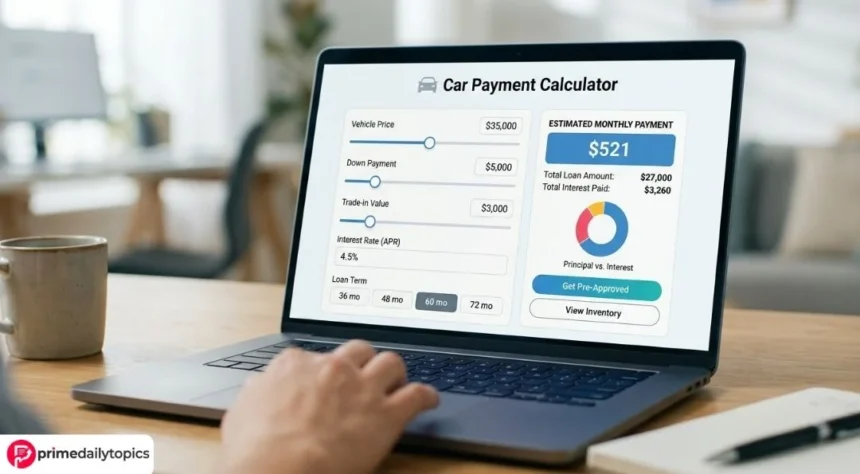
A car payment calculator estimates how much you may pay each month for an auto loan. Enter the vehicle’s out-the-door price, down payment, trade-in credit, loan term, and annual percentage rate (APR) to compare financing options before visiting a dealership.
Your result is only an estimate. The payment stated in your final loan agreement may differ because of taxes, registration costs, lender fees, optional products, trade-in debt, and the rate for which you qualify.
Information needed to calculate a car payment
For a useful estimate, gather the following figures:
| Calculator input | What to enter |
|---|---|
| Vehicle price | The negotiated price before subtracting a down payment or trade-in |
| Sales tax | The applicable state and local vehicle tax |
| Fees | Title, registration, documentation, destination, and other charges |
| Down payment | Cash paid at the beginning of the purchase |
| Trade-in value | The agreed credit for your current vehicle |
| Trade-in loan balance | Any amount you still owe on the vehicle being traded |
| APR | The annual percentage rate offered by the lender |
| Loan term | The repayment period, usually stated in months |
| Add-ons | Any warranty, GAP product, or other optional item being financed |
Ask the seller for the out-the-door price, which includes the vehicle price, taxes, and fees before financing. The Federal Trade Commission’s car-financing guidance recommends obtaining this figure in writing so that offers can be compared on the same basis.
How a car payment is calculated
First, estimate the amount that must be financed:
Amount financed = Vehicle price + taxes + fees + financed add-ons − down payment − net trade-in credit
Net trade-in credit is the trade-in value minus any outstanding loan balance. If you owe more than the vehicle is worth, the difference is called negative equity. Rolling that debt into the new loan increases the amount financed.
For a standard fixed-rate amortizing loan, the estimated monthly payment is:
Monthly payment = P × [r(1 + r)ⁿ] ÷ [(1 + r)ⁿ − 1]
In this formula:
- P is the principal or amount financed.
- r is the monthly interest rate, calculated by dividing the annual rate by 12.
- n is the total number of monthly payments.
Most borrowers do not need to calculate this manually. The formula is useful, however, for understanding why the principal, rate, and term all affect the result.
Car payment calculation example
Suppose a buyer is considering these terms:
| Item | Amount |
|---|---|
| Vehicle price | $30,000 |
| Estimated taxes | $2,400 |
| Fees | $600 |
| Down payment | $3,000 |
| Net trade-in credit | $2,000 |
| Amount financed | $28,000 |
| APR | 6.5% |
| Loan term | 60 months |
Under these assumptions, the estimated payment is approximately $548 per month. Over 60 months, the borrower would pay about $32,870, including roughly $4,870 in interest.
The estimate excludes fuel, insurance, maintenance, repairs, parking, and other ownership expenses. Rounding may also cause small differences between calculator results and a lender’s repayment schedule.
How APR affects your payment
APR represents the yearly cost of credit, including the interest rate and certain required fees. It is not necessarily identical to the loan’s stated interest rate.
According to the Consumer Financial Protection Bureau’s explanation of auto-loan disclosures, lenders and dealers must disclose information such as the APR, finance charge, amount financed, total of payments, and monthly payment before a borrower signs the contract.
When comparing offers, use APR against APR rather than comparing one lender’s APR with another lender’s interest rate.
Using the same $28,000, 60-month loan, different rates produce substantially different results:
| APR | Estimated monthly payment | Estimated total interest |
|---|---|---|
| 4% | $516 | $2,940 |
| 6.5% | $548 | $4,870 |
| 9% | $581 | $6,870 |
| 12% | $623 | $9,370 |
These figures are estimates for illustration and assume a conventional fixed-rate loan with equal monthly payments.
How the loan term changes the total cost
A longer term generally reduces the required monthly payment because repayment is spread across more months. It usually increases total interest, however, because the balance remains outstanding longer.
For example, financing $28,000 at 6.5% produces approximately these results:
| Loan term | Estimated payment | Estimated total interest |
|---|---|---|
| 36 months | $858 | $2,890 |
| 48 months | $664 | $3,890 |
| 60 months | $548 | $4,870 |
| 72 months | $471 | $5,890 |
A 72-month loan saves about $77 per month compared with the 60-month option, but it adds roughly $1,020 in estimated interest. It also keeps the borrower in debt for another year.
The CFPB advises consumers to compare the amount financed, APR, term, monthly payment, and total cost—not the payment alone. Its auto-loan comparison guidance also notes that longer terms can increase the risk of owing more than the vehicle is worth.
Costs a basic calculator may miss
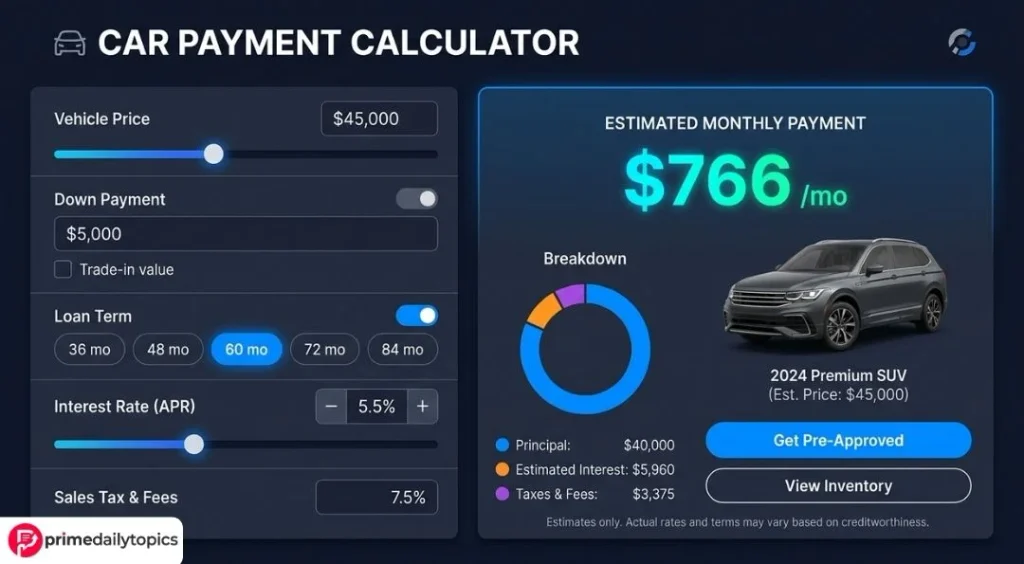
A calculator is only as accurate as its inputs. Commonly omitted costs include:
- State and local sales taxes
- Title and registration charges
- Dealer documentation or processing fees
- Destination and delivery charges
- Extended warranties or service contracts
- GAP products and credit insurance
- Dealer-installed accessories
- Negative equity from a trade-in
- Lender origination or other required charges
Optional products can raise both the principal and the interest paid. For example, adding a $2,000 product to a five-year loan at 6.5% adds approximately $39 to the monthly payment and about $348 in interest.
Ask for the price of each product separately, confirm whether it is optional, and calculate its cost over the entire loan term.
How to lower a potential car payment
Several changes can reduce the estimated payment:
- Negotiate a lower out-the-door price. A smaller purchase price reduces the amount financed directly.
- Make a larger down payment. Borrowing less generally lowers both the payment and total interest.
- Compare multiple lenders. Banks, credit unions, online lenders, and dealership financing may offer different terms.
- Improve your credit before applying. Credit history can influence the rate offered, although lenders use different approval models.
- Choose a less expensive vehicle. This can also reduce sales tax, insurance, and depreciation exposure.
- Decline unwanted add-ons. Financing optional products increases the loan balance.
- Use a shorter term when affordable. The payment may rise, but total interest usually falls.
A down payment should not consume money needed for emergencies, insurance, registration, or immediate repairs. Affordability depends on the buyer’s complete budget, not solely on whether a lender approves the application.
Review the final loan disclosure
Before signing, compare the calculator estimate with the written financing documents. Check the:
- APR
- Amount financed
- Finance charge
- Number and amount of payments
- Total of payments
- Optional products
- Late-payment terms
- Prepayment conditions
- Vehicle’s final cash and financed prices
Do not assume that a familiar monthly payment means the agreement matches the negotiated deal. A seller can reach a target payment by extending the term, increasing the down payment, or including a final structure that costs more overall.
Frequently asked questions
Does a car payment include insurance?
No. A standard auto-loan payment generally covers principal, interest, and any products financed through the contract. Auto insurance is normally a separate expense, although lenders typically require adequate coverage.
What credit score is needed for a car loan?
There is no single universal minimum. Requirements and rates vary among lenders, and approval can also depend on income, existing debts, down payment, loan amount, and vehicle age.
Are car payment calculator results exact?
No. Results are estimates based on the numbers entered. The lender’s calculation, payment timing, fee treatment, rounding method, and final contract terms can produce a different amount.
Is a lower monthly car payment always better?
Not necessarily. A lower payment achieved through a longer term may lead to substantially more interest and a longer period of negative equity. Compare the total of payments and finance charge as well as the monthly amount.
What happens if I trade in a car with an outstanding loan?
The existing balance must be paid as part of the transaction. If the trade-in value exceeds the payoff amount, the difference can reduce the new loan. If the payoff is higher, the resulting negative equity may be paid in cash or added to the new amount financed.
Read More Prime Daily Topics
