



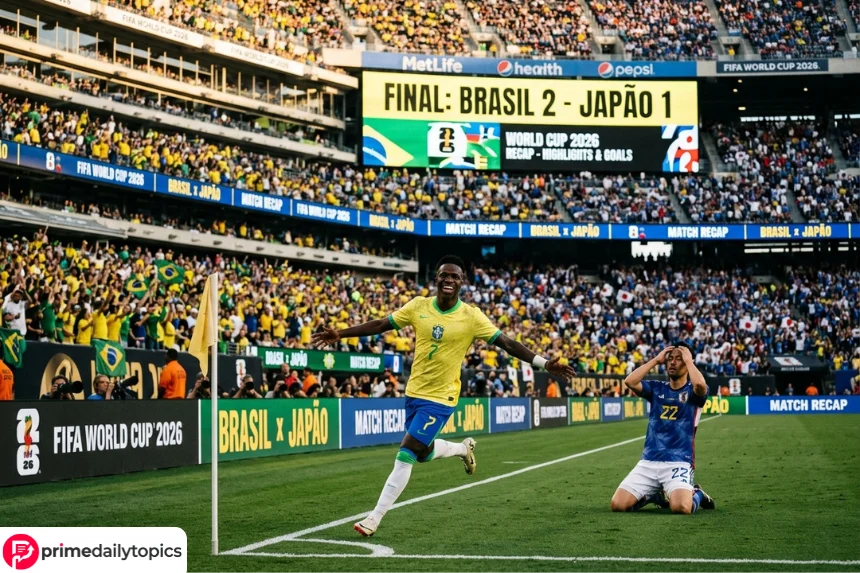
Brasil x Japão ended in a dramatic 2-1 comeback victory for Brazil on June 29, 2026, in Houston, Texas. Japan took the lead through Kaishu Sano in the 28th minute, but Casemiro equalized early in the second half before substitute Gabriel Martinelli scored the winning goal in stoppage time. The victory sent Brazil into the Round of 16 of the 2026 FIFA World Cup.
The match tested Brazil in a way the previous group-stage victories had not. Japan defended with discipline, protected central areas, and threatened on the counterattack. Nevertheless, Carlo Ancelotti’s team remained patient after falling behind and eventually found the attacking solutions it needed.
FIFA named Casemiro the Player of the Match after his equalizing goal and influential midfield performance. Meanwhile, Martinelli emerged from the bench to decide the contest at 90+4 and keep Brazil’s World Cup campaign alive.
Brasil x Japão: Final Result
The final score was Brazil 2-1 Japan.
Japan struck first through Kaishu Sano after 28 minutes. As a result, Brazil entered halftime trailing 1-0 despite controlling much of the ball.
The second half looked very different.
Brazil increased its presence inside the Japanese penalty area and attacked with greater urgency. Casemiro headed in the equalizer after a Gabriel Magalhães cross.
Still, a draw would not settle a knockout match.
Ancelotti then introduced fresh attacking options, including Endrick and Gabriel Martinelli. Deep into stoppage time, Brazil recovered possession high up the field before Bruno Guimarães released Martinelli.
The substitute finished calmly and completed the comeback.
Therefore, Brazil advanced with a 2-1 victory rather than facing extra time.
Brasil x Japão Quick Match Facts
| Match detail | Information |
|---|---|
| Match | Brazil 2-1 Japan |
| Date | June 29, 2026 |
| Competition | FIFA World Cup 2026 |
| Stage | Round of 32 |
| Venue | Houston Stadium / NRG Stadium |
| City | Houston, Texas |
| Japan scorer | Kaishu Sano |
| Brazil scorers | Casemiro, Gabriel Martinelli |
| Sano goal | 28′ |
| Casemiro goal | 54′ |
| Martinelli goal | 90+4′ |
| Player of the Match | Casemiro |
| Attendance | 68,777 |
| Brazil coach | Carlo Ancelotti |
| Result | Brazil advanced to the Round of 16 |
The official CBF match record confirms the score, scorers, attendance, starting lineups, substitutions and timing of the three goals.
How the World Cup Knockout Match Unfolded
Brazil entered the knockout stage after winning Group C.
Ancelotti’s side had drawn with Morocco before beating Haiti and Scotland 3-0. Japan, meanwhile, reached the Round of 32 after finishing second in Group F.
From the opening minutes, Brazil tried to establish control.
Japan did not respond by pressing recklessly. Instead, Hajime Moriyasu’s team defended compactly and tried to close the spaces Brazil wanted to use between the lines.
That approach frustrated the South American side.
Rather than finding clear central combinations, Brazil often needed to circulate the ball from one side to the other.
Japan then punished Brazil with a goal in the first half.
Brasil x Japão Started With Brazil in Possession
Brazil controlled much of the early territory.
Casemiro and Bruno Guimarães worked behind Lucas Paquetá, while Vinícius Jr., Rayan and Matheus Cunha occupied the attacking positions.
However, possession alone did not produce enough clear chances.
Japan protected its penalty area with numbers.
That structure forced Brazil to play around the defensive block instead of through it.
At the same time, Japan remained ready to counter when possession changed hands.
The tactical battle required patience from Ancelotti’s players.
Even so, Japan found the first major breakthrough.
Kaishu Sano Put Japan Ahead
Kaishu Sano scored Japan’s goal in the 28th minute.
The opener transformed the match.
Before scoring, Japan could remain patient and wait for counterattacking opportunities. After taking the lead, the Asian side had an even stronger reason to protect space and defend deeply.
Brazil suddenly faced both a tactical and psychological test.
A knockout game leaves less room for mistakes than a group-stage match.
Therefore, Ancelotti’s team could not allow frustration to dictate its decisions.
Japan reached halftime with a 1-0 advantage, leaving Brazil 45 minutes away from elimination.
Brasil x Japão Changed After Halftime
Ancelotti did not ask Brazil to abandon its identity.
Instead, he demanded more presence inside the penalty area.
FIFA’s post-match analysis noted that Japan defended in a compact 5-4-1 structure, which limited central space. Brazil consequently needed more bodies in the box and greater use of crosses.
The adjustment quickly produced better pressure.
Brazil began forcing Japan deeper.
Gabriel Magalhães also became more adventurous in possession.
That willingness from a center-back eventually created the equalizer.
Nine minutes into the second half, Brazil finally broke through.
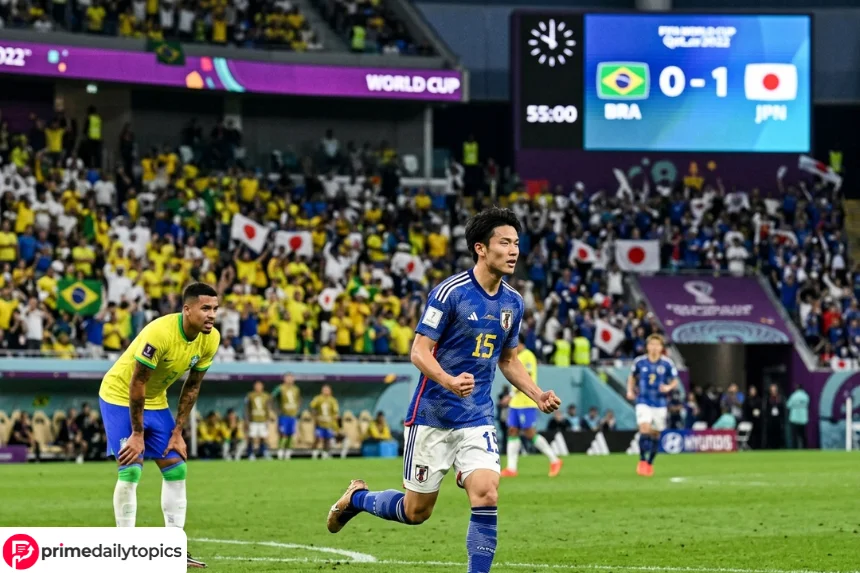
Goals From Brasil x Japão
The three goals told the story of the match.
Japan’s opener rewarded its disciplined first-half plan.
Casemiro’s equalizer reflected Brazil’s tactical adjustment after halftime.
Finally, Martinelli’s stoppage-time winner rewarded Brazil for maintaining pressure until the end.
Each goal changed the emotional direction of the knockout tie.
Japan Opened Brasil x Japão Through Sano
Sano’s first-half goal gave Japan a genuine chance to eliminate Brazil.
The timing mattered.
By scoring before the half-hour mark, Japan gained plenty of time to settle into an even more compact defensive shape.
Brazil now needed to take greater attacking responsibility.
However, rushing would have played into Japan’s hands.
Ancelotti’s side therefore continued moving the ball and searching for a weakness.
The challenge was clear: Brazil needed to create openings without becoming vulnerable to another Japanese counterattack.
That balance shaped the rest of the contest.
Casemiro Equalized Brasil x Japão
Casemiro brought Brazil level early in the second half.
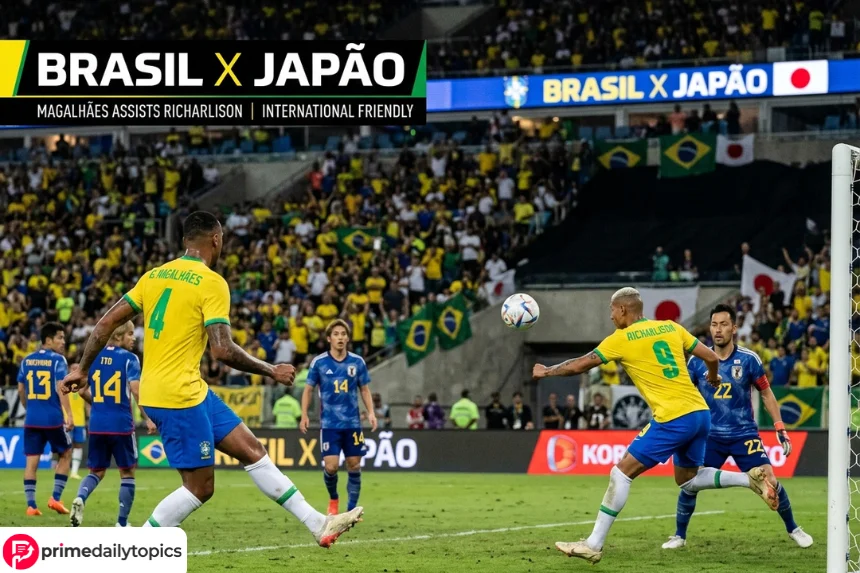
Vinícius Jr. moved the ball to Gabriel Magalhães near the attacking area.
Instead of recycling possession, the Arsenal center-back looked up and delivered a precise cross.
Casemiro attacked the space and headed the ball into the net.
FIFA later highlighted Gabriel Magalhães’ creative contribution, noting how unusual and effective it was for a center-back to supply the decisive cross.
More importantly, the goal changed Brazil’s emotional state.
The team no longer needed to chase an equalizer.
With the score at 1-1, Brazil could focus entirely on finding the winner.
Gabriel Martinelli Won Brasil x Japão
Martinelli entered during the second half for Matheus Cunha.
The substitution became decisive.
As the match entered stoppage time, Brazil continued pressing rather than settling immediately for extra time.
Rayan regained possession in an advanced area and moved the ball toward Bruno Guimarães.
The midfielder then found Martinelli in a dangerous position.
Martinelli placed his finish into the corner and made the score 2-1.
The goal arrived at 90+4 according to the official CBF match record.
FIFA later described Martinelli as Brazil’s “super-sub” after the goal secured progression to the Round of 16.
Casemiro Was the Key Figure
Martinelli scored the winner, but FIFA selected Casemiro as Player of the Match.
His influence went beyond the equalizing goal.
Casemiro helped Brazil maintain its structure when Japan threatened on transitions.
He also provided leadership while the team trailed.
That experience became especially important because knockout football can quickly create panic.
Instead of forcing every attack, Brazil continued moving Japan’s defensive block.
Casemiro later explained that the team needed calm because Japan defended deeply and waited for opportunities to counter.
His equalizer then rewarded that patience.
Therefore, his performance combined leadership, tactical discipline and a decisive attacking contribution.
Brasil x Japão and Gabriel Magalhães’ Assist
Gabriel Magalhães played as a center-back, yet one of Brazil’s most creative moments came from his left foot.
After Brazil recycled possession around Japan’s penalty area, Gabriel received the ball in an advanced position.
Many defenders would have chosen a simple pass.
Instead, he delivered an accurate cross toward Casemiro.
The midfielder headed in the equalizer.
That moment demonstrated why attacking variety matters against a low block.
Japan expected Brazil’s forwards and midfielders to create most of the danger.
A center-back stepping forward changed the picture.
FIFA specifically highlighted Gabriel’s playmaking ability after the game.
Martinelli Became the Perfect Substitute
Martinelli had to wait for his opportunity.
Ancelotti started Matheus Cunha in attack, while Martinelli began on the bench.
During the second half, the coach needed a different type of threat.
Martinelli brought fresh acceleration.
Japan’s defenders had already spent much of the game moving laterally and protecting their box.
A fast substitute could therefore attack tired legs.
The winning goal showed the value of that decision.
Martinelli remained composed when Bruno Guimarães gave him the chance.
Rather than striking wildly under pressure, he placed the ball into the corner.
That finish turned a strong substitute appearance into one of Brazil’s defining moments of the tournament.
Brasil x Japão Tested Ancelotti’s Patience
The game became one of Ancelotti’s toughest tests with Brazil.
His team trailed at halftime in a World Cup knockout match.
A manager could easily respond by making several desperate changes.
Ancelotti chose a calmer approach.
According to FIFA, players later emphasized how the coach’s composure helped them believe the comeback would arrive.
The tactical message also remained clear.
Brazil needed greater presence in Japan’s penalty area without losing balance behind the ball.
That plan eventually worked.
Casemiro equalized early enough to give Brazil time.
Afterward, Ancelotti gradually added attacking options.
Martinelli then decided the contest.
Why Japan’s 5-4-1 Caused Problems
Japan’s shape made central combinations difficult.
When Brazil approached the final third, the defensive line stayed compact.
Four midfielders also protected the areas directly in front of that back line.
Consequently, Brazil’s attackers had little space between defenders.
FIFA reported that Bruno Guimarães described the center as congested and explained that Brazil needed to become more imposing inside the penalty area after halftime.
That tactical lesson matters.
Technical superiority does not automatically create chances against a well-organized opponent.
Sometimes the solution requires width, crosses and extra runners into the box.
Brazil eventually adapted.
Brasil x Japão Showed Brazil’s Mental Strength
The comeback revealed an important psychological quality.
Brazil had produced comfortable 3-0 wins over Haiti and Scotland before facing Japan.
Neither game required the team to overturn a deficit.
Japan created a completely different situation.
Brazil entered halftime behind and potentially faced elimination.
Still, the players avoided panic.
They returned with greater intensity while keeping their structure.
Casemiro’s equalizer provided belief.
Martinelli’s late winner completed the response.
Therefore, the 2-1 result offered more than qualification.
It showed that Ancelotti’s team could respond when a World Cup match turned against it.
Brasil x Japão Starting Lineups
Brazil and Japan both used experienced players alongside younger attacking options. The official CBF technical sheet provides the full starting teams and substitutions.
| Brazil | Japan |
|---|---|
| Alisson | Zion Suzuki |
| Danilo | Shogo Taniguchi |
| Marquinhos | Ritsu Doan |
| Gabriel Magalhães | Daizen Maeda |
| Douglas Santos | Keito Nakamura |
| Casemiro | Junya Ito |
| Bruno Guimarães | Daichi Kamada |
| Lucas Paquetá | Ayase Ueda |
| Rayan | Hiroki Ito |
| Matheus Cunha | Takehiro Tomiyasu |
| Vinícius Jr. | Kaishu Sano |
Carlo Ancelotti coached Brazil, while Hajime Moriyasu led Japan.
Brazil later introduced Endrick, Gabriel Martinelli, Fabinho and Danilo Santos among its changes.
Substitutions Changed Brasil x Japão
The bench became increasingly important during the second half.
Ancelotti introduced Endrick at halftime for Lucas Paquetá.
Later, Martinelli replaced Matheus Cunha.
Those changes increased Brazil’s attacking presence.
Endrick provided a more direct threat around the penalty area.
Martinelli added speed and movement from a fresh position.
Eventually, the latter produced the winning goal.
Casemiro later praised the quality of Brazil’s squad and highlighted how substitutes maintained the team’s level.
That depth becomes crucial during a World Cup.
Knockout matches rarely follow a perfect plan for all 90 minutes.
Coaches need alternatives.
Against Japan, Brazil found them.
Rayan’s Role in the Winning Goal
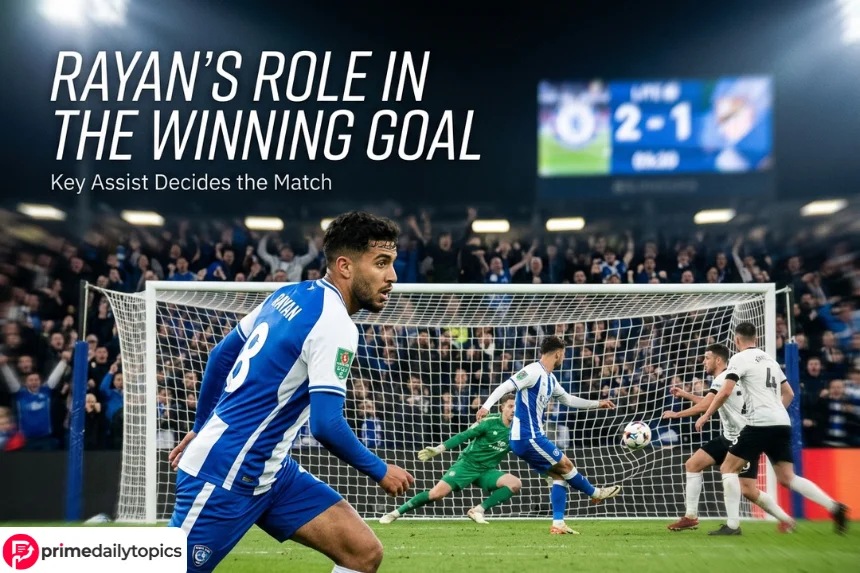
Rayan did not score, but he contributed to the decisive sequence.
Japan tried to play out during stoppage time.
Rayan pressured the ball and helped Brazil recover possession high up the field.
That recovery prevented Japan from resetting its defensive structure.
The ball quickly reached Bruno Guimarães.
From there, Brazil attacked an unsettled defense rather than another organized 5-4-1 block.
Martinelli received the final pass and scored.
Therefore, the winning goal began with collective pressure rather than only the final shot.
This detail fits Ancelotti’s broader emphasis on controlling matches without the ball as well as with it.
Brasil x Japão and Bruno Guimarães’ Influence
Bruno Guimarães played an important role throughout the game.
Japan’s compact midfield required Brazil to circulate possession carefully.
Bruno helped connect different areas and maintained the tempo.
Later, he became directly involved in the winning goal.
After Rayan recovered the ball, Bruno recognized Martinelli’s position and released him quickly.
The decision mattered because Japan had not yet rebuilt its defensive block.
A slower pass would have allowed defenders to recover.
Instead, Brazil attacked immediately.
That combination of patience for most of the match and speed when the opening appeared was crucial.
Brazil Needed More Players in the Box
One of the clearest halftime adjustments involved penalty-area occupation.
During the first half, Brazil sometimes circulated the ball without enough targets near Japan’s goal.
Crossing becomes less effective when only one attacker waits inside.
After halftime, the approach changed.
More Brazilian players attacked the penalty area.
Casemiro’s goal illustrated the difference perfectly.
A holding midfielder became an additional aerial target while Gabriel Magalhães supplied the cross.
Ancelotti later described the match as one in which Brazil searched for solutions after encountering first-half problems.
The change gave Japan more players to track and created new spaces.
What Brasil x Japão Revealed About Brazil
The victory exposed both strengths and weaknesses.
Brazil showed patience.
The team also demonstrated squad depth and resilience.
However, Japan revealed that compact opponents could slow Brazil’s central attacking play.
That information mattered for the next stages.
World Cup knockout opponents study previous matches carefully.
A future rival could attempt the same low-block strategy.
Therefore, Ancelotti needed to keep developing solutions through crosses, wide combinations, midfield runs and movement from defenders.
The Japan match proved Brazil could solve the problem.
Still, the fact that the winner came in stoppage time showed how demanding the challenge had been.
Brazil’s Road to Brasil x Japão
Brazil reached the Round of 32 as Group C winner.
The campaign began with a 1-1 draw against Morocco.
After that, Brazil defeated Haiti 3-0 and Scotland 3-0.
Those seven points put Ancelotti’s team first in the group.
Japan finished second in Group F.
The Japanese campaign included a 2-2 draw against the Netherlands, a 4-0 victory over Tunisia and a 1-1 draw with Sweden.
Therefore, Japan entered the knockout game with evidence that it could score and compete against strong opposition.
The tight contest in Houston should not have surprised Brazil.
Brasil x Japão and the 2025 Friendly
The 2026 World Cup meeting carried extra context because Brazil had lost to Japan only months earlier.
On October 14, 2025, Japan defeated Brazil 3-2 in a friendly.
That result marked Japan’s first senior victory over Brazil. CBF’s record of Ancelotti’s matches confirms the 3-2 loss as part of his early tenure.
The World Cup game therefore offered Brazil a chance to respond on a far bigger stage.
Unlike the friendly, the Houston match carried immediate elimination consequences.
Japan again caused serious problems and even took the lead.
This time, however, Brazil recovered and won.
The contrast added another layer to the rivalry.
Why the 2025 Loss Did Not Predict 2026
Football results depend heavily on context.
A friendly allows experimentation.
A World Cup knockout game creates completely different tactical and psychological pressure.
Personnel can also change.
Therefore, Japan’s 3-2 win in 2025 did not guarantee another victory in 2026.
Still, it gave Brazil a warning.
Japan had already shown that it could punish mistakes and compete technically.
The World Cup match confirmed that threat.
Sano’s opening goal put Brazil in danger once again.
However, Ancelotti’s team managed the setback better this time.
That improvement mattered more than simply reversing the previous scoreline.
Houston Stadium and the World Cup Atmosphere
Brazil played Japan at Houston Stadium, also known outside FIFA tournament naming conventions as NRG Stadium.
CBF reported that the venue has a capacity close to 69,000 and hosted several World Cup matches.
The official attendance for Brazil-Japan reached 68,777.
That created a major-event atmosphere.
Brazil had already played group games in other American cities, but the Houston contest carried knockout pressure.
Every mistake mattered more.
The late winner consequently produced one of the biggest Brazilian celebrations of the tournament.
Brasil x Japão Became Ancelotti’s 10th Brazil Win
The victory also marked a coaching milestone.
CBF recorded the Japan result as Carlo Ancelotti’s 10th victory in charge of Brazil.
It came in his 16th match as national-team coach.
The statistic itself was less important than the setting.
Ancelotti had won major knockout matches throughout his club career.
However, this was his first World Cup elimination match as Brazil coach.
Trailing 1-0 at halftime made the challenge even greater.
The successful comeback therefore strengthened confidence in his ability to manage high-pressure international games.
Why Casemiro’s Leadership Mattered
Casemiro’s role became particularly important after Japan scored.
Brazil needed urgency without losing organization.
As the holding midfielder, Casemiro had to balance both priorities.
He also carried a yellow card during the match.
Ancelotti could have removed him to reduce risk.
Instead, the coach trusted his experience.
That choice paid off.
Casemiro moved forward at the right moment and scored the equalizer.
FIFA and CBF later emphasized his leadership and calm under pressure.
A younger team can benefit enormously from that type of presence during knockout football.
Brasil x Japão Showed the Value of Patience
Brazil could have become desperate after halftime.
Instead, the team continued trying to move Japan’s defensive block.
That patience eventually produced the equalizer.
Even after reaching 1-1, Brazil did not simply launch uncontrolled attacks.
The players continued building pressure.
Japan remained dangerous enough on the counter to punish careless positioning.
Therefore, Brazil needed both ambition and caution.
The winning goal arrived because the team stayed alert until the final seconds.
Rayan pressed.
Bruno Guimarães recognized the opening.
Martinelli finished.
The sequence rewarded persistence rather than desperation.
What Brazil Could Improve After the Match
A comeback win creates excitement, but Brazil still had areas to improve.
First, the team struggled to create clear central chances against Japan’s low block.
Second, conceding the first goal placed unnecessary pressure on the second half.
Brazil also needed to generate more penalty-area presence earlier.
Ancelotti recognized these issues and praised the team for finding solutions rather than pretending the first half had been perfect.
That response is important.
A World Cup champion usually needs several ways to win.
Some opponents offer space.
Others defend deep.
Japan showed Brazil that technical quality alone would not always open a compact defense.
What Happened After Brasil x Japão
The victory moved Brazil into the Round of 16.
Initially, the team had to wait for the winner of Norway versus Ivory Coast.
Norway then won 2-1 and became Brazil’s next opponent.
CBF confirmed that Brazil would face Norway on July 5 in New Jersey.
That match ultimately ended Brazil’s World Cup campaign.
Norway defeated Brazil 2-1 in the Round of 16, with Neymar scoring Brazil’s late goal from the penalty spot.
Therefore, the comeback against Japan became Brazil’s final victory of the 2026 World Cup.
Why Brasil x Japão Still Matters
The later elimination does not erase the significance of the Japan game.
Brazil faced a difficult tactical opponent.
The team trailed at halftime.
Elimination became a realistic possibility.
Yet Ancelotti’s players found an equalizer and then produced a stoppage-time winner.
Casemiro delivered leadership.
Gabriel Magalhães contributed creatively.
Martinelli changed the game from the bench.
Rayan and Bruno Guimarães helped create the decisive final attack.
For those reasons, the match remains one of Brazil’s most dramatic moments from the 2026 tournament.
It also demonstrated both the promise and imperfections of Ancelotti’s developing team.
Frequently Asked Questions About Brasil x Japão
What Was the Result of Brasil x Japão?
Brasil x Japão ended 2-1 for Brazil.
Japan led 1-0 at halftime through Kaishu Sano.
Casemiro equalized early in the second half before Gabriel Martinelli scored the winning goal in stoppage time.
Who Scored in Brasil x Japão?
Kaishu Sano scored for Japan.
Brazil’s goals came from Casemiro and Gabriel Martinelli.
Martinelli’s winner arrived at 90+4 and sent Brazil into the Round of 16.
When Was Brasil x Japão Played?
Brasil x Japão took place on June 29, 2026.
The match formed part of the Round of 32 at the FIFA World Cup 2026.
Where Was Brasil x Japão Played?
The game took place in Houston, Texas.
The venue was Houston Stadium, the World Cup naming of NRG Stadium. CBF recorded an attendance of 68,777.
Did Casemiro Score in Brasil x Japão?
Yes.
Casemiro headed in Brazil’s equalizer after a cross from Gabriel Magalhães.
FIFA later named the midfielder Player of the Match.
Did Gabriel Martinelli Score in Brasil x Japão?
Yes.
Martinelli entered as a second-half substitute and scored the winning goal at 90+4.
His finish secured Brazil’s place in the Round of 16.
Who Scored Japan’s Goal in Brasil x Japão?
Kaishu Sano scored Japan’s goal in the 28th minute.
His strike gave Japan a 1-0 halftime lead and forced Brazil to mount a second-half comeback.
Who Was Player of the Match in Brasil x Japão?
FIFA selected Casemiro as Player of the Match.
He scored the equalizer and provided important leadership while Brazil tried to break down Japan’s compact defense.
Who Did Brazil Play After Brasil x Japão?
Brazil faced Norway in the Round of 16.
Norway qualified by beating Ivory Coast 2-1 and then defeated Brazil 2-1 on July 5, ending Brazil’s World Cup campaign.
Had Japan Beaten Brazil Before Brasil x Japão?
Yes.
Japan defeated Brazil 3-2 in a friendly on October 14, 2025.
However, Brazil won the far more consequential World Cup meeting in 2026 by completing a 2-1 comeback in Houston.
Conclusion: Brasil x Japão Ended With a Dramatic Brazil Comeback
Brasil x Japão finished 2-1 for Brazil, but the score alone does not explain how difficult the victory became.
Japan took the lead through Kaishu Sano and entered halftime only 45 minutes away from eliminating Brazil.
Nevertheless, Ancelotti’s team stayed composed.
Casemiro headed in the equalizer after Gabriel Magalhães delivered a precise cross.
Fresh attacking options then increased Brazil’s pressure.
Finally, Gabriel Martinelli came off the bench and scored the winner at 90+4.
The result sent Brazil into the Round of 16 and gave Ancelotti his tenth victory as national-team coach. FIFA also recognized Casemiro as the Player of the Match.
More importantly, the game showed Brazil could respond when a knockout match moved in the wrong direction.
Japan’s compact 5-4-1 exposed problems in Brazil’s first-half attacking play. However, greater penalty-area presence, patient circulation and effective substitutions eventually changed the match.
For anyone searching brasil x japão, the answer is straightforward: Brazil beat Japan 2-1 on June 29, 2026, with Casemiro scoring the equalizer and Gabriel Martinelli delivering the stoppage-time winner that sent Brazil into the World Cup Round of 16.
LEARN MORE AT: primedailytopics
