



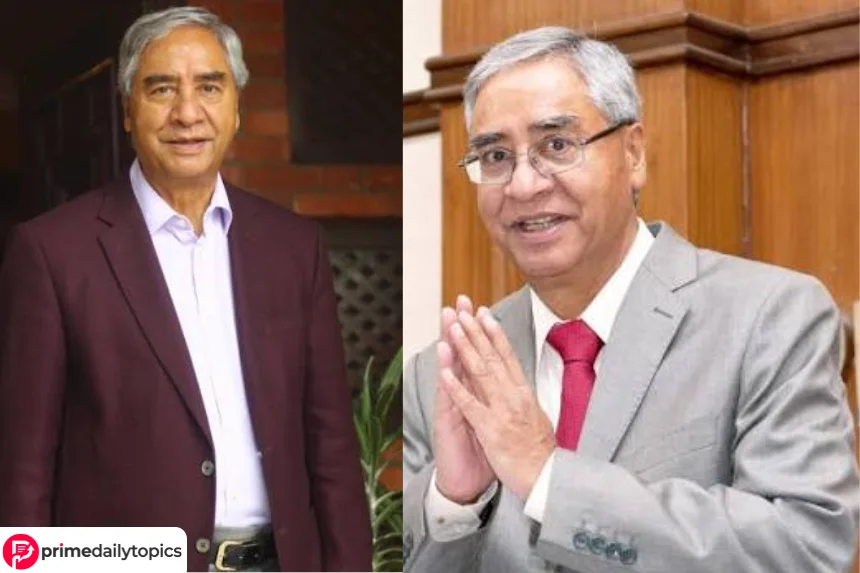
Sher Bahadur Deuba is a Nepali politician who served five terms as prime minister between 1995 and 2022. Born on June 13, 1946, he rose from student activism and years of imprisonment under Nepal’s partyless Panchayat system to become a central figure in the Nepali Congress and one of the country’s most persistent coalition leaders.
As of July 30, 2026, Deuba is a former prime minister, former Nepali Congress president, and former member of Parliament. He did not contest Nepal’s March 2026 election. Moreover, he and his wife are subjects of an ongoing money-laundering investigation; arrest warrants were issued in April 2026, but no final judicial finding against them had been reported by the cutoff date used for this article.
Who Is Sher Bahadur Deuba?
Sher Bahadur Deuba is best known for leading Nepal’s government five times during periods of coalition bargaining, armed conflict, monarchical intervention, constitutional transition, and federal elections. His premierships ran from 1995 to 1997, 2001 to 2002, 2004 to 2005, 2017 to 2018, and 2021 to 2022.
Deuba belongs to the Nepali Congress, Nepal’s long-established democratic party. He also represented Dadeldhura for decades and led the party from 2016 until a disputed leadership transition in January 2026. Therefore, his biography closely tracks Nepal’s movement from constitutional monarchy to a federal democratic republic.
Sher Bahadur Deuba Quick Answer
| Question | Answer |
|---|---|
| Why is he known? | He served as Nepal’s prime minister five times. |
| When was he born? | June 13, 1946 |
| Where was he born? | Ashigram, Dadeldhura District, Nepal |
| What party does he belong to? | Nepali Congress; he led a separate Nepali Congress (Democratic) from 2002 to 2007 |
| Is he the current prime minister? | No |
| Is he the current Nepali Congress president? | No; the party lists him as a former president |
| What is his status in 2026? | Former officeholder, outside Parliament, and under an unresolved financial investigation |
Sher Bahadur Deuba Key Facts
| Fact | Verified detail |
|---|---|
| Full name | Sher Bahadur Deuba |
| Nepali name | शेरबहादुर देउवा |
| Date of birth | June 13, 1946 |
| Age on July 30, 2026 | 80 |
| Birthplace | Ashigram in Nepal’s Dadeldhura District |
| Nationality | Nepali |
| Political party | Nepali Congress |
| Major early office | Minister of Home Affairs, 1991–1994 |
| Prime-ministerial terms | Five |
| Party presidency | 2016–January 2026 |
| Spouse | Arzu Rana Deuba |
| Child publicly identified | One son, Jayabir Singh Deuba; English spellings vary |
| Current elected office | None confirmed as of July 30, 2026 |
The government’s historical officeholder record confirms five separate periods in which Deuba headed Nepal’s government. For readers who need wider context, a background guide to Nepal’s head-of-government role explains how that office developed.
What Was Sher Bahadur Deuba’s Early Life and Education?
Deuba was born in Ashigram, a village in the far-western district of Dadeldhura. Some English sources render the place name as Asigram. However, the difference reflects transliteration rather than two competing birthplaces.
He completed early schooling in western Nepal and later studied in Kathmandu. Biographical records credit him with bachelor’s, law, and master’s studies at Tribhuvan University. In addition, the London School of Economics identifies him as a research student in international relations during 1988–1989.
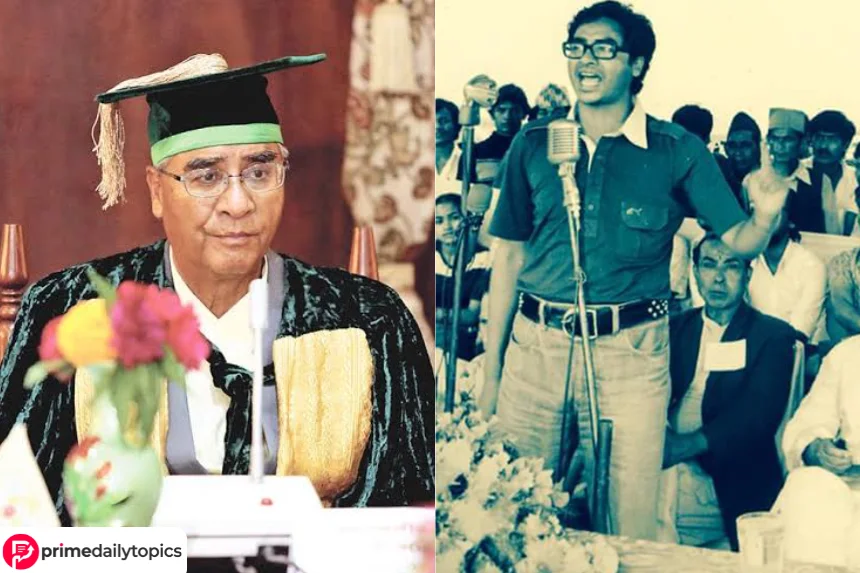
Deuba’s political education began well before he held office. He joined pro-democracy student organizing when Nepal’s partyless Panchayat system restricted conventional party politics. Later, he became a founding figure and president of the Nepal Students’ Union. He spent roughly nine or ten years in prison across separate periods for political activity; reputable institutional profiles differ slightly because they count the periods differently.
How Did Deuba Enter National Politics?
Deuba built his national career through the Nepali Congress and the democracy movement. After multiparty democracy returned in 1990, voters elected him to the House of Representatives from Dadeldhura in 1991. He then served as home affairs minister under Prime Minister Girija Prasad Koirala.
That post gave him a national profile, while his repeated victories in Dadeldhura created a durable electoral base. Consequently, he emerged as a parliamentary leader during the fragmented politics that followed Nepal’s 1994 election. He became prime minister for the first time in September 1995.
Deuba continued winning elections from Dadeldhura through 2022, although constituency arrangements changed as Nepal rewrote its political system. Meanwhile, he served in the House of Representatives, the Constituent Assembly, and the later federal Parliament.
Why Did Sher Bahadur Deuba Serve Five Terms as Prime Minister?
Deuba returned to office because Nepal repeatedly produced divided parliaments, shifting coalitions, and constitutional confrontations. His political strength lay less in a single uninterrupted mandate than in his ability to assemble support during periods of institutional uncertainty.
First term: September 1995 to March 1997
Deuba first became prime minister after the fall of Man Mohan Adhikari’s minority government. His coalition depended on smaller parties, and his cabinet became known for its unusually large size. Nevertheless, his administration also presided over the Mahakali Treaty with India and the introduction of value-added tax.
The coalition eventually lost its parliamentary footing. As a result, Deuba left office in March 1997 after a confidence struggle.
Second term: July 2001 to October 2002
His second term unfolded during a severe escalation of Nepal’s Maoist insurgency. The government initially pursued a ceasefire and negotiations. However, talks collapsed, violence intensified, and the state declared an emergency.
Deuba dissolved the House and sought elections, but the security crisis made the timetable difficult to meet. King Gyanendra dismissed him on October 4, 2002, accusing the government of incompetence. The removal of an elected prime minister also deepened concern about royal intervention.
Third term: June 2004 to February 2005
King Gyanendra reappointed Deuba in June 2004 after sustained political pressure for a party-based government. Yet the arrangement lasted only eight months. On February 1, 2005, the king dismissed the cabinet, assumed direct power, and restricted political leaders.
This term therefore became part of a larger constitutional struggle. It was not simply another coalition collapse; it ended in a royal takeover that accelerated opposition to the monarchy.
Fourth term: June 2017 to February 2018
Deuba returned under a power-sharing agreement between the Nepali Congress and the Communist Party of Nepal (Maoist Centre). His government oversaw important local, provincial, and federal elections under the 2015 Constitution. In addition, those votes helped move Nepal’s new federal structure from constitutional text into practice.
The Nepali Congress performed poorly against the left alliance in the federal contest. Deuba consequently resigned in February 2018, clearing the way for KP Sharma Oli.
Fifth term: July 2021 to December 2022
The fifth premiership followed a constitutional case over the dissolution of the House of Representatives. Nepal’s Supreme Court ordered Deuba’s appointment, and the president’s office recorded the new government in an official July 2021 swearing-in notice.
Deuba led a broad coalition through the remaining parliamentary term and the 2022 elections. However, the post-election alliance shifted, and Pushpa Kamal Dahal became prime minister on December 26, 2022.
Why Did King Gyanendra Dismiss Deuba?
King Gyanendra dismissed Deuba twice, but the circumstances differed. In October 2002, the king removed him after the government said it could not hold scheduled elections amid the Maoist insurgency. Then, in February 2005, the king dismissed Deuba’s restored government and took direct executive control.
The first dismissal opened a period of monarch-appointed governments. The second formed part of a full royal takeover. Ultimately, those interventions intensified the democratic movement that ended direct royal rule and helped lead Nepal toward republican government.
What Happened in Sher Bahadur Deuba’s 2005 Case?
A royal anti-corruption body sentenced Deuba to two years in prison in July 2005 over the Melamchi water-supply project. At the time, Deuba denied wrongdoing and challenged the Royal Commission for Corruption Control’s legitimacy.
The legal ending is essential. On February 13, 2006, Nepal’s Supreme Court declared the commission unconstitutional and annulled its actions. The court’s English-language decision said acts performed by the unconstitutional body could not receive legal recognition. Deuba was then released.
Therefore, describing him only as “convicted of corruption” leaves out the controlling legal outcome. A precise account says the royal commission convicted him, but the Supreme Court later invalidated the commission and its decisions.
How Did Sher Bahadur Deuba Lead the Nepali Congress?
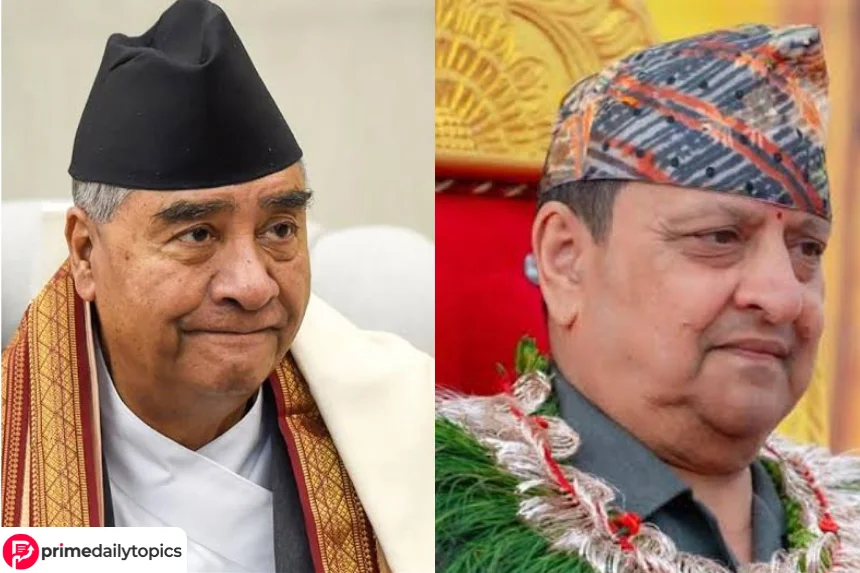
Deuba’s relationship with the Nepali Congress included rivalry, a party split, reunification, and a decade at the top. In 2002, conflict with Girija Prasad Koirala over the emergency and Parliament’s dissolution led to Deuba’s expulsion. He then formed Nepali Congress (Democratic).
The two organizations reunited in 2007. Later, Deuba won the Nepali Congress presidency in 2016 and secured reelection in 2021. His leadership rested on organization, factional negotiation, and long experience, although critics associated the era with patronage and resistance to generational change.
In January 2026, a special convention elected Gagan Kumar Thapa as president. The Election Commission recognized Thapa’s committee, and the Supreme Court upheld that position in April. Accordingly, the party’s official former-presidents list now places Deuba among its past leaders.
What Happened to Deuba During the 2025 Protests?
On September 9, 2025, anti-corruption protests that began over a social-media ban turned violent across Kathmandu. Protesters attacked and burned political and government properties. Moreover, Deuba and Arzu Rana Deuba were beaten at their residence and sustained visible injuries, according to Associated Press coverage of the September unrest.
Online videos later purported to show large quantities of cash at the damaged home. Those images became politically explosive, but they did not by themselves prove ownership, amount, or an unlawful source. Deuba later said a widely circulated video was likely AI-generated, while investigators reported that recovered fragments included genuine currency.
Because the claims remain contested, the available evidence does not establish a final financial offense. Nevertheless, the episode helped trigger official scrutiny that continued into 2026.
What Is Sher Bahadur Deuba’s Current Status in 2026?
As of July 30, 2026, Deuba holds no confirmed elected office. He ceased being Nepali Congress president in January, did not contest the March 5 parliamentary election, and is widely described as having taken a political rest. However, “retired” may be too absolute because he has not issued a definitive, permanent withdrawal from public life.
His legal status also requires careful wording. Nepal’s Department of Money Laundering Investigation opened a detailed inquiry involving Deuba, his wife, and other political figures. A Kathmandu court issued arrest warrants for the couple on April 7, 2026. Interpol subsequently declined Nepal’s requests for a Red Notice and sought more information, according to established reporting.
In June, the couple reportedly wrote from Hong Kong that they were abroad for medical treatment, intended to return within two months, and would cooperate with investigators. The June 2026 status report also said their exact whereabouts had not been officially confirmed.
No final conviction or acquittal in that investigation had been reported by July 30. Therefore, the inquiry, warrants, Deuba’s denial, and the lack of a final finding should appear together in any current biography.
What Is Known About Deuba’s Family?
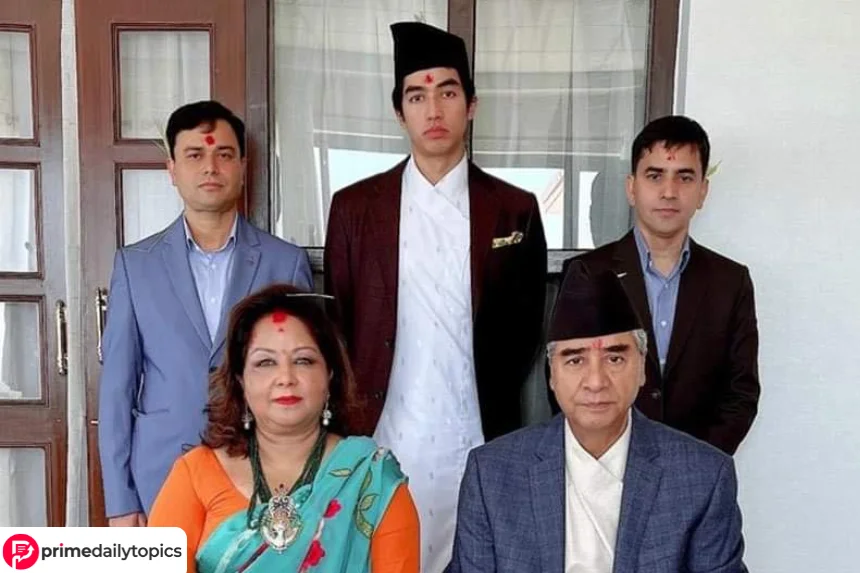
Deuba is married to Arzu Rana Deuba, a Nepali Congress politician who served as Nepal’s foreign minister from July 2024 until September 2025. She has also served in Parliament and has worked on social-policy and development issues.
The couple have one publicly identified son, usually rendered in English as Jayabir Singh Deuba, although Jaiveer and other spellings appear. Beyond those basics, reliable public information about private family matters remains limited. Therefore, claims about relatives’ occupations, relationships, or private assets need primary documentation.
What Is Sher Bahadur Deuba’s Net Worth?
No authoritative financial source confirms Deuba’s net worth in U.S. dollars or any other currency. Online estimates lack a transparent valuation method and should not be treated as facts.
The ongoing 2026 investigation concerns assets and suspected financial transactions, but an investigation is not a net-worth statement or proof of criminal conduct. Moreover, property registered to family members cannot automatically be counted as Deuba’s personal wealth. Until verified disclosures and final legal findings are available, a precise net-worth figure would be misleading.
Sher Bahadur Deuba Timeline
| Year | Event |
|---|---|
| 1946 | Born on June 13 in Ashigram, Dadeldhura |
| 1960s–1980s | Participated in pro-democracy student politics and spent multiple periods in prison |
| 1970–1971 | Helped establish the Nepal Students’ Union and became its president |
| 1988–1989 | Conducted research studies at the London School of Economics |
| 1991 | Won election from Dadeldhura and entered the Cabinet as home affairs minister |
| 1995 | Began his first term as prime minister |
| 2001 | Began his second term during the Maoist insurgency |
| 2002 | Dismissed by King Gyanendra; formed Nepali Congress (Democratic) |
| 2004 | Reappointed prime minister for a third term |
| 2005 | Dismissed in the royal takeover; later jailed by a royal commission |
| 2006 | Released after the Supreme Court invalidated that commission |
| 2007 | Reunited his party with the Nepali Congress |
| 2016 | Elected president of the Nepali Congress |
| 2017 | Became prime minister for a fourth term |
| 2021 | Reelected party president and began a fifth premiership |
| 2022 | Left the prime minister’s office after the federal election |
| 2025 | Injured when protesters attacked his residence in September |
| 2026 | Left the party presidency, sat out the election, and became subject to an ongoing financial investigation |
How Should Sher Bahadur Deuba’s Legacy Be Assessed?
Deuba’s supporters emphasize survival, electoral durability, and his participation in Nepal’s democratic transitions. He opposed the Panchayat system, endured imprisonment, returned after royal dismissals, and remained relevant through monarchy, civil conflict, a peace process, constitution-making, and federalism. In addition, his fourth government oversaw elections that operationalized the federal structure.
Critics focus on large cabinets, unstable alliances, patronage, and a political culture dominated by a small group of repeat leaders. They also question decisions made during the Maoist conflict and argue that long-serving party leadership slowed renewal. More recent financial allegations have intensified that criticism, although they remain unresolved in court.
Ultimately, his record resists a one-line verdict. Deuba was both a product of Nepal’s unstable coalition system and one of its most effective practitioners. His five premierships demonstrate unusual resilience; however, they also embody public frustration with repeated elite bargaining and limited institutional reform.
FAQs About Sher Bahadur Deuba
How old is Sher Bahadur Deuba?
He turned 80 on June 13, 2026. This age follows the widely documented birth date of June 13, 1946.
Where was he born?
He was born in Ashigram in Dadeldhura District, western Nepal. Some English-language records spell the village name Asigram.
How many times was he prime minister?
He served five separate terms as Nepal’s prime minister. Those terms began in 1995, 2001, 2004, 2017, and 2021.
When did he first become prime minister?
He began his first term on September 12, 1995. However, the coalition lost its footing, and he left office in March 1997.
Which political party does he belong to?
He belongs to the Nepali Congress. Nevertheless, he led the separate Nepali Congress (Democratic) between the 2002 party split and the 2007 reunification.
Is he still president of the Nepali Congress?
No. Gagan Kumar Thapa replaced him in January 2026, and the party now identifies Deuba as a former president.
Who is his wife?
His wife is Arzu Rana Deuba, a Nepali Congress politician and former foreign minister. She also became part of the financial investigation involving the family in 2026.
Does he have children?
Public biographies identify one son, Jayabir Singh Deuba. However, English sources use several spellings of his given name.
Why was he jailed in 2005?
A royal commission jailed him after convicting him in a case connected to the Melamchi project. However, Nepal’s Supreme Court declared that commission unconstitutional in February 2006, annulled its actions, and cleared the way for his release.
Is he still active in politics?
He did not contest the March 2026 election and no longer leads his party. Consequently, he has stepped back from frontline politics, although a permanent retirement has not been conclusively announced.
Sher Bahadur Deuba in Perspective
Sher Bahadur Deuba remains one of the defining political figures of modern Nepal. His journey from student organizer and political prisoner to five-time prime minister reflects the country’s long struggle over democracy, monarchy, conflict, and constitutional government.
Yet his story is still developing. As of July 30, 2026, he is outside elected office and faces an unresolved investigation whose outcome should not be presumed. Therefore, the most accurate assessment combines his historic political endurance with clear, dated language about his changed party role and present legal status.
