



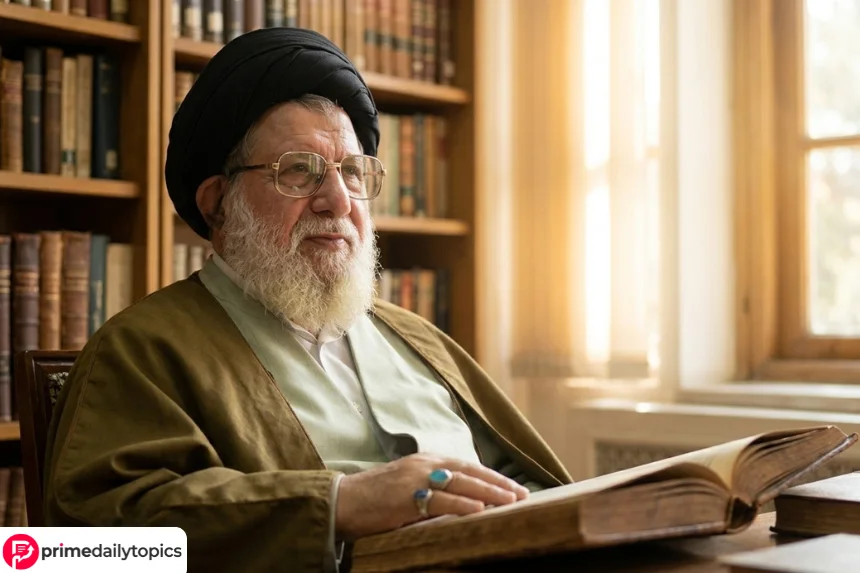
Seyyed Mohammad Khamenei is an Iranian Shiite cleric, legal scholar, former parliamentarian, and writer on Islamic philosophy. Born in Mashhad in 1935, he emerged from a religious scholarly environment and later combined seminary education with university-level legal studies. He subsequently became involved in the political institutions created after Iran’s 1979 revolution.
Although his surname is internationally recognizable, Mohammad Khamenei should not be confused with his younger brother, Ali Khamenei, who later became Iran’s second supreme leader. Mohammad developed a distinct career that crossed religious scholarship, law, constitutional politics, parliament, and philosophy.
His later intellectual work became particularly associated with Mulla Sadra and Transcendent Philosophy. Bibliographic records, for example, catalogue books by Mohammad Khamenei dealing directly with Mulla Sadra’s philosophical thought.
Quick Answer: Who Is Seyyed Mohammad Khamenei?
Seyyed Mohammad Khamenei is an Iranian cleric, jurist, former member of parliament, and scholar of Islamic philosophy. He was born on December 25, 1935, in Mashhad and is the elder brother of Ali Khamenei. After receiving both religious and legal education, he participated in Iran’s post-revolutionary constitutional process and represented Mashhad in the country’s parliament. Later, philosophy and cultural scholarship became increasingly prominent parts of his public work.
An archival Iranian government photograph from 1979 identifies Mohammad Khamenei as a member of the body responsible for reviewing the new constitution after the revolution.
Seyyed Mohammad Khamenei Quick Facts
| Fact | Information |
|---|---|
| Full name | Seyyed Mohammad Hosseini Khamenei |
| Commonly known as | Seyyed Mohammad Khamenei |
| Date of birth | December 25, 1935 |
| Birthplace | Mashhad, Iran |
| Nationality | Iranian |
| Religious tradition | Twelver Shia Islam |
| Main fields | Islamic scholarship, law, politics and philosophy |
| University education | Legal studies at the University of Tehran |
| Political constituency | Mashhad |
| Parliamentary service | First and second terms of the Islamic Consultative Assembly |
| Constitutional involvement | Member of the 1979 constitutional-review assembly |
| Scholarly focus | Islamic philosophy and Mulla Sadra |
| Notable institution | Sadra Islamic Wisdom Foundation |
| Family connection | Elder brother of Ali Khamenei |
| Another notable relative | Uncle of Mojtaba Khamenei |
Historical parliamentary records independently list Seyyed Mohammad Hosseini Khamenei of Mashhad among representatives in Iran’s first parliament and show that he served in both the first and second parliamentary terms.
Who Is Seyyed Mohammad Khamenei?
Seyyed Mohammad Khamenei belongs to a generation of Iranian clerics whose lives intersected religious education, political upheaval, and the creation of new state institutions after the Iranian Revolution.
However, defining him solely through politics would give an incomplete picture.
His career can broadly be understood through three areas: religious and legal education, political participation, and Islamic philosophy.
During the early years of the Islamic Republic, he participated directly in political and constitutional affairs. He later served as a representative from Mashhad in the Islamic Consultative Assembly.
Over time, however, his public profile shifted toward scholarly work. He became particularly associated with research into Islamic philosophy and the writings of the seventeenth-century Persian philosopher Mulla Sadra.
Academic bibliographic records support that connection. A 2004 Persian-language volume attributed to Mohammad Khamenei is titled Hikmat-i Muta’aliyah va Mulla Sadra, or Transcendent Philosophy and Mulla Sadra, and was published by the Sadra Islamic Wisdom Foundation.
Another collection of his essays was published by the same foundation in 2007.
Therefore, his biography extends well beyond his family relationship with Iran’s political leadership.
Mohammad Khamenei Is Not Ali Khamenei
One of the most important points for readers is the distinction between Mohammad Khamenei and Ali Khamenei.
They are brothers, not alternative names for the same person.
Mohammad was born earlier and pursued his own combination of clerical study, law, parliamentary politics, and philosophy. Ali Khamenei, meanwhile, followed a separate political trajectory that eventually took him to the presidency and then Iran’s supreme leadership.
This distinction matters because search results for “Seyyed Mohammad Khamenei” often contain material about other members of the Khamenei family.
The confusion has become even more significant because the family includes several public figures.
For this reason, reliable biographical coverage should evaluate Mohammad through his own documented roles rather than simply attaching events from Ali Khamenei’s career to his name.
That distinction also applies to Mojtaba Khamenei, who is Mohammad Khamenei’s nephew rather than his son or brother.
Consequently, readers researching Mohammad should be cautious when a biography suddenly shifts to events, positions, photographs, or quotations concerning Ali or Mojtaba without explaining the change in subject.
Early Life in Mashhad
Mohammad Khamenei was born on December 25, 1935, in Mashhad, a major city in northeastern Iran.
Mashhad has long held exceptional importance within Iranian Shiite religious life because it is home to the shrine of Imam Reza, the eighth Imam in Twelver Shiism. Therefore, Khamenei grew up in a city where religious institutions and clerical education had a substantial cultural presence.
His father, Seyyed Javad Khamenei, was a cleric. As a result, Mohammad encountered traditional religious education from an early age.
The household later produced several figures involved in Iran’s religious and political life. Nevertheless, Mohammad’s career should be considered separately because his legal and philosophical interests eventually gave him a distinctive intellectual profile.
His formative years occurred during the reign of Mohammad Reza Shah Pahlavi, decades before the political order created by the 1979 revolution.
Accordingly, his education developed under institutions belonging to pre-revolutionary Iran rather than the Islamic Republic that he would later help shape politically.
Religious Education and Seminary Studies
Religious study formed the first major foundation of Mohammad Khamenei’s education.
He studied Islamic subjects in Mashhad and later continued his seminary education in Qom, one of the most important centers of Shiite scholarship.
Seminary education in this tradition generally involves progressive study of Arabic, Islamic jurisprudence, legal principles, Quranic interpretation, theology, logic, and related disciplines.
For Khamenei, however, philosophy also became especially important.
That interest eventually developed into a long-term engagement with Islamic philosophical thought. In later decades, it would become one of the defining features of his academic identity.
Indeed, outside assessments of Mohammad Khamenei have also highlighted this philosophical dimension. French Islamic-philosophy scholar Christian Jambet described him in 2026 as a cultured intellectual closely associated with editing and studying the works of Mulla Sadra.
Therefore, Khamenei’s later philosophical work was not simply a late-career title. It reflected an intellectual interest that became central to his scholarly reputation.
Legal Education Alongside Religious Study
Unlike a purely seminary-trained cleric, Mohammad Khamenei also pursued formal legal education.
He studied law at the University of Tehran, adding a modern academic component to his traditional religious training.
This combination is particularly relevant to understanding his subsequent career.
Religious education gave him familiarity with Islamic jurisprudence and clerical scholarship. University-level legal study, by contrast, placed him in contact with modern concepts of criminal law, state institutions, legislation, and constitutional organization.
Therefore, when Mohammad Khamenei later became involved in Iran’s constitutional and parliamentary affairs, he brought experience from more than one intellectual tradition.
This combination of religious jurisprudence and formal law helps explain why constitutional questions became an important element of his early political activity.
At the same time, his legal education should not overshadow his later philosophical work. The two areas instead show the unusual breadth of his career.
From Religious Scholarship Toward Public Life
By the years preceding the 1979 revolution, Mohammad Khamenei’s life was increasingly connected with the political and intellectual currents surrounding Iranian clerical opposition to the monarchy.
That environment brought together religious scholars with different approaches to politics, governance, law, and social change.
After the revolution succeeded, those debates were no longer theoretical.
Iran suddenly needed a new constitution, legislature, and institutional framework. Mohammad Khamenei subsequently became directly involved in that transition.
A surviving government image from 1979 documents him as a member of the Assembly for the Final Review of the Constitution, the body responsible for examining the constitution of the newly established Islamic Republic.
This role marked an important transition in his biography.
He was no longer only a cleric with legal and philosophical interests. Instead, he had entered the process of constructing the constitutional system of post-revolutionary Iran.
His work in that period would soon lead into parliamentary politics, major constitutional debates, and one of the most turbulent eras in modern Iranian history.
Role in Iran’s 1979 Constitutional Process
Following the Iranian Revolution, one of the new government’s most important tasks was creating a constitution for the Islamic Republic.
Seyyed Mohammad Khamenei became directly involved in that process as a member of the Assembly for the Final Review of the Constitution. The constituent body began its work in August 1979 and was responsible for examining and revising the proposed constitutional framework before it went to a national referendum.
The assembly should not be confused with the later Assembly of Experts for Leadership, which is responsible for selecting Iran’s supreme leader. Although the names are sometimes translated similarly, they are separate institutions with different responsibilities.
The 1979 constitutional assembly had 73 seats and completed its deliberations in November of that year. Afterward, the new constitution was submitted to voters in December 1979.
Readers who want to examine the constitutional document itself can consult the Constitution of the Islamic Republic of Iran hosted by Refworld.
Mohammad Khamenei’s participation in this assembly is significant because it placed him inside the political process that established the institutional framework of the new republic.
However, it is more accurate to describe him as a participant in the constitutional review process rather than to claim that he personally created Iran’s political system. The assembly contained dozens of members, and its decisions emerged through broader political and ideological debates.
Entering Iran’s New Parliament
Soon after the constitutional process, Mohammad Khamenei moved into parliamentary politics.
He represented Mashhad in the Islamic Consultative Assembly, commonly known as the Majlis.
His parliamentary service covered the first two terms of the post-revolutionary legislature:
| Parliamentary term | Period |
|---|---|
| First Majlis | 1980–1984 |
| Second Majlis | 1984–1988 |
The first parliament began work in 1980, while the second served from 1984 to 1988.
For historical context, the U.S. Institute of Peace’s overview of Iran’s parliaments describes the first Majlis as politically diverse compared with many of the legislatures that followed.
The political environment changed considerably by the second term. Clerical political organizations had become more dominant, although significant disagreements still existed among figures inside the revolutionary establishment.
Therefore, Mohammad Khamenei’s eight years in parliament covered a period in which Iran’s new political system was still developing.
Constitutional Law Became Part of His Parliamentary Work
Mohammad Khamenei’s earlier legal studies became especially relevant during his years as a legislator.
Iran’s new constitution divided authority among institutions such as the parliament, presidency, judiciary, Guardian Council, and supreme leadership. Consequently, lawmakers frequently faced questions about where parliamentary authority ended and constitutional interpretation began.
Khamenei participated in discussions surrounding such issues.
This aspect of his career helps explain why describing him only as a cleric or political relative is incomplete. His background included both Islamic jurisprudence and formal legal study, while his parliamentary career placed him directly inside debates about how the new constitutional structure would function.
The broader legal framework is documented in the Iran Data Portal’s collection of Iranian laws and constitutional materials, maintained through Syracuse University.
Although political disagreements during this period could be intense, Khamenei’s documented public role remained primarily legislative rather than executive.
He was not Iran’s president, prime minister, or supreme leader.
That distinction remains particularly important because online searches for his name frequently return information belonging to other members of the Khamenei family.
Parliament During a Period of Political Upheaval
The first years of the Islamic Republic were marked by rapid institutional change and severe political conflict.
Iran faced internal struggles among competing revolutionary factions. At the same time, the Iran-Iraq War began in September 1980 and became a defining national crisis throughout most of Mohammad Khamenei’s parliamentary career.
Political violence also intensified.
Prominent government figures were assassinated, armed opposition organizations fought the new government, and revolutionary institutions conducted extensive crackdowns against political opponents.
The Iran Primer political timeline provides broader historical context for the instability of this period.
Against this background, parliament was operating while Iran faced both an external war and violent domestic political confrontation.
Mohammad Khamenei’s parliamentary career cannot be separated entirely from those circumstances because he himself became the target of an assassination attempt.
The 1982 Assassination Attempt
On January 10, 1982, gunmen attacked Seyyed Mohammad Khamenei in Tehran.
The attack occurred as he was leaving the parliamentary complex at Baharestan, the historic location associated with Iran’s legislature.
According to contemporary reporting, the attackers opened fire on Khamenei and members of his security detail.
Mohammad Khamenei was seriously wounded.
Two of his bodyguards were killed.
He survived the shooting and subsequently recovered from his injuries.
The incident is an important part of his biography because it illustrates how directly the political violence of the early Islamic Republic affected members of parliament and other government officials.
However, care is necessary when describing responsibility for the attack.
Different historical accounts discuss opposition violence during this period, but publicly accessible evidence about this specific shooting is less extensive than documentation surrounding some of the era’s better-known assassinations. Therefore, it is safer not to assign responsibility to a particular organization without stronger evidence specifically connecting that group to the January 1982 attack.
Do Not Confuse This Attack With the Attempt on Ali Khamenei
Another common factual mistake involves confusing Mohammad Khamenei’s shooting with an earlier assassination attempt against his brother.
Ali Khamenei was attacked on June 27, 1981, several months before the shooting involving Mohammad.
In Ali Khamenei’s case, a bomb concealed in a tape recorder exploded while he was speaking at a mosque in Tehran. Contemporary United Press International reporting documented the attack and the serious injuries he suffered.
Readers can see the original contemporary account in the United Press International archive.
The two incidents were therefore different:
| Detail | Mohammad Khamenei | Ali Khamenei |
|---|---|---|
| Date | January 10, 1982 | June 27, 1981 |
| Type of attack | Gunfire | Explosive device |
| Location/context | Leaving the parliamentary complex | Speaking at a Tehran mosque |
| Outcome | Seriously wounded; survived | Seriously wounded; survived |
Keeping these events separate is essential for an accurate Seyyed Mohammad Khamenei biography.
Continuing His Parliamentary Career After the Attack
The assassination attempt did not end Mohammad Khamenei’s public career.
After recovering, he continued his political activity and eventually completed his service through the second parliamentary term.
His years in the Majlis therefore stretched from the creation of the post-revolutionary legislature through much of the Iran-Iraq War.
Nevertheless, he did not continue indefinitely on a conventional electoral-political path.
By the end of his second parliamentary term in 1988, a different dimension of his career was becoming increasingly important.
Rather than building a long sequence of elected offices, Mohammad Khamenei eventually devoted considerably more attention to Islamic philosophy, scholarship, research, and cultural institutions.
This transition separates his later biography from the political trajectory of his younger brother Ali.
Why His Political Career Is Historically Relevant
Mohammad Khamenei never reached the executive power associated with some of his better-known relatives. Even so, his early political record has historical significance for several reasons.
First, he participated in the constitutional assembly during the formative months of the Islamic Republic.
Second, he became part of the country’s first post-revolutionary parliament.
Third, he remained in the legislature for two terms during a period dominated by political consolidation, internal conflict, and the Iran-Iraq War.
Finally, his legal background meant that his political career intersected with constitutional and institutional questions rather than being based solely on clerical status.
Together, these roles place him among the figures who participated in Iran’s early post-1979 political institutions.
However, politics represents only one stage of his career.
After leaving parliament, Mohammad Khamenei increasingly became known for a very different field: Islamic philosophy and the study of Mulla Sadra.
From Politics to Islamic Philosophy
After his period in parliamentary politics, Seyyed Mohammad Khamenei became increasingly associated with scholarship, especially Islamic philosophy.
This later phase is essential to understanding his career. While his family name often leads readers toward Iranian politics, much of Mohammad Khamenei’s intellectual work concerns philosophical questions rather than day-to-day government affairs.
His scholarly interests have included metaphysics, the human soul, the relationship between religion and philosophy, Iranian intellectual traditions, and the work of Mulla Sadra.
Mulla Sadra, whose full name was Sadr al-Din Muhammad Shirazi, was one of the most influential philosophers in the later Islamic philosophical tradition. The Stanford Encyclopedia of Philosophy describes him as a major thinker who transformed discussions of existence, metaphysics, knowledge, and the soul.
Therefore, Mohammad Khamenei’s engagement with Sadra places his later career within a long-standing Iranian philosophical tradition rather than merely within contemporary political debate.
Why Mulla Sadra Became Central to His Scholarly Work
Mulla Sadra developed the philosophical system commonly called Transcendent Philosophy or al-hikma al-muta’aliya.
His thought combines philosophical argument, metaphysics, theology, and forms of mystical insight. In particular, his philosophy is known for giving a central role to existence and for developing a distinctive account of change, knowledge, and the development of the human soul.
Mohammad Khamenei devoted substantial attention to these subjects.
Bibliographic and academic records attribute several studies of Mulla Sadra to him. For example, PhilPapers indexes an article titled “Mulla Sadra and Practical Philosophy” under the name Seyyed Khamenei. The article appeared in Kheradnameh Sadra Quarterly in 2012.
Another indexed work examines the soul in Mulla Sadra’s philosophy, including Sadra’s understanding of the relationship between corporeal existence and spiritual development.
In addition, academic bibliographies cite Mohammad Khamenei’s book Mulla Sadra’s Transcendent Philosophy, published in Tehran by the Sadra Islamic Philosophy Research Institute in 2004.
As a result, his reputation as a philosopher is supported by an identifiable body of published scholarship rather than simply by an honorary academic title.
His Work With the Sadra Islamic Wisdom Foundation
Another major element of Mohammad Khamenei’s scholarly career has been his association with the Sadra Islamic Wisdom Foundation, also rendered in English as the Sadra Islamic Philosophy Research Institute.
The institution focuses heavily on Mulla Sadra, Islamic philosophy, philosophical texts, research, conferences, and related scholarship.
Academic indexes identify Mohammad Khamenei with research published through the institute. For example, Kheradnameh Sadra Quarterly, published by the Sadra Islamic Philosophy Research Institute, contains philosophical work attributed to him on subjects such as Mulla Sadra’s understanding of the soul and practical philosophy.
His association with the foundation therefore provides an important bridge between his own research and the broader modern revival of Sadrian studies.
Rather than treating philosophy as a minor side interest, his later career shows sustained engagement with the field through writing, publishing, and institutional activity.
Questions About the Soul and Human Existence
Among the subjects associated with Mohammad Khamenei’s philosophical writing is the nature of the human soul.
This subject is particularly important in Mulla Sadra’s system.
Sadra argued that the soul should not simply be understood as an unchanging substance inserted into the body. Instead, his philosophy presents human existence as developmental, with the soul undergoing transformation as a person progresses intellectually and spiritually.
Mohammad Khamenei’s published discussion of the subject examines these distinctions and Mulla Sadra’s attempt to address older debates inherited from Platonic and Peripatetic philosophy.
This example illustrates the type of scholarship that occupied a significant portion of Khamenei’s later intellectual life.
It also shows why describing him exclusively as an Iranian politician would leave out an important part of his work.
Interest in Iranian Intellectual and Cultural History
Khamenei’s interests eventually extended beyond a narrow study of one philosopher.
He also became involved with subjects connected to Iranian civilization, intellectual history, cultural identity, and Iranology.
Those interests helped lead to another major institutional position: leadership of the Iranology Foundation.
The foundation studies aspects of Iranian history and civilization, including literature, culture, identity, geography, arts, and intellectual heritage.
Therefore, Khamenei’s involvement was broadly consistent with the historical and philosophical direction of his later scholarship.
Leadership of the Iranology Foundation
Mohammad Khamenei was appointed president of the Iranology Foundation in 2013.
His tenure is documented in institutional and media records. For example, a 2021 report identified Seyyed Mohammad Khamenei as president of the foundation while covering his remarks about Iranian culture and civilization.
However, articles published today need an important update.
Mohammad Khamenei is not the current president of the Iranology Foundation.
Older biographies and search-result summaries may still describe him that way, but the information is outdated.
By 2025, former Iranian foreign minister Ali Akbar Salehi had taken over the position. An official April 26, 2025 statement from Armenia’s embassy in Iran identifies Salehi as president of the Iranology Foundation.
An additional Armenian Foreign Ministry record from October 2025 likewise identifies Ali Akbar Salehi as head of the foundation.
Consequently, the accurate wording for a current biography is that Mohammad Khamenei formerly served as president of the Iranology Foundation.
This distinction matters because outdated institutional titles are frequently repeated across biography websites long after a leadership change.
Mohammad Khamenei and Ali Khamenei: Their Family Relationship
A major reason readers search for Mohammad Khamenei is his relationship with Ali Khamenei.
The two men were brothers.
Mohammad was the elder brother, while Ali became a much more internationally visible political figure.
Nevertheless, their careers should not be merged.
Mohammad’s public record included constitutional participation, parliamentary service, legal scholarship, Islamic philosophy, and cultural institutions.
Ali’s trajectory was different. He became president of Iran and later served as the country’s second supreme leader.
Therefore, a photograph, speech, political decision, religious ruling, or government position associated with Ali Khamenei should not automatically be attributed to Mohammad merely because both men share the Khamenei surname.
That distinction is particularly important for search-engine content, where similarly named entities can easily become mixed together.
How Is He Related to Mojtaba Khamenei?
Mohammad Khamenei is the uncle of Mojtaba Khamenei, because Mojtaba is Ali Khamenei’s son.
That relationship gained additional public significance in 2026.
Ali Khamenei died after the February 28, 2026 attacks in Iran, and Mojtaba Khamenei subsequently became Iran’s third supreme leader in March 2026. Reuters was still identifying Mojtaba as supreme leader in reporting published on July 21, 2026.
Accordingly, a current family relationship can be summarized as follows:
| Person | Relationship to Mohammad Khamenei |
|---|---|
| Ali Khamenei | Younger brother |
| Mojtaba Khamenei | Nephew |
| Seyyed Javad Khamenei | Father |
However, Mojtaba’s current office does not give Mohammad Khamenei a corresponding constitutional position.
His biography remains separate from the political careers of both his younger brother and his nephew.
Why Seyyed Mohammad Khamenei Is Historically Significant
Mohammad Khamenei is historically notable because his career connects several different aspects of modern Iranian intellectual and political history.
First, he participated in the formative political period following the 1979 revolution.
Moreover, he served in the new parliament at a time when the institutions of the Islamic Republic were still taking shape.
Yet electoral politics did not remain the sole focus of his career.
Instead, his later work developed around Islamic philosophy, Mulla Sadra, Iranian intellectual traditions, and cultural scholarship.
As a result, his biography provides a useful example of how religious education, modern law, revolutionary politics, and philosophical scholarship could overlap within the careers of Iranian clerical intellectuals.
His family connections undoubtedly increased public interest in him. Nevertheless, his own scholarly publications and institutional activities provide separate reasons for studying his life.
What Makes His Career Different From Ali Khamenei’s?
The contrast between the brothers is one of the simplest ways to understand Mohammad Khamenei’s public identity.
Ali Khamenei’s career became increasingly centred on executive and supreme political authority.
Mohammad Khamenei, by comparison, stepped away from elected parliamentary politics and became much more closely associated with scholarly institutions.
In particular, his research on Mulla Sadra represents an intellectual field far removed from the conventional responsibilities of presidents, legislators, or supreme leaders.
Therefore, readers should view the brothers as separate figures whose careers occasionally intersected with the same political era but developed in substantially different directions.
Frequently Asked Questions About Seyyed Mohammad Khamenei
Who is Seyyed Mohammad Khamenei?
Seyyed Mohammad Khamenei is an Iranian Shiite cleric, jurist, former member of parliament, and scholar of Islamic philosophy. His career has included constitutional politics, parliamentary service, philosophical research, and leadership in cultural and academic institutions.
Is Mohammad Khamenei the brother of Ali Khamenei?
Yes. Mohammad Khamenei was the elder brother of Ali Khamenei.
However, they were separate public figures and should not be confused in biographical coverage.
Is Mohammad Khamenei the current supreme leader of Iran?
No.
Mohammad Khamenei has never served as Iran’s supreme leader. As of July 2026, Reuters identifies Mojtaba Khamenei, Mohammad’s nephew, as Iran’s supreme leader.
What is Mohammad Khamenei known for?
He is known for participating in Iran’s early post-revolutionary constitutional and parliamentary institutions and, later, for extensive involvement with Islamic philosophy.
His scholarly work is especially associated with Mulla Sadra and Transcendent Philosophy.
What did Mohammad Khamenei write about?
His philosophical writing has addressed subjects such as Mulla Sadra, practical philosophy, metaphysics, the soul, Islamic thought, and related philosophical questions.
PhilPapers records work under his name discussing both Mulla Sadra’s practical philosophy and his theory of the soul.
What is Mulla Sadra’s connection to Mohammad Khamenei?
Mulla Sadra is one of the central subjects of Mohammad Khamenei’s later academic work.
Khamenei has written and published research concerning Sadra’s philosophy, while his institutional work has also been connected with organizations devoted to studying and publishing Sadrian thought.
Was Mohammad Khamenei a member of parliament?
Yes. As covered earlier in this biography, he represented Mashhad during the first two terms of Iran’s post-revolutionary parliament.
His parliamentary period preceded the later scholarly phase discussed in this section.
Did Mohammad Khamenei work at the Iranology Foundation?
Yes.
He previously served as president of the Iranology Foundation. However, he is not its current president. Official diplomatic records identify Ali Akbar Salehi as president by 2025.
Is Seyyed Mohammad Khamenei still active in politics?
His most prominent later public work has been associated more strongly with scholarship, philosophy, and cultural institutions than with elected political office.
Therefore, it is more accurate to describe him historically as a former parliamentarian rather than as a current elected politician.
How is Mohammad Khamenei related to Mojtaba Khamenei?
Mojtaba Khamenei is his nephew.
Mojtaba is the son of Mohammad’s younger brother Ali Khamenei and became Iran’s supreme leader in March 2026. Reuters continued to report him in that position in July 2026.
Conclusion
Seyyed Mohammad Khamenei has had a career that stretches across politics, law, religious learning, and Islamic philosophy.
His involvement in Iran’s early post-revolutionary institutions makes him relevant to the country’s political history. However, his later scholarly work is equally important for understanding his public identity.
In particular, decades of engagement with Mulla Sadra and Islamic philosophy distinguish Mohammad Khamenei from better-known members of his family.
He also held a significant role in Iranian cultural scholarship through his former leadership of the Iranology Foundation. Meanwhile, academic records document his writing on philosophical questions including practical philosophy and the nature of the soul.
Most importantly, Mohammad Khamenei should be treated as a distinct historical figure.
He was the elder brother of Ali Khamenei and is the uncle of Mojtaba Khamenei. Nevertheless, his own record is defined by a combination of constitutional participation, parliamentary service, legal knowledge, Islamic philosophy, and scholarly institutions.
That broader perspective provides a more accurate picture of Seyyed Mohammad Khamenei than simply describing him through his connection to Iran’s supreme leaders.
